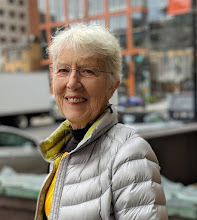
One thing leads to another . .. . poet Amy Eisner connected me to mathematician Jordan Ellenberg who knew of Easy Math (Sarabande Books, 2013) by Lauren Shapiro -- and Lauren gave me permission to post her "Bent Syllogism."
Bent Syllogism by Lauren Shapiro
There was a pattern to the way the mythical beasts
flew over the dreary town, but we were too dreary
to understand it. The psychologist, too, was in touch
with extraterrestrials, but she had to stand on the spire
of a church and wear 3-D glasses to see them.
Thursday, November 7, 2013


Tuesday, November 5, 2013
Love mathematics!
In the stanzas below, I have some fun with math terminology. Hope you'll enjoy it too.
Love! by JoAnne Growney
Love algebra! Through variable numbers
of factored afternoons and prime evenings,
party in and out of your circle of associates,
identify your identity, meet your inverse.
Love! by JoAnne Growney
Love algebra! Through variable numbers
of factored afternoons and prime evenings,
party in and out of your circle of associates,
identify your identity, meet your inverse.
Sunday, November 3, 2013
Neruda speaks of numeration
The collection, Late and Posthumous Poems, 1968-1974 (Grove Press, 1988) by Chilean Nobelist Pablo Neruda (1904-1973) offers to readers a collection of Neruda's later work, ably translated by Ben Belitt. Here is a poem that explores the vast world opened by the invention of numeration.
28325674549 by Pablo Neruda
A hand made the number.
It joined one little stone
to another, one thunderclap
to another,
one fallen eagle
to another, one
arrowhead to another,
and then with the patience of granite
the hand
made a double incision, two wounds,
and two grooves: and a
number was born.
28325674549 by Pablo Neruda
A hand made the number.
It joined one little stone
to another, one thunderclap
to another,
one fallen eagle
to another, one
arrowhead to another,
and then with the patience of granite
the hand
made a double incision, two wounds,
and two grooves: and a
number was born.
Thursday, October 31, 2013
On poetry and geometric truth . . .
On poetry and geometric truth
And their high privilege of lasting life,
From all internal injury exempt,
I mused; upon these chiefly: and at length,
My senses yielding to the sultry air,
Sleep seized me, and I passed into a dream.
William Wordsworth (1770-1850)
from The Prelude, Book 5
Tuesday, October 29, 2013
From order to chaos -- a sonnet
Fractals by Diana Der-Hovanessian
Euclid alone has looked on beauty bare
--Edna St. Vincent Millay
Euclid alone began to formulate
the relation of circle, plane and sphere
in equations making it quite clear
that symmetry is what we celebrate.
Euclid alone has looked on beauty bare
--Edna St. Vincent Millay
Euclid alone began to formulate
the relation of circle, plane and sphere
in equations making it quite clear
that symmetry is what we celebrate.
Saturday, October 26, 2013
Two cultures
The opening poem of Uneasy Relations by mathematician-poet Michael Bartholomew-Biggs is concerned with similarities and differences between mathematical and poetic cultures -- a topic of immense interest also to me and one that I too try to address in my verse. I wonder -- HOW can I show non-mathematicians that good mathematics is poetry??!! And, moreover, how can I (mostly a mathematician) write (as advocated by Wallace Stevens and agreed with by other poets) of things rather than (as mathematics wants) of ideas. OR, may one make poetry of ideas?
Two Cultures by Michael Bartholomew-Biggs
Graves claimed there isn't
much money in poetry:
and none vice-versa.
The first part stays true
if we replace poetry
by mathematics.
Two Cultures by Michael Bartholomew-Biggs
Graves claimed there isn't
much money in poetry:
and none vice-versa.
The first part stays true
if we replace poetry
by mathematics.
Tuesday, October 22, 2013
Two-line poems -- Landays -- from Afghanistan
Celebrate Activist Poetry -- At Nov. 1 Event
BE THERE on November 1, 2013 at the Goethe-Intitut in Washington DC when poet and journalist Eliza Griswold is honored with the Split this Rock Freedom Plow Award (register here for this important event) for Poetry and Activism for her work collecting and introducing the folk poems of Afghan women to America. The June issue of Poetry Magazine is entirely dedicated to landays -- two-line poems by Afghan women that capture dark, funny, and revealing moments that few outsiders ever witness. (Edited and introduced by Griswold, the poems are magnificently supplemented by photographs by Seamus Murphy.)
Here are three landays from Griswold's Poetry collection, each selected for inclusion here because it includes at least one number:
Monday, October 21, 2013
Topology for poets
The title of this posting ("Topology for Poets") comes from Maryland Poet Amy Eisner's poem "Lure" (offered below) -- a poem that plays with math concepts. (In mathematics, "topology" is a variant of geometry in two shapes are "equivalent" if one could be obtained from the other by stretching or bending.)
It was my pleasure to meet Amy when she read in the Takoma Park Third Thursday Poetry Series earlier this year. I like her work. Enjoy!
Lure by Amy Eisner
1.
My friend is crocheting a fishing line. This is not a gift and keeps no one warm.
This is withdrawing. Persisting in a flaw. Forfending.
She knows there’s something perverse in it. Like growing a mold garden.
Fishing does involve a hook, a line, and a net. But not like this.
It was my pleasure to meet Amy when she read in the Takoma Park Third Thursday Poetry Series earlier this year. I like her work. Enjoy!
Lure by Amy Eisner
1.
My friend is crocheting a fishing line. This is not a gift and keeps no one warm.
This is withdrawing. Persisting in a flaw. Forfending.
She knows there’s something perverse in it. Like growing a mold garden.
Fishing does involve a hook, a line, and a net. But not like this.
Friday, October 18, 2013
Mathematics of love . . .
"Mathematics of Love" is the title poem of a collection by John Edwin Cohen (1941-2012), published in 2011 by Anaphora Literary Press and presented here with press permission. Cohen has used mathematics playfully and does what a mathematician never dares to do, use a mathematical term with other than its precise meaning. Still, perhaps, even math folks may enjoy this application of geometric shape and poetic license!
Mathematics of Love by John Edwin Cohen
1.
Engine of joy
arithmetic and sincere
holding the hemisphere
and geometry of
youth
Mathematics of Love by John Edwin Cohen
1.
Engine of joy
arithmetic and sincere
holding the hemisphere
and geometry of
youth
Tuesday, October 15, 2013
Circle Power
Everything the Power of the World does is done in a circle
by Black Elk (1863-1950) (translated from Sioux)
Everything the Power of the World does
is done in a circle. The sky is round,
and I have heard that the earth is round
like a ball, and so are all the stars.
The wind, in its greatest power, whirls.
Monday, October 14, 2013
"My Proteins"
The mysteries of science are sometimes explored in poems and, in this vein, I was delighted to find "My Proteins" by Jane Hirshfield (a poet whose work I like and admire) on page 56 of the September 16, 2013 issue of The New Yorker. As she explores the riddles of who she is and where she came from, she has these lines-with-numbers (stanzas 3 and 4):
from My Proteins by Jane Hirshfield
Ninety percent of my cells, they have discovered,
are not my own person,
they are other beings inside me.
As ninety-six percent of my life is not my life.
. . .
Look for the entire poem; and enjoy!
Another exploration of what the self is and isn't may be found in Hirshfield's "My Skeleton" -- today's Poem-A-Day selection from Poets.org. Jane Hirshfield's poem "Mathematics" is available here in my post for 23 June 2010.
from My Proteins by Jane Hirshfield
Ninety percent of my cells, they have discovered,
are not my own person,
they are other beings inside me.
As ninety-six percent of my life is not my life.
. . .
Look for the entire poem; and enjoy!
Another exploration of what the self is and isn't may be found in Hirshfield's "My Skeleton" -- today's Poem-A-Day selection from Poets.org. Jane Hirshfield's poem "Mathematics" is available here in my post for 23 June 2010.
Friday, October 11, 2013
Mathews retells Dowland (with permutations)
In my post for 6 September 2013 I presented Oulipian Harry Mathews' poem "Multiple Choice" -- a poem whose alternative story lines might be represented by a tree diagram. That poem was but one of 29 variations (or "Exercises in Style") by Harry Mathews as he retold again and again a tale first offered by lute-player and composer John Dowland (1563-1626), a musician whose work still finds audience today. Here is Dowland's tale, from which Mathews created 29 alternative versions. (See "Trial Impressions" in Armenian Papers, Poems 1954-1984 (Princeton University Press, 1987, out of print) and in A Mid-Season Sky: Poems 1953-1991 (Carcanet, 1992).)
Tuesday, October 8, 2013
Split This Rock 2014
Plan now to attend the 4th national biennial Split This Rock Poetry Festival: Poems of Provocation & Witness in Washington, DC, March 27-30, 2014.
The sixteen poets to be featured at the 2014 festival are: Sheila Black, Franny Choi, Eduardo C. Corral, Gayle Danley, Natalie Diaz, Joy Harjo, Maria Melendez Kelson, Yusef Komunyakaa, Dunya Mikhail, Shailja Patel, Wang Ping, Claudia Rankine, Tim Seibles, Myra Sklarew, Danez Smith, and Anne Waldman. The website SplitThisRock.org offers photographs and more information about the festival. It will be awesome!
Sunday, October 6, 2013
Measuring the World . . .
Yesterday afternoon, at the Goethe Institut in Washington DC, I saw a wonderful film, "Measuring the World." Based on a popular 2005 novel by Daniel Kehlmann, the story of a friendship between preeminent German mathematician Carl Friedrich Gauss (1777-1855) and Prussian naturalist Alexander von Humboldt (1769-1859). The film offers a delightful interplay of personalities and ideas as it darts between the explorations of these two men -- one digging inside his head for mathematics and the other traveling over mountains, through jungles, across oceans.
Wednesday, October 2, 2013
Sonnet -- To Science
Edgar Allan Poe's "Sonnet -- To Science" was the "Poem-A-Day" selection of poets.org last week on September 29. The poem is in the public domain and I offer it to you below. As Poe speaks of science I wonder whether -- if he had not announced his subject -- we might as easily imagine he is speaking of poetry.
Monday, September 30, 2013
Splendid Wake project
On Wednesday, September 25, more than one hundred poets met at the George Washington University Gelman Library's Special Collection Conference Room to show support for the Splendid Wake project -- an effort to document poetry in the Washington, DC area from 1900 forward. Initiated more than a year ago by Myra Sklarew and Elisavietta Ritchie, the project will honor poets associated with our nation's capital. Interested persons are invited to visit the project's main page and to consider a submission -- biographies and information about poetry projects of all sorts (journals, reading series, websites, and so on). Management of the project is being coordinated by GW Special Collections Librarian Jennifer King (jenking @ gwu.edu).
In celebration of this project, here is "Monuments," a sestina (a poetic form involving permutations of the line-end-words) by Myra Sklarew that honors some of DC's past poets.
In celebration of this project, here is "Monuments," a sestina (a poetic form involving permutations of the line-end-words) by Myra Sklarew that honors some of DC's past poets.
Thursday, September 26, 2013
Averaging . . . geometry of the center
Perhaps partly due to his experience as an Air Force pilot during World War II, Harold Nemerov (1920 - 1991) uses geometry with deft precision as he describes phenomena around him. Here is a poem inspired by a 1986 news item.
Found Poem by Howard Nemerov
after information received in The St. Louis Post-Dispatch, 4 v 86
The population center of the USA
Has shifted to Potosi, in Missouri.
The calculation employed by authorities
In arriving at this dislocation assumes
That the country is a geometric plane,
Perfectly flat, and that every citizen,
Found Poem by Howard Nemerov
after information received in The St. Louis Post-Dispatch, 4 v 86
The population center of the USA
Has shifted to Potosi, in Missouri.
The calculation employed by authorities
In arriving at this dislocation assumes
That the country is a geometric plane,
Perfectly flat, and that every citizen,
Monday, September 23, 2013
A poet re-envisions space
University of Pennsylvania professor Robert Ghrist, in his September 19 lecture ("Putting Topology to Work") at the MAA's Carriage House, credited poet John Milton (1608-1674) with the first use of the word space as an abstract entity -- and, Ghrist asserted, by so doing, Milton opened a door to the study of abstract space (known in mathematics as topology).
The following material is a 24 September correction
from my 23 September posting. For I discovered -- in a thoughtful email from Ghrist --
that the proper citation of "space" was not from line 50 of Book 1 but from line 89 of Book 7.
(I invite you go to Project Gutenberg for Paradise Lost in its entirety.)
Here, below, I have replaced my original posting of lines 44-74 of Book 1
with lines 80 - 97 of Book 7 -- lines taken from my shelf copy of Milton's Paradise Lost,
the 1968 Signet Classic Edition, edited by Christopher Ricks.
In the selection below and throughout his epic, Milton replaces past visions of hell down-in-the-earth and heaven up-in-the-sky with more complex and abstract configurations.
Thursday, September 19, 2013
BRIDGES poems, from 17 poets
Due to the hard work of mathematician-poet Sarah Glaz, poetry has been an important part of recent BRIDGES-Math-Art Conferences. And, under her editing, a Bridges 2013 Poetry Anthology has been released, featuring poetry from these poets who participated in one or more of the three most recent BRIDGES conferences (Enschede, Netherlands, 2013; Towson, Maryland, 2012; Coimbra, Portugal, 2011).
Tuesday, September 17, 2013
Perfect circle, Haiku
Perfect circle round
the moon
In the center of the sky
by Jack Kerouac (1922-1969), from Book of Haikus (Penguin, 2003). Thanks, Francisco.
PS. If Kerouac were a mathematician he'd have noticed that "perfect" is implied by the definition of "circle" and is unnecessary. But Kerouac was a poet and he saw a different necessity.
Sunday, September 15, 2013
Consider Pascal
Mathematician Blaise Pascal (France, 1623-1662) is known for his explorations with computing machines, for his ideas concerning probabilities, for trying to make rational a decision to believe in God and eternal life, for his explorations of the cycloid and the limacon (curves generated by rolling circles) and a host of other topics.
I was introduced to Melbourne poet, novelist, and mathematician (he teaches at Victoria University of Technology), Tom Petsinis by South-African editor of Poetry-International, Liesl Jobson. Here from Petsinis' collection, Naming the Number (Penguin, 1998) is "Pascal's Tooth," (a poem also available at the Poetry-International site). In the grip of severe pain, Petsinis ponders the ideas of Pascal.
I was introduced to Melbourne poet, novelist, and mathematician (he teaches at Victoria University of Technology), Tom Petsinis by South-African editor of Poetry-International, Liesl Jobson. Here from Petsinis' collection, Naming the Number (Penguin, 1998) is "Pascal's Tooth," (a poem also available at the Poetry-International site). In the grip of severe pain, Petsinis ponders the ideas of Pascal.
Thursday, September 12, 2013
Kaplansky sings Kaplansky (and Pi)
I first knew of mathematician Irving Kaplansky (1917-2006) through his monograph, Infinite Abelian Groups -- it was one of my texts for a graduate seminar (with Gene Levy) at the University of Oklahoma in the 1960s. Later I knew Kaplansky as a songwriter, author of new lyrics for "That's Entertainment." Kaplansky's adaptation, "That's Mathematics," dedicated to his former student, math-musician-songwriter Tom Lehrer, and to his daughter, singer Lucy Kaplansky, is given below.
In 1999, in Science News, writer Ivars Peterson (now Director of Publications for the MAA -- Mathematical Association of America) wrote an article about Kaplansky's songwriting in which he mentions his daughter, Lucy Kaplansky, a singer who frequently performs her father's songs. A YouTube recording of Lucy singing "The Song of Pi" (in which there is a correspondence between musical notes and the first fourteen digits of pi) is available here. (Lyrics for "The Song of Pi" and information about the correspondence are available in Peterson's article.)
In 1999, in Science News, writer Ivars Peterson (now Director of Publications for the MAA -- Mathematical Association of America) wrote an article about Kaplansky's songwriting in which he mentions his daughter, Lucy Kaplansky, a singer who frequently performs her father's songs. A YouTube recording of Lucy singing "The Song of Pi" (in which there is a correspondence between musical notes and the first fourteen digits of pi) is available here. (Lyrics for "The Song of Pi" and information about the correspondence are available in Peterson's article.)
Subscribe to:
Posts (Atom)

 Posts
Posts