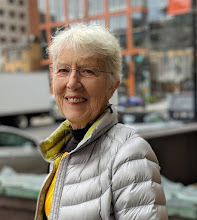
My friend Carol Ann Heckman has studied with Denise Levertov and feeds voraciously on her work. For many years I have loved Levertov's "The Secret" and today, rereading an email from Carol Ann, I went looking for a mathy poem by this beloved poet. I found the following -- with two numbers (and a hint of recursion):
The Mockingbird of Mockingbirds by Denise Levertov
A greyish bird
the size perhaps of two plump sparrows,
fallen in some field,
soon flattened, a dry
mess of feathers--
and no one knows
this was a prince among his kind,
virtuoso of virtuosos,
lord of a thousand songs,
debonair, elaborate in invention, fantasist,
rival of nightingales.
This poem rests on my bookshelf in Levertov's collection, Breathing the Water (New Directions, 1987).
Wednesday, July 24, 2013


Saturday, July 20, 2013
Poets at BRIDGES
These seven poets will be reading math-related poems at the upcoming (July 27-31) BRIDGES Conference in Enschede, the Netherlands; biographical information about the coordinator, Sarah Glaz, and each of the poets is available here. With each poet's name I have offer a date that is linked to one of my postings of his/her work:
Michael Bartholomew-Biggs 19 October 2012
Tatiana Bonch-Osmolovskaya 10 March 2013
Carol Dorf 31 May 2011
Sarah Glaz 7 November 2011
Emily Grosholz 24 September 2010
Alice Major 30 December 2012
Eveline Pye 12 April 2012
Here (and also to be offered at BRIDGES) is an elegant and thoughtful poem by Alice Major -- "For Mary, Turning Sixty" -- that compares mathematical meanings of terms with personal ones.
Michael Bartholomew-Biggs 19 October 2012
Tatiana Bonch-Osmolovskaya 10 March 2013
Carol Dorf 31 May 2011
Sarah Glaz 7 November 2011
Emily Grosholz 24 September 2010
Alice Major 30 December 2012
Eveline Pye 12 April 2012
Here (and also to be offered at BRIDGES) is an elegant and thoughtful poem by Alice Major -- "For Mary, Turning Sixty" -- that compares mathematical meanings of terms with personal ones.
Thursday, July 18, 2013
BRIDGES 2013 -- Math-Art in the Netherlands
Since 1998, Summer BRIDGES Conferences have been held -- enthusiastic gatherings where theater and visual art and music and poetry and mathematics engage participants in lively exchange. This year's conference is July 27-31 in Enschede, the Netherlands, and mathematician-poet Sarah Glaz has organized an outstanding group of talented readers to share their poetry on Sunday, July 28. Following the featured readers will be an open reading -- and interested readers are invited to email Glaz using the address found here.
One of the scheduled readers on July 28 in Enschede is Scottish poet and statistician Eveline Pye; shown below is one of the poems she will read -- "Love of Algebra" :
One of the scheduled readers on July 28 in Enschede is Scottish poet and statistician Eveline Pye; shown below is one of the poems she will read -- "Love of Algebra" :
Tuesday, July 16, 2013
Haiku to Mars -- select and vote
Each of us may now (July 15 - 29) vote for one of the thousands of Haiku submitted to NASA's "Haiku for Mars" contest. Three top vote-getters will be selected for transmission to our red planet. I invite you to vote (at this link) for my entry. My contest Haiku also is shown below; it follows a particular number scheme -- formed from one-syllable words with word-lengths following this pattern: 1-2-3-4-5-6-7-8-9-8-7-6-5-4-3-2-1.
THANKS for your vote.
I go for Mars, start
dreams -- flights straight, stretched, streamed, whirled bright.
Round bold red am I.
THANKS for your vote.
Thursday, July 11, 2013
Counting on numbers
Alan Michael Parker's anthologized and highly regarded poem "Family Math" begins in the style of a typical word-problem from Algebra -- and continues with a weaving of the ways that numbers describe our lives.
Family Math by Alan Michael Parker
I am more than half the age of my father,
who has lived more than twice as long
as his father, who died at thirty-six.
Family Math by Alan Michael Parker
I am more than half the age of my father,
who has lived more than twice as long
as his father, who died at thirty-six.
Monday, July 8, 2013
Pool -- a game of geometry?
Years ago I taught a "liberal arts mathematics" course -- and for a time we used the text Mathematics, a Human Endeavor: A Textbook for Those Who Think They Don't Like the Subject by Harold R. Jacobs (W H Freeman, 1971); the text's topics included one new to me, the geometry of the paths of billiard balls. The ease I found with this mathematics ill-prepared me for the skill I needed to avoid embarrassment at a neighbor's new pool table -- and the memories of it all drew me immediately into Dan Brown's poem, "Why I Never Applied Myself to Pool," found in the March 2013 issue of Poetry.
Why I Never Applied Myself to Pool by Dan Brown
Why I Never Applied Myself to Pool by Dan Brown
Friday, July 5, 2013
Grandma got STEM
There are so many fine websites to visit and blogs to read that it is hard to get to them all. One of my recent pleasures has been Grandma Got STEM (STEM = Science, Technology, Engineering, Mathematics), orchestrated by Rachel Levy, Harvey Mudd College, Mathematics. Recent entries there that I've enjoyed are Martha Siegel (Towson University, Mathematics) and Carol Jo Crannell (mother of Annalisa Crannell, Franklin and Marshall College, Mathematics and Art).
For a while I wondered how I might link these STEM pioneers to poetry and this morning was delighted to discover in a bio of poet Mei-Mei Berssenbrugge that her Chinese mother was a mathematician. And these initial stanzas of Berssenbrugge's poem "Tan Tien" illustrate her familiarity with mathematical vocabulary.
For a while I wondered how I might link these STEM pioneers to poetry and this morning was delighted to discover in a bio of poet Mei-Mei Berssenbrugge that her Chinese mother was a mathematician. And these initial stanzas of Berssenbrugge's poem "Tan Tien" illustrate her familiarity with mathematical vocabulary.
Tuesday, July 2, 2013
Calculus (and calyculus)
For lots of years I have subscribed to A.Word.A.Day, founded by Anu Garg, and on 3 June 2013 -- offered in the category of "words that appear to be misspellings" -- the word that appeared in my email was calyculus (kuh-LIK-yuh-luhs), a noun designating a cup-shaped structure. From this, of course, my thoughts turned to calculus and to poems on that subject. Below I offer "UR-CALCULUS" by Jonathan Holden. This Kansan poet has said that that his physicist father would write equations while sitting at the dining room table -- and "UR-CALCULUS" considers mathematics from a boy-riding-in-the-back-seat-of-a-car point of view.
UR-CALCULUS by Jonathan Holden
The child is the father of the man.
-- W. W. Wordsworth
Back then, "Calculus"
was a scary college word,
and yet we studied it
from the back seat, we studied
the rates at which
the roadside trees went striding
UR-CALCULUS by Jonathan Holden
The child is the father of the man.
-- W. W. Wordsworth
Back then, "Calculus"
was a scary college word,
and yet we studied it
from the back seat, we studied
the rates at which
the roadside trees went striding
Sunday, June 30, 2013
Miroslav Holub -- "what use is it?"
In earlier postings I have expressed my admiration for the Czech poet Miroslav Holub (1923-1998) -- a research scientist who also wrote fine poetry. In a biographical sketch of Holub at poetryfoundation.org, the poet is quoted as saying, " . . . I'm afraid that, if I had all the time in the world to write my poems, I would write nothing at all." There is no agreed standard for the amount of time to spend on a creative work. Many poets devote their full time to their craft; others fear over-writing and strictly limit their writing and editing. In each aspect of our lives it is possible to do too much or too little thinking about things. And so it goes.
My post on 5 April 2013 linked to several math-related Holub poems. And here is another; in "Magnetism," Holub focuses on the sometimes-silly, sometimes-practical, sometimes-too-limiting question often put to mathematics or science, "what use is it?"
Magnetism by Miroslav Holub
My post on 5 April 2013 linked to several math-related Holub poems. And here is another; in "Magnetism," Holub focuses on the sometimes-silly, sometimes-practical, sometimes-too-limiting question often put to mathematics or science, "what use is it?"
Magnetism by Miroslav Holub
Thursday, June 27, 2013
17-word Haiku
On 25 May 2013 this blog contained an announcement of NASA's Haiku-to-Mars contest. The contest rules are here -- and July 1 is the deadline for submission. Voting to select three favorite submissions will begin on July 15. For my own submission I decided to use numerical constraints -- I limited my Haiku to one-syllable words and used an increasing-decreasing pattern of the lengths of words. Here is an example (not the one I submitted, which begins "I go for Mars . . .").
A is the sign first
spread through thoughts –- stretched, breathed, squared, sighed.
Trace thru all to Z.
spread through thoughts –- stretched, breathed, squared, sighed.
Trace thru all to Z.
Tuesday, June 25, 2013
Symmetric squares
Sometimes we find meaning among disparate objects when they are juxtaposed. Here are nine words I have chosen because of the ways they are spelled. Using them to form two squares. Are my squares poems?
S A F E
A R E A
F E A R
E A R N
S A F E
A R E A
F E A R
E A R N
Saturday, June 22, 2013
Why is SHE less known? . . .
Sometimes matching words to a syllable-count helps to bring focus to my musings. Here are two stanzas for which I used the Fibonacci numbers as lengths for the lines I built as I considered the continuing invisibility of most math-women. (I have some hope that the second of these is primarily remembering -- and is not true of family child-care today.)
8-5-3-2-1-1 A FIB
HE is famous but SHE is not.
Yet we once judged her
potential
greater
than
his.
8-5-3-2-1-1 A FIB
HE is famous but SHE is not.
Yet we once judged her
potential
greater
than
his.
Wednesday, June 19, 2013
Balancing an Equation
I grew up on a farm and spent my middle life in a small town and now live in a city. A sort of immigrant. A farm girl who became a professor. A balancing act.
Some years back, one of my math department colleagues posted on his office door a quote from George Bernard Shaw (1856-1950) :
The reasonable man adapts himself to the world: the unreasonable one persists
in trying to adapt the world to himself. Therefore all progress depends
on the unreasonable man.
At one time I much agreed with the Shaw quote. Now (perhaps because I am older or because I now live near to Washington, DC and contentious party politics) I am more admiring of balance than unreasonableness. Here is a lovely poem by Caroline Caddy about balance and numbers.
Some years back, one of my math department colleagues posted on his office door a quote from George Bernard Shaw (1856-1950) :
The reasonable man adapts himself to the world: the unreasonable one persists
in trying to adapt the world to himself. Therefore all progress depends
on the unreasonable man.
At one time I much agreed with the Shaw quote. Now (perhaps because I am older or because I now live near to Washington, DC and contentious party politics) I am more admiring of balance than unreasonableness. Here is a lovely poem by Caroline Caddy about balance and numbers.
Sunday, June 16, 2013
What is not possible?
It is impossible for a number to be greater than 2 if it is not greater than 1. It is impossible to find a rational number whose square is 2. Up to now it has not been possible to show that π is a normal number. Mathematicians like the challenge of the impossible. To challenge, to prove, to refute.
In the poem below Chelsea Martin devises an entertaining web of circular reasoning to explore the impossibility of eating at MacDonald's.
McDonalds Is Impossible by Chelsea Martin
Eating food from McDonald's is mathematically impossible.
Because before you can eat it, you have to order it.
And before you can order it, you have to decide what you want.
And before you can decide what you want, you have to read the menu.
And before you can read the menu, you have to be in front of the menu.
And before you can be in front of the menu, you have to wait in line.
And before you can wait in line, you have to drive to the restaurant.
And before you can drive to the restaurant, you have to get in your car.
And before you can get in your car, you have to put clothes on.
In the poem below Chelsea Martin devises an entertaining web of circular reasoning to explore the impossibility of eating at MacDonald's.
McDonalds Is Impossible by Chelsea Martin
Eating food from McDonald's is mathematically impossible.
Because before you can eat it, you have to order it.
And before you can order it, you have to decide what you want.
And before you can decide what you want, you have to read the menu.
And before you can read the menu, you have to be in front of the menu.
And before you can be in front of the menu, you have to wait in line.
And before you can wait in line, you have to drive to the restaurant.
And before you can drive to the restaurant, you have to get in your car.
And before you can get in your car, you have to put clothes on.
Thursday, June 13, 2013
Count your things
In the development of human culture, mathematics began with counting. And so it also begins with each child as she/he grows.
Someone said that a person is wealthy when she has more things than she can count. Another view is that true wealth is having no need to count. Whether or not either is is correct, we can appreciate "My/My/My" by poet Charles Bernstein (begun below and completed at poets.org).
My/My/My by Charles Bernstein
Count these number of things you call mine. This is the distance between
you and enlightenment. —Swami Satchidananda
(for Jenny)
my pillow
my shirt
Someone said that a person is wealthy when she has more things than she can count. Another view is that true wealth is having no need to count. Whether or not either is is correct, we can appreciate "My/My/My" by poet Charles Bernstein (begun below and completed at poets.org).
My/My/My by Charles Bernstein
Count these number of things you call mine. This is the distance between
you and enlightenment. —Swami Satchidananda
(for Jenny)
my pillow
my shirt
Monday, June 10, 2013
A sestina from Rudyard Kipling
My father died many years ago, when I was still a young girl, and I have few possessions that were once his. One is The First Jungle Book, signed "Fulton Simpson" with his hand; it is very precious. By extension, all work by Rudyard Kipling (1865-1936) falls under my interest. And a sestina by Kipling is worthy of note:
Sestina of the Tramp-Royal by Rudyard Kipling
1896
Speakin’ in general, I ’ave tried ’em all—
The ’appy roads that take you o’er the world.
Speakin’ in general, I ’ave found them good
For such as cannot use one bed too long,
But must get ’ence, the same as I ’ave done,
An’ go observin’ matters till they die.
Sestina of the Tramp-Royal by Rudyard Kipling
1896
Speakin’ in general, I ’ave tried ’em all—
The ’appy roads that take you o’er the world.
Speakin’ in general, I ’ave found them good
For such as cannot use one bed too long,
But must get ’ence, the same as I ’ave done,
An’ go observin’ matters till they die.
Friday, June 7, 2013
A Man-Made Universe and "found" poems
Some poems are found rather than crafted.
It's such fun -- can happen to anyone --
to be reading along and find a poem.
It's such fun -- can happen to anyone --
to be reading along and find a poem.
This post continues (from the June 4 posting) consideration of lines that were not initially written as poetry but have been later discovered to have the desirable characteristics of a poem.
In an early-April posting I offered a poem-in-a-photo, a poem created of book spines -- and the bottom book in my pile of six is Mathematics, the Man-Made Universe: an Introduction to the Spirit of Mathematics by Sherman K Stein (Third Edition, Freeman, 1976). Reprinted in 2010 in paperback format, Stein's textbook -- for a "general reader," a curious person who is not a mathematician -- has been on my shelf for many years and, though I never taught from it, I have enjoyed it and shared it with friends (and I love its title). Recently, in the opening paragraph of Stein's Chapter 19 (page 471), I found a poem:
Tuesday, June 4, 2013
A poem from an airline call center
Poet Laura LeHew offers us "The New Math"-- a "found" poem that features conversations and calculations from call center negotiations to reschedule an airline flight -- posted in April, 2011 by the nonprofit literary arts collective [PANK].
LeHew's poem starts out like this:
The New Math by Laura LeHew
a found poem
Credit for the call center in India
to change your flight to the wrong day,
again
LeHew's poem starts out like this:
The New Math by Laura LeHew
a found poem
Credit for the call center in India
to change your flight to the wrong day,
again
($350.00) USD
Sunday, June 2, 2013
Geometry of distance
Some of the poems herein arrive as gifts from friends. Today's poem came via e-mail from Susan (a Californian whom I have gotten to know when she visits my neighbor, Priscilla). Susan got it from Larry Robinson who connected me with the poet, Richard Retecki, for permission to post it here.
As has been said in other contexts, It takes a village . . .
Thanks to you all!
ascension by Richard Retecki
for Jonathan Glass
the geometry
of distance annoys
is unfilled
As has been said in other contexts, It takes a village . . .
Thanks to you all!
for Jonathan Glass
the geometry
of distance annoys
is unfilled
Thursday, May 30, 2013
Haiku with a number or two
Recently Irish poet and New Yorker poetry editor Paul Muldoon read at the Folger Shakespeare Library -- and, sadly, I missed the event. To note the occasion, however, I turned to a Muldoon collection on my shelf, purchased a dozen years ago when I heard him read -- a lively and enjoyable performance, with wit and gusto -- at Bucknell University's Stadler Poetry Center.
I have not found significant mathematical imagery in Muldoon's work -- but here are several stanzas from his "Hopewell Haiku" that include numbers.
XLI by Paul Muldoon
Jean paints one toenail.
In a fork of the white ash,
quick, a cardinal.
I have not found significant mathematical imagery in Muldoon's work -- but here are several stanzas from his "Hopewell Haiku" that include numbers.
XLI by Paul Muldoon
Jean paints one toenail.
In a fork of the white ash,
quick, a cardinal.
Tuesday, May 28, 2013
Related rates -- in fiction and poetry
During the Memorial Day weekend I had the opportunity to read Black Rice (WSI, 2013), a novella by Burmese-American poet, artist, activist -- and friend -- Kyi May Kaung; I strongly recommend this book to you. (My 5-star review of Kaung's book is available here at amazon.com -- follow the link and scroll down.)
Here, in this blog, we mention topics if and only if they relate to both mathematics and poetry. Read on and you will see!
Midway through Black Rice, the narrator (speaking of an overflowing stream) reveals a negative attitude toward mathematics -- a strategy often used to provoke readers to experience empathy: "Ahhh, just like me." Here are the Burmese soldier's words:
Here, in this blog, we mention topics if and only if they relate to both mathematics and poetry. Read on and you will see!
Midway through Black Rice, the narrator (speaking of an overflowing stream) reveals a negative attitude toward mathematics -- a strategy often used to provoke readers to experience empathy: "Ahhh, just like me." Here are the Burmese soldier's words:
Saturday, May 25, 2013
Haiku to Mars
Send a Haiku to Mars on the MAVEN!
to select three Haiku to send to Mars:
NASA is offering all of us a way to ‘Go to Mars’ aboard a DVD flying on the solar winged MAVEN (Mars Atmosphere and Volatile Evolution) orbiter via a contest managed by the University of Colorado at Boulder’s Laboratory for Atmospheric and Space Physics (CU/LASP). Haiku messages will be voted on by the public; the top three most popular entries will be sent to Mars on the MAVEN spacecraft and will be displayed on the MAVEN website. More information here.
7-prime Haiku
Start with 2 - 3 - 5
and then 7 - 11 -
13 - 17
and then 7 - 11 -
13 - 17
Wednesday, May 22, 2013
Shifting patterns
This poem by California poet and scientist Lucille Lang Day weaves a shifting display of images -- the flight patterns of birds made vivid with mathematical terminology. As the poet's observations meander, they build to a question: is a galaxy something like a sparrow?
Form/Formless by Lucille Lang Day
A flock of red-winged blackbirds
swooping and swirling
in cyclonic and anticyclonic patterns
always in motion like Jovian clouds
that appear, then disappear
according to the mathematics of chaos
in yellow, brown and salmon-colored layers
Form/Formless by Lucille Lang Day
A flock of red-winged blackbirds
swooping and swirling
in cyclonic and anticyclonic patterns
always in motion like Jovian clouds
that appear, then disappear
according to the mathematics of chaos
in yellow, brown and salmon-colored layers
Saturday, May 18, 2013
Mathematics and Mexican Food
Recently Rattle posted a wonderful mathy poem by Diana Rosen entitled "Mathematics and Molé." Here's the first stanza:
Mathematics and Molé by Diana Rosen
Numbers flicker in front of my eyes as
I give him my full attention.
Differential geometry explains the black hole, he says.
It’s very obvious.
I lean forward to catch his words,
my chin in cupped hand,
eyes intent on his, yet
thinking of Mexican food.
Mathematics is the language of science, he says.
. . .
Rosen's complete poem is here.
Mathematics and Molé by Diana Rosen
Numbers flicker in front of my eyes as
I give him my full attention.
Differential geometry explains the black hole, he says.
It’s very obvious.
I lean forward to catch his words,
my chin in cupped hand,
eyes intent on his, yet
thinking of Mexican food.
Mathematics is the language of science, he says.
. . .
Rosen's complete poem is here.
Subscribe to:
Posts (Atom)

 Posts
Posts