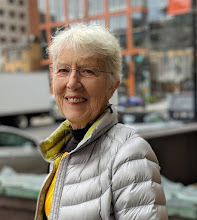
Pennsylvanian Craig Czury works as a travelling poet in schools, homeless shelters, prisons, mental hospitals, and community centers around the world. Czury sent me the following translation, "Writing Sheet," by Willie Westwood of a poem by Jacques Prévert (1900-1977) -- the original French version may be found at Westwood's site (scroll down).
Wednesday, April 20, 2011


Monday, April 18, 2011
Teaching math with a poem
Sarah Glaz is an algebraist (University of Connecticut) who uses poetry to teach mathematics. At her web page, scroll down to "Recent Articles" to see titles and links to three such papers. One of the articles is "The Enigmatic Number e: A History in Verse and its Uses in the Mathematics Classroom" -- and it contains an annotated version of the poem whose opening stanzas are found below; it's found in the Digital Library of the Mathematical Association of America (MAA), Loci: Convergence (April 2010).
Sunday, April 17, 2011
A picture should extend beyond its frame
Since April is Mathematics Awareness Month -- with theme "Unraveling Complex Systems" -- this blogger has been seeking out poems that embrace "complexity." Today we have a selection by British poet, novelist, and critic John Fuller from his Newdigate prize-winning poem of 1960, "A Dialogue between Caliban and Ariel.".
Thursday, April 14, 2011
Finding poems with "numbers"
Here's a quick and enjoyable activity:
Go to the website for The Poetry Foundation. Browse for a bit and, when you have completed your look-around, go to the search box toward the upper right and enter the word numbers, then click on the search button to bring a list of results. On that new page, go to the left column menu and click on Poems. Enjoy "Number Man" by Carl Sandburg and several other poems.
When your time permits, search using a second mathematical term, and a third. Bookmark the site. April is National Poetry Month and Mathematics Awareness Month. Celebrate!
Go to the website for The Poetry Foundation. Browse for a bit and, when you have completed your look-around, go to the search box toward the upper right and enter the word numbers, then click on the search button to bring a list of results. On that new page, go to the left column menu and click on Poems. Enjoy "Number Man" by Carl Sandburg and several other poems.
When your time permits, search using a second mathematical term, and a third. Bookmark the site. April is National Poetry Month and Mathematics Awareness Month. Celebrate!
Wednesday, April 13, 2011
Conditional statements
The "If ... , then ... ." statements of mathematical theorems are often termed "conditionals." We have, for example, the conditional, "If x < 3, then x² < 9." And so on. Formal conditional statements in a poem can give it the feel of mathematics, even if no mathematical terminology is used. This is illustrated in "Omens" by the Romanian poet Marin Sorescu (1936-1996); Sorescu's poem also treats us to word-play -- with allusions that range from nursery rhymes to religious narratives.
Sunday, April 10, 2011
What can mathematics do?
For many, mathematics offers interpretive links between a mind and the truths it seeks to know, the same role that a story plays in this poem -- "Story Water" -- by Jelaluddin Balkhi Rumi (1207 - 1273).
Thursday, April 7, 2011
A poetic perspective on algebra
Last Monday (April 4), the Washington Post had an article concerning the value of Algebra II as a predictor of college and work success. Since then I have heard numerous successful people point out that they did not have the cited course. Also on April 4, NPR had a feature on the advantages of being bilingual. My own mind joined these two stories -- for me, algebra is a second language and has enabled my learning of lots of other things.
Colette Inez 's poem "Forest Children" uses the language of poetry to speak of algebra (and of her concern for shrinking woodlands).
Colette Inez 's poem "Forest Children" uses the language of poetry to speak of algebra (and of her concern for shrinking woodlands).
Tuesday, April 5, 2011
What color is 3?
Long before there were six-digit hexadecimal codes for color (red #FF0000 or green #000800), there were paint-by-number craft activities. And there is synaesthesia (syn -joined, aesthesia -sense), a neurological condition in which two or more senses are connected. For example music might be "seen" in colours and patterns, or taste may have shapes, or letters and numbers have textures.
Miroslav Holub (1923-98), Czech poet and research scientist (and one of my favorite poets) establishes number-color pairings in the following poem:
Miroslav Holub (1923-98), Czech poet and research scientist (and one of my favorite poets) establishes number-color pairings in the following poem:
Sunday, April 3, 2011
April -- month of poetry and mathematics
April is both National Poetry Month and Mathematics Awareness Month (with theme this year being "Unraveling Complex Systems"). Today's poem by physicist Richard Feynmann (1918-1988) celebrates both poetry and complexity; from the Epilogue of Feynman's book, What do you care what other people think?, we have these lines:
Wednesday, March 30, 2011
Coleridge: A Mathematical Problem
"A Mathematical Problem" by Samuel Taylor Coleridge (1772-1834) -- found online at Elite Skills Classics -- uses verse to describe construction of an equilateral triangle; Coleridge introduces the poem with a letter to his brother telling of his admiration of mathematics, a view rather rare among poets.
Sunday, March 27, 2011
The Nightmare of an Unsolved Problem
Back in the 1980s when I first met the Collatz conjecture in a number theory textbook it was stated this way:
Start with any whole number n :
If n is even, reduce it by half, obtaining n/2.
If n is odd, increase it by half and round up to the nearest whole number, obtaining 3n/2 + 1/2 = (3n+1)/2. Collatz' conjecture asserts that, no matter what the starting number, iteration of this increase-decrease process will each time reach the number 1.
Start with any whole number n :
If n is even, reduce it by half, obtaining n/2.
If n is odd, increase it by half and round up to the nearest whole number, obtaining 3n/2 + 1/2 = (3n+1)/2. Collatz' conjecture asserts that, no matter what the starting number, iteration of this increase-decrease process will each time reach the number 1.
Thursday, March 24, 2011
Numbers are more than numbers
Today, a poem in three parts, "Trouble with Numbers" -- from the collection Mathematics and Other Poems by William Wall.
Tuesday, March 22, 2011
Celebrating Newman's "World of Mathematics"
Lionel Deimel is a database and Web site designer, a steam locomotive enthusiast, a cat lover, an essayist and a poet who maintains an eclectic website entitled Lionel Deimel’s Farrago. There I found a small poem about one of my most-valued literary treasures, The World of Mathematics, a four-volume collection compiled with commentaries and notes by James R Newman, first printed in 1956. The range of topics is vast and the primary requirement for reading is not calculus but curiosity. Sections of Volume 4 include "Mathematics in Literature," "Mathematics as a Culture Clue," and "A Mathematical Theory of Art." (You should not be without this fine collection.) Here is Deimel's poem:
Sunday, March 20, 2011
Counting: 1, 2, 3, 4, 5, . . .
At Peter Cameron's Blog, "Counting the things that need to be counted," the July 14, 2010 entry contains a reflective poem entitled "Millenium" which meditates on the ten digits in stanzas whose lengths count them. Here are the opening stanzas:
Friday, March 18, 2011
Who are our prophets?
Here is the opening sentence of an article, "Mathematicians and Poets," by Cai Tianxin, a mathematics professor at Zhejiang University -- it appears in the April 2011 issue of Notices of the AMS:
"Mathematicans and poets exist in our world as uncanny prophets."
"Mathematicans and poets exist in our world as uncanny prophets."
Wednesday, March 16, 2011
9 9-square stanzas
In the current (March 21, 2011) issue of The New Yorker (pages 46-47) may be found the poem "Green Farmhouse Chairs" by Donald Hall. Hall's fine nostalgic poem consists of 9 stanzas; each stanza is "square" -- and has 9 lines with 9 syllables per line. Enjoy!
Tuesday, March 15, 2011
Remembering Pi-day, a day late
Yesterday (3-14) was Pi-day, but my recent thoughts have been focused on my math-teacher son Eric (who has acute pancreatitis) and his family -- and I forgot to post this poem on the proper day. Thanks to Lana Hechtman Ayers for these opening lines of "Circumference: A love poem."
Sunday, March 13, 2011
Teaching Math
When I was a new professor in the 1970s at Bloomsburg University (then Bloomsburg State College) my colleague PH and I discussed our teaching efforts and compared them with the ways we had been taught. We agreed that our university teachers seemed simply to dump mathematics on us in any manner whatever -- believing, it seemed, that those who were "smart enough" would pick it up. (And other students should study sociology or communications or the like.) We and all around us worked to improve our teaching techniques and yet many years later it seems to continue that the privileged -- whether of wealth or education or gender or birthplace or whatever -- seldom see their advantages over those who are different. And sometimes those of us who try the hardest fail our students because we do too much. This latter idea led me to write this poem.
Monday, March 7, 2011
Numerology
On her website Deanna Rubin describes herself this way, "I have a degree in Technical Writing and Computer Science from Carnegie Mellon University, and my head is full of random numbers." Illustrating this latter claim is her poem, "Numerology":
Friday, March 4, 2011
Journal of Humanistic Mathematics -- V1, Issue 1
A new door has opened for those of us interested in the humanistic aspects of mathematics. Under the able leadership of editors Mark Huber (Claremont McKenna College) and Gizem Karaali (Pomona College), the idea of the former Humanistic Mathematics Network Journal has been revived and Volume 1 Issue 1 of the Journal of Humanistic Mathematics is now available online. The inaugural issue contains several poems, including the following one by Caleb Emmons, "Seeing Pine Trees," in which Emmons characterizes the views of a poet and a mathematician as two halves of one whole.
Wednesday, March 2, 2011
Perfect as soap bubbles
An alert to today's poem came from Greg Coxson, a University of Wisconsin-educated, Silver Spring-based, radar engineer who loves mathematics and poetry. The poem is by Howard Nemerov (1920-1991) and it builds to a presentation of its perfect mathematical image near its end.
Sunday, February 27, 2011
Immense polygons of evening
Sometimes one wonderful line makes me fall in love with a poem. I offer the following -- in which the title first draws me in and then "immense polygons of evening" delights me even more. Here, by Paula Closson Buck, is "A Betrayal of Integers," which uses mathematical terminology as the perfect mix of seasonings for a gourmet dish.
Thursday, February 24, 2011
Counting rhymes -- Catalan, Bell numbers
In mathematics, the Catalan numbers (named for Belgian mathematician Eugène Charles Catalan, 1814–1894, and beginning with 1, 1, 2, 5, 14, 42, 132, 429, . . . ) and the Bell numbers (named for the Scottish mathematician Eric Temple Bell, 1883-1960, and beginning with 1, 1, 2, 5, 15, 52, 203, 877, . . . ), provide answers to a variety of mathematical counting-problems, including counting the number of rhyme schemes for stanzas of poetry. In English, earliest classification of rhyme schemes dates back to George Puttenham and his treatise, The Arte of English Poesie (published around 1590).
Tuesday, February 22, 2011
Poems of set paradox and spatial dimension
Universal Paradox by Sandra DeLozier Coleman
One gigantic set made of all that there is
Boggles the mind with paradoxes.
For it is greater than all, but smaller than this —
The set which consists of the subsets of it.
One gigantic set made of all that there is
Boggles the mind with paradoxes.
For it is greater than all, but smaller than this —
The set which consists of the subsets of it.
Sunday, February 20, 2011
Black History Month -- celebrate Haynes and Hughes
Living on the border of Washington DC I am exposed to items of local history for our nation's capital. One such item involves the "discovery" of Langston Hughes (1902-1967) by poet Vachel Lindsay (1879 - 1931) at the Marriott Wardman Park Hotel, a leading conference hotel in the city. A second story is a mathematical one. Martha Euphnemia Lofton Haynes (1890-1980), a fourth-generation Washingtonian, was the first black woman to earn a PhD in mathematics -- conferred in 1943 by Catholic University.
Friday, February 18, 2011
Srinivasa Ramanujan
One of the most intriguing tales in the modern history of mathematics involves Indian-born mathematician and genius Srinivasa Ramanujan (1887-1920) who traveled to England to work with G H Hardy (1877-1947). Poet Jonathan Holden, who writes often of matters mathematical, offers this portrait of the Indian prodigy:
Wednesday, February 16, 2011
Thinking about Thinking
The question of what it means to think is never far from my focus -- and is particularly on my mind during these days that the computer Watson is competing on the TV game show, Jeopardy. Here is a poem I like a lot -- "New Math" by Cole Swensen -- in which the poet (writing more than 20 years ago) considers the limits of computation (and whether it could aid persons unable to recognize faces).
Monday, February 14, 2011
Puzzles, puzzlers, and parody
For lots of fun, go to plus online magazine at this link to find a poem that requires a knight's tour of a chess board for you to unscramble its words and read its eight lines.
Saturday, February 12, 2011
Loving a mathematician (Valentine's Day and . . . )
A perfect way to celebrate Valentine's Day -- especially for you who enjoy mathematics -- read (aloud and to each other) some "poems of love and mathematics." Such is easily possible, for the anthology, Strange Attractors: Poems of Love and Mathematics (A K Peters, 2008), edited by Sarah Glaz and me, contains words on the topic by more than 150 poetic voices.
Thursday, February 10, 2011
Dividing by Zero
Fairy godmothers have their magic wands and mathematician have division by zero as a way to make the impossible happen -- for example, we can show that 2 equals 3:
Tuesday, February 8, 2011
How much math does a math-poem need?
Poems offered in this blog vary in the levels of mathematics they contain. One mathematical reader commented privately that in some of the poems the use of mathematical terms is "purely decorative." Indeed, some people have particular expectations for poetry that relates to mathematics -- they want the content to use mathematical notation or to present a mathematical truth. Such as, perhaps, this abbreviated statement of the four-color theorem (formulated as a 4x4 square):
Sunday, February 6, 2011
Electronic poetry -- Stephanie Strickland
Computers offer new opportunities for poetry -- permitting new types of poems. Animated perhaps, or hypertext, or vast manuscripts of which we can see at most a fragment -- the possibilities are many. Stephanie Strickland is one of the pioneers of electronic literature -- and this post was sparked by my experiences at her presentations at Georgetown University on February 1.
Friday, February 4, 2011
AWP avoids mathematics
I am currently attending the 2011 AWP* Conference and am disappointed that none of the sessions involves connections of writing with mathematics -- this disappointment has prodded me to write the Fib that I include below. (Recall that a Fib is a poem whose successive line-syllable counts follow the **Fibonacci seqence -- the numbers that count the petals on a flower, the spirals of seedheads on a pine cone or pineapple, and many other natural things.)
Wednesday, February 2, 2011
Painting tragedy with numbers
Although words such as "massacre" and "victim" and "buried" help us to understand the effects of disaster and injustice, sometimes the most vivid descriptions of horrific events are painted with numbers -- 6 million slain, 4-year-old girl raped, 11 days without food. One of the strong poetic voices of the twentieth century was June Jordan (1936-2002). Works in her collection, Kissing God Goodbye (Anchor Books, 1997), speak out for all victims, in Baghdad or Belfast, in Lebanon or Algeria. In the following poem from that 1997 collection, Jordan uses numbers to heighten her portrayal of tragedy in Bosnia.
Monday, January 31, 2011
Romanian poets -- Cassian and Barbu
Born in 1924, in Galati, Romania, Nina Cassian has published over fifty books -- besides poetry, she has works of fiction and books for children. Since 1985 she has lived in exile in the United States. Among those Cassian credits with strong influences on her poetry is mathematician / poet Dan Barbilian / Ion Barbu (1895-1961). This poem by Cassian illustrates those mathematical influences:
Sunday, January 30, 2011
Sonnet for a geometry teacher
Wisconsin poet Ronald Wallace has fun with math-words in the following sonnet that celebrates a teacher of plane geometry.
Friday, January 28, 2011
Poems starring mathematicians - 8
Even though Johnny Depp played a mathematician in his recent film, The Tourist, we don't learn much about what mathematicians think or do from that story. Poetry offers more insight. Mathematician and writer Sherman Stein gives us this portrayal:
Wednesday, January 26, 2011
Self-portrait with numbers
Visual poet Geof Huth lives and blogs in Schenectady, NY. In 2010 he turned 50 and early in 2011 he sent me (via snail mail, on smooth white paper) a letter. The letter is a poem; the poem is a celebration of life, a sort of self-portrait, using numbers. Geof gave me permission to post it here.
Monday, January 24, 2011
Poem and parody -- isomorphic?
In mathematics, algebraic systems that have different objects but the same structure are described as isomorphic. The parody in poetry illustrates the same idea -- a new poem is created that matches the form of a chosen poem, but uses different words. For example, here are the opening stanzas of a poem published in 1799 by Robert Southey (1777-1843) that was later parodied by Lewis Carroll (1832-1898) in Alice's Adventures in Wonderland.
Saturday, January 22, 2011
Integrals -- a poem
Integrals by Jonathan Holden
Erect, arched in disdain,
the integrals drift from left
across white windless pages
to the right,
serene as swans.
Erect, arched in disdain,
the integrals drift from left
across white windless pages
to the right,
serene as swans.
Thursday, January 20, 2011
Hyperbolic effects
Last month I went to the Hyperbolic Crochet Coral Reef Exhibit at the Smithsonian Museum of Natural History -- for a photo scroll down to the end of this post -- and that visit provoked me to begin searching for the term "hyperbolic" in poems. I came close when I found "hyperbola" in a poem by Jonathan Holden and hyperbole in a sonnet by Elizabeth Barrett Browning:
Tuesday, January 18, 2011
Poetry inspired by Chaos
Poet Robin Chapman studies the language learning of children -- and has collaborated with physics professor Julien Sprott on a lovely and fascinating collection The Art and Poetry of Chaos: Images from a Complex World (World Scientific, 2005). In the following poem Chapman offers (as she does throughout the poetry of the collection) a human interpretation of technical terminology.
Monday, January 17, 2011
Dr King's dream and Black math students
Today is our public celebration of the January 15 birthday of Martin Luther King, Jr (1929-1968) who was both preacher and poet in the "I have a dream" speech he delivered on the steps at the Lincoln Memorial in Washington D.C. on August 28, 1963.
Friday, January 14, 2011
Rather like an elephant
What is mathematics?
These days I am outside of mathematics looking in and my views of the subject are more complex than during the days when I was a professor and mathematician. Back in my math-prof days -- when I moaned about those who held the view that mathematics is merely computation -- I tried to explain to uncompreheding friends the role of calculation within mathematics with this analogy: computation is to mathematics as spelling is to poetry. But those for whom computation is all of their mathematics do not accept this argument. Indeed, I myself now have the notion that one can navigate life competently without algebra -- much as I get along without Spanish or Chinese. But I regret not knowing them -- they are, like algebra, among the world's important languages.
These days I am outside of mathematics looking in and my views of the subject are more complex than during the days when I was a professor and mathematician. Back in my math-prof days -- when I moaned about those who held the view that mathematics is merely computation -- I tried to explain to uncompreheding friends the role of calculation within mathematics with this analogy: computation is to mathematics as spelling is to poetry. But those for whom computation is all of their mathematics do not accept this argument. Indeed, I myself now have the notion that one can navigate life competently without algebra -- much as I get along without Spanish or Chinese. But I regret not knowing them -- they are, like algebra, among the world's important languages.
Wednesday, January 12, 2011
Geometry and autism
We do not easily describe what goes on inside our own heads and have still greater difficulty seeing into the minds of others. Pennsylvania poet Barbara Crooker uses images from geometry to help us to see into autism.
Monday, January 10, 2011
Tribute to four teachers
Many people offer advice about education--and, in particular, about mathematics education. I'm skeptical of general pronouncements because my encounters with learning (as student or teacher or parent) have been singular: one mind meeting another mind for a period of exchange. Here's a poem that recalls four of my teachers, three of them teachers of mathematics.
Friday, January 7, 2011
Which are "real" numbers?
The adjective "real" in the term "real number" causes confusion for many whose mathematics is casual rather than intense. I like the mathematical definition of a number as real iff it corresponds to a point on the number line -- for this gives the abstract number a geometric counterpart (an attachment to reality) -- but there are others for whom the reality of a number depends on its emotional connections, perhaps used in ways that poet Ginger Andrews uses numbers in the following poem.
Wednesday, January 5, 2011
Mathematics and race
Sherman Alexie is a Spokane / Coeur d’Alene Indian from Wellpinit, Washington. Besides several collections of poetry, Alexie has published novels and short-stories; he wrote the screen-play for the 1998 film, Smoke Signals. Here, in verse, he deals with the mathematics of racial identity:
Monday, January 3, 2011
New poems from old -- by permutation
One of the founding members of the Oulipo, Jean Lescure (1912-2005), devised categories of permutations of selected words of a poem to form a new poem; three of these rearrangements are illustrated below using the opening stanza of "Mathematics or the Gift of Tongues" by Anna Hempstead Branch (1875-1937). Here is the original stanza from Branch's poem:
From 2010 -- titles and dates of posts
List of postings March 23 - December 31, 2010
A scroll through the 12 months of titles below may lead you to topics and poets/poems of interest. Also helpful may be the SEARCH box at the top of the right-hand column; there you may enter names or terms that you would like to find herein.
Dec 31 The year ends -- and we go on . . .
Dec 30 Mathematicians are NOT entitled to arrogance
Dec 28 Teaching Numbers
Dec 26 Where are the Women?
Dec 21 A Square for the Season
Dec 20 "M" is for Mathematics and . . .
A scroll through the 12 months of titles below may lead you to topics and poets/poems of interest. Also helpful may be the SEARCH box at the top of the right-hand column; there you may enter names or terms that you would like to find herein.
Dec 31 The year ends -- and we go on . . .
Dec 30 Mathematicians are NOT entitled to arrogance
Dec 28 Teaching Numbers
Dec 26 Where are the Women?
Dec 21 A Square for the Season
Dec 20 "M" is for Mathematics and . . .
Subscribe to:
Posts (Atom)

 Posts
Posts