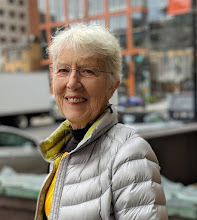
The following poem -- "Fayetteville Junior High" by Delaware poet Fleda Brown -- uses mathematical terms in entertainingly describing a romance between two teachers:
Monday, October 19, 2026


Wednesday, October 14, 2026
Remembering Tom Lehrer (1928-2025)
Celebrated as both a musician and a mathematician was Tom Lehrer (Thomas Andrew Lehrer -- 1928-2025). Lehrer recorded pithy, humorous, and often political songs that became popular in the 1950s and 1960s. Many of his songs parodied popular musical forms, often with original melodies.
The American Mathematical Society (AMS) offers a "mostly mathematical" appreciation of Lehrer -- on YouTube, posted here by mathematician Ken Ono. Links to many videos by Ono are available here.
Friday, October 9, 2026
A Path to Mathematics
A very important source of poetry with links to mathematics is the Journal of Humanistic Mathematics -- an online journal -- edited by Mark Huber (Claremont McKenna College) and Gizem Karaali (Pomona College), and found at this link. In the July 2026 issue of JHM, I found several fine poems, including the following one -- "My Journey to Mathematics" -- by Thao Thuan Vu Ho from Vietnam National University HCMC, University of Science. This thoughtful poem explores the sometimes undermined but important aspects of mathematics.
Friday, October 2, 2026
Writing with AI . . .
Found in Scientific American: Poetry was humanity's first language technology. AI is the next. Read mire here -- and learn (from this February 2026 article) how poet Sasha Stiles connects poetry and AI. Here are a few lines from the article.
Poetry and artificial intelligence can appear as opposites—one deeply human; the other cold and mechanical. Sasha Stiles sees them as expressions of the same impulse. Poetry, the Kalmyk- American poet argues, is “one of our most ancient and enduring technologies,” a system of meter and rhyme invented to store vital information. She views AI as its natural heir.
Thursday, September 24, 2026
More than Maths . . . fun math poems . . .
As you may know aready, British folks uss "maths" as a shortened version of "mathematics" -- while those of us in the U.S. use "math". A fun-to-visit website that I found recenly is MoreThanMaths.com; at the site (at which postings ended in 2015) a search for "poem" led me to this link -- where I found lots of students' mathy poems, including this one:

Explore more student maths poems. visit MoreThanMaths.com.
Friday, September 18, 2026
"Lullaby for the Mathematician"
From the March 1994 issue of Poetry, this thoughtful poem by Pennsylvania poet and professor Robert Bernard Hass:

Saturday, September 12, 2026
Short lines that GROW . . .
With line-lengths whose syllable-counts follow the Fibonacci numbers, a writer has the opportunity to develop a gradually expanding thought. Here are the opening lines of a Fibonacci poem by poet Punya Mishra following that pattern:
 |
| Mishra's complete poem is found here. |
Previous blog postings that include work by Mishra may be found at this link. And still more mathy poetry by Mishra may be found here.
Sunday, September 6, 2026
Remembering Wendell Berry
In today's news I learned of the recent death of award-winning author Wendell Berry (1934–2026). In more than fifty books of poetry, fiction, and essays, Berry explored the notion of living a principled life in accordance with the natural world. His many volumes of poetry include The Broken Ground, The Country of Marriage, and Collected Poems, 1957–1982. True to his vision, Berry lived with his wife, Tanya, on a farm in Kentucky that had been in his family since the nineteenth century,
Here, from the Poetry Foundation website, is one of Berry's fine poems. (published in 1962 and a little bit mathy) exploring the passage of time:
Saturday, August 29, 2026
Walking to find a solution . . .
Exploring Facebook recenty I came across Motive for Metaphor -- a site with this introduction:
Motive for Metaphor offers poetical expressions for sharing & is inspired by a Wallace Stevens poem of the same name (available here)..
At the Motive for Metaphor website I came across a poem title that interested me greatly -- because I often walk to help my thinking . . . Here, below, are the opening stanzas of that poem -- Solvitur Ambulando ''It is solved by walking" by Billy Collins; the complete poem is available at-this-link.
Friday, August 21, 2026
Spread the love of MATH -- with POEMS
For me, writing is part of my thinking process -- my fingers join my brain in formulating thoughts. And, if the current day is not one that inspires my creativity, then reading the creative work of others helps me to restore. Earlier this month (on August 8) I posted a sample from this website of Claire Jensen:
Poems of Maths: 35 Creative Math Poems for Students and Teachers .
and I do so again today to encourage the thinking that occurs as we write. Taking notes from what we read helps plant it in our brain.
Monday, August 17, 2026
Mathematics and Cats
An interesting, somewhat poetic quote:

Background information about the Quote Investigator website may be found here -- and about its creator, Garson O'Toole, John Conway (1937-2020) has been previously mentioned in this blog's posts found at this link.
Wednesday, August 12, 2026
A poetic view of Arithmetic
Recently I found -- and have been musing over -- this poetic quote by poet Carl Sandburg (1878-1967):
Arithmetic is where the answer is right and everything is nice and you can look out of the window and see the blue sky --- or the answer is wrong and you have to start over and try again and see how it comes out this time.
Saturday, August 8, 2026
Is each of us a MATH PERSON?
This article "Everybody is a Math Person . . ." by writer and teacher Larry Ferlazzo explores the nature of math anxiety and also the meanings of the terms: "math person" and "poetry person."
Ferlazzo offers these views: Many students say: “I’m not good at math.” A statement made by one student that turns into a ripple effect: “Math is so hard.” “My parents aren’t good at math, and neither am I.” “I just don’t have a math brain.”
Saturday, August 1, 2026
Reasons and Proofs -- in a Poem
This week I have been enjoying family vacation time but this evening I have a moment to share a mathy poem that I found recently on Facebook -- "THE WORLD I LIVE IN" -- lines by one of my favorite poets, Mary Oliver (1935-2019), Lots of information about her is available at this link and ten of her very fine poems are available here.

Tuesday, July 21, 2026
Browsing the Web -- Finding Mathy Poems
Recently I came across this website -- 30 Memorable Mathematics Poems - Tiny Poetry -- and I enjoyed browsing its poems. The website included the following comment:
These poems are completely original - not copied from anywhere. Feel free to use them however you want.
Here is a sample:
Tuesday, July 14, 2026
Exploring the truth -- with a FIB!
Gregory Coxson, recently retired faculty member at the US Naval Academy's Electrical and Computer Engineering Department -- and a long-time friend, enjoys discovering and sharing mathy poems -- some of them his own, Recently he sent me the following Fib.
A Fib by Gregory Coxson
I
You
We all
Have built-in
Math abilities
We’re captivated by puzzles
Daily life is full of numbers and calculations.
Wednesday, July 8, 2026
Counting , , ,
Here are the opening stanzas of a thoughtful poem by mathematician-writer Marian Christie:

Christie's complete poem is available here on her website and previous inclusions of her work in this blog may be found at this link.
Friday, July 3, 2026
Short word problems: do the math
Raymond Nat Turner is the poet-in-residence for Black Agenda Report (a website of news, commentary, and analysis from the black left) -- and I have found and been moved by his mathy poem of protest entitled "Short word problems: do the math" l I offer its opening stanzas below, followed by a link to the complete poem.
Monday, June 29, 2026
YouTube Video Celebrates Omar Khayyam
Enjoy a 1-minute video celebrating
the MATH and POETRY of Omar Khayyam
This Mathematician Solved Impossible Equations
While Writing Poetry -- YouTube
This blog posting -- from long ago in 2011 -- also features Khayyam.
Omar Khayyam (1048–1131) was a Persian poet and polymath, known for his contributions to mathematics, astronomy, philosophy, and Persian literature. He was born in Nishapur, Iran and lived during the Seljuk era, around the time of the First Crusade.
Monday, June 22, 2026
Cross BRIDGES ... 2026 Bridges Galway Conference
Each year an international BRIDGES Conference celebrates the connections between mathematics and the arts -- featuring connections with music, literature, visual art, theater . . . Here is a link to the website for the 2026 BRIDGES Conference -- to be held August 5-8 in Galway, Ireland.
An important and popular part of each BRIDGES Conference is a Poetry Reading. Scheduled for Saturday, August 8, 2026, the formal reading will include mathy poems from each of the poets named below; on this webpage (maintained by poetry reading co-organizer--and poet--Sarah Glaz) each of the following names is linked to biographical information and a sample poem.
Subscribe to:
Posts (Atom)

 Posts
Posts