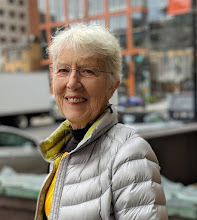
As noted in my 5 August posting, the Stillwater poetry festival (organized by Kevin Clark) was scheduled for last Saturday, September 7 -- and I was (though delayed by the death of a car battery) able to attend. A time to catch up with old friends -- River Poets Dave Barsky, Carol Ann Heckman, and Janet Locke, and Wilkes-Barre poet Richard Aston. Poets and musicians featured at the festival included Lester Hirsh, Pamela Kavanaugh, James Pingry, Doug McMinn, Jack Troy, Julia Spicher Kasdorf, and Sheryl St. Germain.
The theme at Stillwater was Nature/Agriculture and my 5 August post included poems from conference organizer Clark and featured reader Kasdorf -- poems that involved both nature and mathematics. Although found in Kasdorf's opening poem, "Double the Digits," mathematics was scarce. Sheryl St. Germain, the final reader (currently a Pittsburgher, transplanted from New Orleans) briefly mentions computation and measurement in her "Hurricane Season ." The full poem is available through St Germain's website; here is one of its stanzas.
Monday, September 9, 2013


Friday, September 6, 2013
Mathematical structure and Multiple choice
A sonnet repeats the iambic rhythm of the heart beat (da-DUM, da-DUM, . . .) with a line length corresponding to a typical breath (5 heartbeats); it thus seems easy to internalize the numerical structure that guides such a poem.
A decision tree offers a very different choice of mathematical structure for a poem -- displaying for a reader different choices among stanzas. Originally proposed to the OULIPO by founder Francois Le Lionnais, and referred to as a multiple-choice narrative, such a structure allows readers of a poem to choose among subsequent events. Instead of reading the poem vertically, we may jump about, choosing the sequence we want to read.
A decision tree offers a very different choice of mathematical structure for a poem -- displaying for a reader different choices among stanzas. Originally proposed to the OULIPO by founder Francois Le Lionnais, and referred to as a multiple-choice narrative, such a structure allows readers of a poem to choose among subsequent events. Instead of reading the poem vertically, we may jump about, choosing the sequence we want to read.
Tuesday, September 3, 2013
Poetry-with-math in Baltimore -- 17 Jan 2014
At the Joint Mathematics Meetings in Baltimore (January 15-18, 2014), the Journal of Humanistic Mathematics (under the leadership of editors Mark Huber and Gizem Karaali) will sponsor a poetry reading. Mark your calendar now! (And be sure to scroll down past the reading announcement to poems from last year's JHM reading in San Diego by poets Katie Manning and Karen Morgan Ivy.)
Friday, January 17, 2014. 4:30 - 6:30 PM
Room 308 Baltimore Convention Center
Saturday, August 31, 2013
A square-root of dead weight . . .
A poet I love (Seamus Heaney, 1939-2013, 1995 Nobelist) has died. The NYTimes obituary for Heaney quotes one of my favorites of his poems, "Digging" -- also available at poetryfoundation.org. Part of what I like about this Irishman's poetry is its design. Not only do his poems offer musicality of language but they feel carefully constructed -- modeling real world phenomena as mathematical models do -- built with careful attention to structure and detail until varied factors have been erected into in integrated whole. "Digging" ties together the physical activity of Heaney's father shoveling in the peat bogs of Ireland to his own probing with a pen for words.
Thursday, August 29, 2013
Poetry in a math text
In the 1980s, all students at Bloomsburg University were required to take at least one mathematics course and I worked with colleagues to develop a suitable offering -- one that did not require expertise in algebra but which emphasized problem-solving. Our course became "Mathematical Thinking" -- and I began to develop suitable materials -- eventually writing and publishing Mathematics in Daily Life: Making Decisions and Solving Problems (McGraw-Hill, 1986). Each of the twenty-two chapters of this textbook is introduced with a relevant quote. Chapter 11, "Visualizing the Structure of Information with a Tree Diagram," opens with two lines by one of my favorite poets, Theodore Roethke:
Once upon a tree
I came across a time.
Once upon a tree
I came across a time.
Monday, August 26, 2013
Celebrating a math-woman
I am continually searching for poems that feature past and current math-women.
When you find one (or create one) I will be glad to have you send it along.
When you find one (or create one) I will be glad to have you send it along.
The lunar crater L Herschel is named for astronomer Caroline Lucretia Herschel (1750-1848) -- and I have celebrated this math-woman earlier with two fine poems: "Letter from Caroline Herschel" by Siv Cedering , and "Planetarium" by Adrienne Rich. Now Herschel is the focus of a forthcoming book by poet Laura Long, The Eye of Caroline Herschel: A Life in Poems, (Finishing Line Press, 2013). Here, from that collection, is "The Taste of Mathematics: Caroline Herschel at 31" -- this poem also appears, along with a note about the full collection, in the July 2013 issue of The Journal of Humanistic Mathematics.
Thursday, August 22, 2013
Out of 100 -- in the Klondike Gold Rush
Adding to my recent post on 19 August I note that OEDILF is seeking submissions.
Join the project: submit limerick definitions of (math) terms for OEDILF consideration.
Join the project: submit limerick definitions of (math) terms for OEDILF consideration.
One of my favorite poets is the 1996 Nobelist Wislawa Szymborska (1923 - 2012, Poland); one of my favorites of her poems is "A Contribution to Statistics." Szymborska's poem served as a model for a poem of mine shown below, about Gold Rush Days in Skagway, Alaska. Written while I was poet-in-residence at Klondike Gold Rush National Historical Park, (in Skagway), this poem draws on historical data from the park's library to paint a bleak picture of wealth and survival in those gold-mad days.
Counting in the Klondike by JoAnne Growney
after Wisława Szymborska
Of 100 who left Seattle for Skagway in 1898
40 made it to the gold fields
8 found gold.
Monday, August 19, 2013
OEDILF - the Limerick Dictionary
At this site Editor-in-Chief Chris Strolin is coordinating development of OEDILF: The Omnificent English Dictionary In Limerick Form. So far, definitions are available (and being submitted) for terms beginning with letter-pairs Aa - Fd -- and completion of the dictionary is predicted at the OEDILF website for 2043.
I have mentioned OEDILF before -- on 5 December 2012 and 29 March 2010. And today I offer a draft limerick about "factors" -- I am at this point, however, dissatisfied with my use of the plural rather than simply "factor." More work needed.
I have mentioned OEDILF before -- on 5 December 2012 and 29 March 2010. And today I offer a draft limerick about "factors" -- I am at this point, however, dissatisfied with my use of the plural rather than simply "factor." More work needed.
Friday, August 16, 2013
Pushkin inspires Seth -- novels in verse
My enjoyment of novels in verse began to thrive when a friend and I determined to get into Vikram's Seth's The Golden Gate (Random House, 1986) by taking turns reading its sonnets aloud to each other. After several dozen aloud, I could hear the voice even when I read silently and I went on to finish alone. And I loved it. I have gone on to enjoy several more works by Seth -- none of them poems but all wonderful stories, well told.
Seth has said that he was moved to write by the novel Alexander Pushkin's verse novel Eugene Onegin noted here on 10 August 2013 -- a novel of interest to mathematicians because of its link to Markov Chains. Seth's novel (reviewed here) also was made into an opera. These first two stanzas -- each containing the numbers 26 and 1980 -- introduce the novel's computer-guy, John:
Seth has said that he was moved to write by the novel Alexander Pushkin's verse novel Eugene Onegin noted here on 10 August 2013 -- a novel of interest to mathematicians because of its link to Markov Chains. Seth's novel (reviewed here) also was made into an opera. These first two stanzas -- each containing the numbers 26 and 1980 -- introduce the novel's computer-guy, John:
Tuesday, August 13, 2013
Emily Dickinson
Although I do not consider any of Emily Dickinson's poems "mathematical," I find that she does not shy from using the terminology of mathematics. For example, her repetition of the word "circumference" noted in an earlier posting. (To search this blog for mentions of Dickinson (1830 - 1886) or any other poet or topic, follow the instructions offered in green in the column to the right.)
Dickinson is on my mind these recent days following my opportunity last Saturday evening to attend a session of a conference held by the Emily Dickinson International Society. A gracious invitation by Martha Nell Smith enabled me to attend a program that featured two long-time friends, actor Laurie McCants of the Bloomsburg Theatre Ensemble, performing a scene from her one-woman show, Industrious Angels, and Stephanie Strickland, a New York poet who, along with collaborator Nick Montfort, offered background and performance for Sea and Spar Between, a poetry generator that works with language patterns for these two writers.
Dickinson is on my mind these recent days following my opportunity last Saturday evening to attend a session of a conference held by the Emily Dickinson International Society. A gracious invitation by Martha Nell Smith enabled me to attend a program that featured two long-time friends, actor Laurie McCants of the Bloomsburg Theatre Ensemble, performing a scene from her one-woman show, Industrious Angels, and Stephanie Strickland, a New York poet who, along with collaborator Nick Montfort, offered background and performance for Sea and Spar Between, a poetry generator that works with language patterns for these two writers.
Saturday, August 10, 2013
Pushkin poetry, Markov chains
A Markov chain is a mathematical process that can be used to answer questions such as these:
If the current letter I am reading is a vowel, what is the probability
that the next letter will be a vowel? A consonant?
Answers from these may be combined to create more lengthy predictions -- about the 3rd letter after a given one, or the 10th -- and so on.
A recent article by Brian Hayes in American Scientist (brought to my attention by Greg Coxson) alerted me to the fact that it is 100 years since the Russian mathematician A. A. Markov (1856 - 1922) announced his findings about these transition probabilities -- and, moreover, his work was based on analysis of poetry; the poetry was Eugene Onegin, a verse-novel in iambic tetrameter by Alexander Pushkin (1799-1837). Markov's analyis dealt with Pushkin's novel as a long string of alphabetic characters and he tabulated the categories of vowels and consonants for about 20,000 letters. (For a host of details, visit Hayes' careful and interesting article.)
If the current letter I am reading is a vowel, what is the probability
that the next letter will be a vowel? A consonant?
Answers from these may be combined to create more lengthy predictions -- about the 3rd letter after a given one, or the 10th -- and so on.
A recent article by Brian Hayes in American Scientist (brought to my attention by Greg Coxson) alerted me to the fact that it is 100 years since the Russian mathematician A. A. Markov (1856 - 1922) announced his findings about these transition probabilities -- and, moreover, his work was based on analysis of poetry; the poetry was Eugene Onegin, a verse-novel in iambic tetrameter by Alexander Pushkin (1799-1837). Markov's analyis dealt with Pushkin's novel as a long string of alphabetic characters and he tabulated the categories of vowels and consonants for about 20,000 letters. (For a host of details, visit Hayes' careful and interesting article.)
Subscribe to:
Posts (Atom)

 Posts
Posts