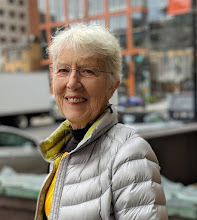
I am honored to announce that my article, "They Say She Was Good -- for a Woman," -- a collection of poems and musings about women in mathematics (and featuring a poem about Emmy Noether) -- is part of the current issue.
Wednesday, July 12, 2017
They Say She Was Good -- for a Woman
Regulars to this blog know of my appreciation and support for the Journal of Humanistic Mathematics -- an online journal that publishes poetry and fiction as well as articles that link the arts with mathematics. Bravo to editors Gizem Karaali and Mark Huber -- a new issue (Vol. 7, Issue 2) has come online today.
I am honored to announce that my article, "They Say She Was Good -- for a Woman," -- a collection of poems and musings about women in mathematics (and featuring a poem about Emmy Noether) -- is part of the current issue.
Other key items in this issue of JHM that I have already found time to enjoy include a visual poem of geometry and numbers by Sara Katz, a collection of poems about "infinity" by Pam Lewis, a review of poetry anthologies by Robin Chapman, a call (deadline, 11/1/17) for "mathematical" Haiku; a call (deadline 1/1/2018) for papers on mathematics and motherhood. Go to the Table of Contents and enjoy it ALL.
I am honored to announce that my article, "They Say She Was Good -- for a Woman," -- a collection of poems and musings about women in mathematics (and featuring a poem about Emmy Noether) -- is part of the current issue.


Sunday, July 9, 2017
Three Odd Words
I love the mental jolt I get when a math word is used with a non-math meaning -- suddenly some playful back-and-forth happens in my head. Here it happens in a tiny poem by Polish Nobelist Wislawa Szymborska (1923-2012).
The Three Oddest Words by Wislawa Szymborska
When I pronounce the word Future,
the first syllable already belongs to the past.
When I pronounce the word Silence,
I destroy it.
When I pronounce the word Nothing,
I make something no nonbeing can hold.
This poem is found on my shelf in Map: Collected and Last Poems (Mariner Books, 2016). Translated from the Polish by Clare Cavanagh and Stanislaw Baranczak, edited by Clare Cavanagh. This link leads to several previous posts that also include work by Szymborska.
The Three Oddest Words by Wislawa Szymborska
When I pronounce the word Future,
the first syllable already belongs to the past.
When I pronounce the word Silence,
I destroy it.
When I pronounce the word Nothing,
I make something no nonbeing can hold.
This poem is found on my shelf in Map: Collected and Last Poems (Mariner Books, 2016). Translated from the Polish by Clare Cavanagh and Stanislaw Baranczak, edited by Clare Cavanagh. This link leads to several previous posts that also include work by Szymborska.
Wednesday, July 5, 2017
Finding poems in Maria Mitchell's words
SO MANY words and phrases are poetic
that are NOT YET called poems.
 |
| A recent Facebook posting for the Max Planck Society featured this picture and quote by 19th century American Astronomer Maria Mitchell (1818-1889): |
Thursday, June 29, 2017
The NUMBERS that help us REMEMBER . . .
Born in Lithuania, poet Czesław Miłosz (1911-2004) became fluent in Polish, Lithuanian, Russian, English and French. He emigrated to the United States (to California) in 1960 and was the 1980 winner of the Nobel Prize in literature. He was not fluent in the language of mathematics but his poem "The Titanic" -- written in Berkeley in 1985 and excerpted below -- illustrates the power of numbers in poetic description AND the circumstances of which numbers are remembered.
from The Titanic by Czesław Miłosz
from The Titanic by Czesław Miłosz
Events--catastrophes of which they learned and those others of which they did not want to know. In Johnstown, Pennsylvania, a flood in 1889 took 2,300 lives; 700 persons perished in the San Francisco earthquake of 1906. Yet they did not notice the earthquake at Messina in Sicily (1908),
Tuesday, June 27, 2017
Chains of Reasoning
In a recent conversation about mathematics, one of us said, "Mathematics is not about what is true, or cannot be, but is a collection of valid chains of reasoning." And from there my mind wandered on to Clarence Wylie's sonnet (offered below) -- which is the final poem in a wide-ranging anthology that Sarah Glaz and I edited : Strange Attractors: Poems of Love and Mathematics (A K Peters/CRC Press, 2008). Enjoy Wylie's play with thinking about the "holy order" of mathematics.
Paradox by Clarence R Wylie, Jr. (1911-1995)
Not truth, nor certainty. These I forswore
In my novitiate, as young men called
To holy orders must abjure the world.
Paradox by Clarence R Wylie, Jr. (1911-1995)
Not truth, nor certainty. These I forswore
In my novitiate, as young men called
To holy orders must abjure the world.
Thursday, June 22, 2017
Euclid's Iron Hand
Alice Major is a Canadian poet who admits to having loved mathematics since girlhood and who often includes mathematical ideas and images in her poems. The first poet laureate of Edmonton, Alberta, Major has been instrumental in spreading a love of poetry in many directions and venues. The selection below, "Euclid's Iron Hand," first appeared in Wild Equations, the Spring 2016 issue of Talking-Writing, an online journal that also in 2012 featured math-related poems and an essay by TW editor, Carol Dorf, "Why Poets Sometimes Think in Numbers."
Euclid's Iron Hand by Alice Major
My iron cannot cope
with non-Euclidean geometry.
Antique and irritable, it insists
on plane surfaces and the fifth postulate,
hissing, Lie down flat, goddamit.
Both Alice Major and Carol Dorf are part of the Poetry Reading
at this summer's BRIDGES Math-Arts Conference July 27-31 in Waterloo, Ontario.
Will we see you there?
Euclid's Iron Hand by Alice Major
My iron cannot cope
with non-Euclidean geometry.
Antique and irritable, it insists
on plane surfaces and the fifth postulate,
hissing, Lie down flat, goddamit.
Tuesday, June 20, 2017
Three Plus Four Divided by Seven
A good friend, Doru Radu -- with whom I have partnered to translate some Romanian poetry into English -- shares with me a love for the work of Polish poet and 1996 Nobelist, Wisława Szymborska (1923-2012). Doru lives in Poland now and had a chance to meet Szymborska, to hear her read, and to translate some of her work into his native Romanian. And last summer, when he traveled to New York, he brought to me a copy of the posthumously published collection, Enough (Wydawnictwo a5). Here are a couple of mathy stanzas from one of its poems, "Confessions of a Reading Machine."
Confessions of a Reading Machine by Wisława Szymborska
I, Number Three Plus Four Divided by Seven,
am renowned for my vast linguistic knowledge.
I now recognize thousands of languages
employed by extinct people
in their histories.
Confessions of a Reading Machine by Wisława Szymborska
translated by Clare Cavanagh
am renowned for my vast linguistic knowledge.
I now recognize thousands of languages
employed by extinct people
in their histories.
Friday, June 16, 2017
Fondness for numbers . . .
Today I am looking back to a posting on 23 April 2011 that includes the first stanza of one of my favorite mathy poems; here is a copy-and-paste of a part of that day's entry.
A poem that offers affection for mathematics is "Numbers," by Mary Cornish, found as Poem 8 at Poetry 180 (a one-a-day collection of poems for secondary students) as well as at The Poetry Foundation. Cornish's poem begins with this stanza:
I like the generosity of numbers.
The way, for example,
they are willing to count
anything or anyone:
two pickles, one door to the room,
eight dancers dressed as swans.
A poem that offers affection for mathematics is "Numbers," by Mary Cornish, found as Poem 8 at Poetry 180 (a one-a-day collection of poems for secondary students) as well as at The Poetry Foundation. Cornish's poem begins with this stanza:
I like the generosity of numbers.
The way, for example,
they are willing to count
anything or anyone:
two pickles, one door to the room,
eight dancers dressed as swans.
Wednesday, June 14, 2017
Equation after equation, smiling . . .
Today's news offers the exciting announcement that Tracy K. Smith is the new Poet Laureate of the United States. I have not found much of mathematics in her work BUT there are these (offered below) provocative lines of Section 6 from the title poem of Life on Mars: Poems (Graywolf Press, 2011). This Pulitzer Prize-winning collection is an elegy for Smith's father, a scientist who worked on the Hubble telescope.
from Life on Mars by Tracy K. Smith
6.
Who understands the world, and when
Will he make it make sense? Or she?
Maybe there is a pair of them, and they sit
Watching the cream disperse into their coffee
Like the A-bomb. This equals that, one says,
Arranging a swarm of coordinates
from Life on Mars by Tracy K. Smith
6.
Who understands the world, and when
Will he make it make sense? Or she?
Maybe there is a pair of them, and they sit
Watching the cream disperse into their coffee
Like the A-bomb. This equals that, one says,
Arranging a swarm of coordinates
Monday, June 12, 2017
Finding the Normal Curve
A poem I have much admired since I first saw it (January, 2016) in the Journal of Humanistic Mathematics is "Pension Building, Washington, DC" -- shown below. At first glance I thought this work by poet E. Laura Golberg to be a growing-melting syllable-snowball, but her syllables conform to line-length rather than count, offering us -- in both shape and content -- a bit of statistics, the normal curve. Please enjoy!
Pension Building, Washington, DC by E. Laura Golberg
A
dis-
play
of the
normal
curve can
be found in
old buildings
Pension Building, Washington, DC by E. Laura Golberg
A
dis-
play
of the
normal
curve can
be found in
old buildings
Thursday, June 8, 2017
The treasures of memory . . .
The Days of the Month
Thirty days hath September,
April, June, and November;
February has twenty-eight alone,
All the rest have thirty-one,
Excepting leap-year--that's the time
When February's days are twenty-nine.
OLD SONG.
Yesterday, hoping to arrange my bookshelves in better order, behind other newer volumes I found an old friend: Poems Every Child Should Know (Doubleday, Page & Company, 1913). On the title page an inscription indicating the book was a present to my Aunt Ruth on her tenth birthday. The collection -- with its poems by Robert Louis Stevenson and Eugene Field and Henry Wadsworth Longfellow and so many others -- got me to thinking how much I have enjoyed throughout my life the few poems I have memorized. And finding the poem above reminded me how much I also have valued particular mnemonic devices for remembering critical information.
This brief stanza gives thirteen digits of π: See, I have a rhyme assisting
my feeble brain,
its tasks sometimes resisting.
More poetry for π is available here.
Thirty days hath September,
April, June, and November;
February has twenty-eight alone,
All the rest have thirty-one,
Excepting leap-year--that's the time
When February's days are twenty-nine.
OLD SONG.
Yesterday, hoping to arrange my bookshelves in better order, behind other newer volumes I found an old friend: Poems Every Child Should Know (Doubleday, Page & Company, 1913). On the title page an inscription indicating the book was a present to my Aunt Ruth on her tenth birthday. The collection -- with its poems by Robert Louis Stevenson and Eugene Field and Henry Wadsworth Longfellow and so many others -- got me to thinking how much I have enjoyed throughout my life the few poems I have memorized. And finding the poem above reminded me how much I also have valued particular mnemonic devices for remembering critical information.
This brief stanza gives thirteen digits of π: See, I have a rhyme assisting
my feeble brain,
its tasks sometimes resisting.
More poetry for π is available here.
Subscribe to:
Posts (Atom)

 Posts
Posts