Wednesday, April 14, 2021

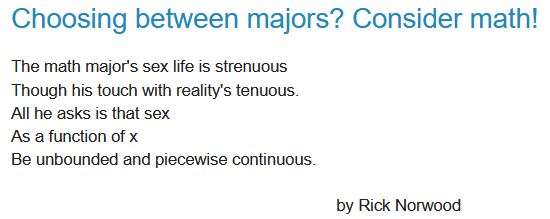
Parody with Limericks

     A limerick is a five-line rhyming verse, usually humorous, often earthy and rude.  Various limericks have appeared previous postings in this blog -- this one comes from the online journal Parody -- Poetry for the world as it really isn't.


I found Norwood's sexist limerick here in a July 2013 posting in ParodyHere is a link to previous postings in this blog of mathy limericks.

Monday, April 12, 2021

Pi-ku Contest in Australia -- deadline Two Pi Day

     Using syllable counts to help to craft poems has been with us since the sonnet and this blog has often presented square poems and Fibs and Pilish and . ..  and today we again focus on the digits of  πOn Pi-Day (3/14) Australia's Cosmos Magazine opened a Pi-Ku Contest which asks for brief Haiku-like poems whose syllables-per-line are counted by the first six digit of the decimal value of  π (Contest information is available at this link.)  Entries must be submitted by 2Pi-Day, or 6/28.

     Here are two mathy samples from the Cosmos contest-information site 

        Learning STEM
        is
        necessary.
        Do
        remember science,
        technology, engineering, maths. 
    by Jennifer Chalmers

        To say safe,
        Keep
        an area
        of
        Pi times one point five
        metres squared around yourself always.
       by Lauren Fuge  

Other poetry forms shaped by the digits of  π include π-ku and Pilish.

Wednesday, April 7, 2021

A Scientist's Math-Poetic Memoir

     Madhur Anand is a poet and a professor of ecology and environmental science at the University of Guelph in Ontario – her work has been noted here in earlier postings in this blog  -- and today I want to introduce readers to her memoir, This Red Line Goes Straight to Your Heart (Penguin Random House, 2020).  

     On the opening page we find these poetic lines:

     Biexponential Function     by Madhur Anand    

     The
     sharpest
     memory
     I have of a
     book from my
     childhood is one
     entitled I Know What
     I Like
.  I remember the    

Monday, April 5, 2021

Mathy Poets plan for 2021 BRIDGES Conference

      The Annual BRIDGES Math-Art Conference will be virtual again this year (August 2-6, 2021) and mathematician-poet Sarah Glaz has developed an online array of poets and poetry to be part of this program.  Bios and sample poems are already available here.

      Participating poets include:  Marian Christie, Carol Dorf, Susan Gerofsky. David Greenslade, Emily Grosholz, JoAnne Growney, Lisa Lajeunesse, Marco Lucchesi, Mike Naylor, Osmo Pekonen, Tom Petsinis, Eveline Pye, Any Uyematsu, Ursula Whitcher -- and, also, these open-mike participants: Susana Sulic, S. Brackert Robertson, Stephen Wren, Marion Deutsche Cohen, Connie Tetteborn, Jacob Richardson, Robin Chapman. Stephanie Strickland.  (Bios and sample poems here.)

     Here is a sample from the BRIDGES poetry program:

Descartes   by Eeva-Liisa Manner
                        translated from the Finnish by Osmo Pekonen

I thought, but I wasn't.
I said animals were machines.
I had lost everything but my reason.  

Wednesday, March 31, 2021

2000 plastic bags in the stomach of a camel!

     When creating a poem, I often find that first choosing a pattern of syllable counts can be very helpful in guiding me into careful word choices.  I have used the Fibonacci numbers as a guide to forming the following lines. Information for these lines has come from a frightening story by Marcus Eriksen  (March 23, 2021 in the Washington Post).   

Save
the
world from
plastics,  Now!
Don't allow more deaths
of desert camels, painful deaths
caused by eating humans' trash within its plastic bags --
chewed plastic not digestible --
causing ulcers and
lots of pain,
leading
to
death.

After a pair of 1's to start the sequence, each succeeding Fibonacci number is the sum of the preceding two numbers:  Above we have (climbing and then reversing):  1, 1, 2, 3, 5, 8, 13, 8, 5, 3, 2, 1, 1.
Monday, March 29, 2021

A Poetry Cube

      Gregory Coxson, professor and researcher in the Department of Electrical and Computer Engineering at the US Naval Academy, is a supporter of integration of the arts with the sciences and enjoys writing poems.  (Here is a link to his previous appearances in this blog.)   Recently Greg has sent me what he calls a CUBE poem (6 stanzas, 6 lines per stanza, 6 syllables per line).   It's FUN to read -- I offer it below:

If I Wrote Poetry     by Gregory Coxson

If I wrote poetry
  It would be efficient,
Stripped-down, like Chinese art,
  Only the sparest lines
Placed by easy habit
  Learned from ten thousand tries    

Tuesday, March 23, 2021

Happy Birthday, Amalie "Emmy" Noether!

      Emmy Noether (1882-1935) is one of my heroes -- and my first posting in this blog, on March 23, 2010, celebrates her -- as do a bunch of other more recent postings.

Above, the epigraph for my poem about Noether, "My Dance is Mathematics."

Sunday, March 21, 2021

UNESCO World Poetry Day

     TODAY, March 21 is UNESCO World Poetry Day:  click on this link for a wealth of information and poetry resources:  UNESCO Creative Cities of Literature join forces to celebrate World Poetry Day 2021 | Creative Cities Network.

"Pure mathematics is, in its way, the poetry of logical ideas." 

--- Albert Einstein

Thursday, March 18, 2021

Probe the gaps between prime numbers . . .

     Each issue of The New Yorker offers poetry, but seldom do the poems link to mathematics.  However, the issue for March 8, 2021 offers us "Number Theory" by poet and translator Rosanna Warren.  Here are a few of its lines:

        . . .   like you, inquisitive.  You sit
       taut in  your chair, whispering, as you probe
       the gaps between prime numbers.  Until infinity.

       It's pattern you seek.  The opening through which
       your thought will glide suddenly into a lit space
       and be at home.   . . .

Here is a link to Warren's complete poem.

Monday, March 15, 2021

Thoughtful Poetic Paradox . . .

     Recently, looking through old piles, I found an article of mine that appeared almost twenty years ago in The Humanistic Mathematics Network Journal -- an article entitled "Journal Review: Third International Anthology on Paradoxism" (a book now available here).  Paradoxism makes heavy use of opposites, as in these examples:

SCAPEGOAT   by Florentin Smarandache (editor of Paradoxism Anthology)

Even if he didn't
he did

MULTIDISCIPLINARY     by Florentin Smarandache

History or art
Or the art of history

ORDER     by Paulo Bauler (Brazil)

Someone with all the reasons is
Somebody with no reason

DISCOVERERS    by Maria do Carmo Gaspar De Oliveira (Brazil)

Portuguese discovered Brazil
Already discovered by Indians

Visit the review -- or, even better, obtain the Anthology -- to read more.

Thursday, March 11, 2021

MATH-GIRL gives us Pi

     Sunday, 3/14, will be Pi-day and I celebrate here with a comment in Pilish from my imagined author MATH-GIRL.  And before the poetic words let me call to attention a non-imaginary story about an amazing woman who calculated trillions of digits of pi.   Go here for an NPR story about the Guinness World Record set by Emma Haruka Iwao

     MATH-GIRL calculates PI

       3.    Now
       1    a
       4    girl --
       1    a
       5    suave
       9    innovator
       2    of
       6    future
       5    style
       3    and
       5    sharp
       8    numeracy --
       9    carefully
       7    fathoms
       9    diameters
       3    for
       2    us.
                 .  .  .

What are the next words that you see for MATH-GIRL? 

Here is a link to several previous Pi-Day/Pilish postings in this blog.

Monday, March 8, 2021

Internat'l Day of the Woman--Name 5 Math-Women!

      Today, March 8, is International Day of the Woman for 2021.  I continue to consider the challenge that I heard offered lots of years ago concerning women in the art world,  Name FIVE.  Each of us who cares about mathematics should be able to name at least five women who made important contributions to the field.  A wonderful resource is this website "Biographies of Women Mathematicians" -- maintained by Larry Riddle of Agnes Scott College that tells of the important lives of math women. 

Here are a few lines that from a poem I wrote that celebrates algebraist Amalie "Emmy Noether" (1882-1935); read more here.

       Emmy Noether's abstract axiomatic view
       changed the face of algebra.
       She helped us think in simple terms
       that flowered in their generality. 

Wednesday, March 3, 2021

Free Minds add, count . . . and . . .

     Free Minds is an organization that uses books, creative writing, and peer support to awaken incarcerated and formerly incarcerated youths and adults to their own potential.  Learn more here about this vital organization -- and reflect on this poem by a Free Minds member:   

     Today’s Mathematics    by JO

      30 minutes of chaos
      Plus 1 Public Pretender
      Plus 1 judge
      Equals 39 years
      16 years, with about 5 of those drug and alcohol-induced
      Produces a very impressionable mind
      Countless days filled with violence
      Equals a whole lot of trauma
      Judaism, Christianity, Islam, Moorish Science, History
      Plus studying mysteries
      Equals a solid understanding
      Empathy plus suffering
      Equals a road to redemption

I found the poem at this link; the Free Minds Book Club and Writing Workshop website posting also offers the opportunity for readers to make comments.

Monday, March 1, 2021

Celebrating Math-Women -- Caroline Herschel

      In the United States, March is National Women's History Month -- and today I am looking back to previous postings that celebrate astronomer and mathematician Caroline Herschel.   In her collection Letters from the Floating World, artist and poet Siv Cedering (1939-2007) has given us a poignant portrait of this math-woman:
 
      Letter from Caroline Herschel
(1750-1848)     by Siv Cedering

     William is away, and I am minding
     the heavens. I have discovered
     eight new comets and three nebulae
     never before seen by man,
     and I am preparing an Index to
     Flamsteed's observations, together with
     a catalogue of 560 stars omitted from
     the British Catalogue, plus a list of errata
     in that publication. William says

     I have a way with numbers, so I handle
     all the necessary reductions and
     calculations. I also plan
     every night's observation
     schedule, for he says my intuition
     helps me turn the telescope to discover
     star cluster after star cluster.                   . . .

The rest of this poem is found here in this posting from 2012.

 Additional poetry that celebrates Herschel may be found at this link.