Monday, January 31, 2022

Math Communicators also are important

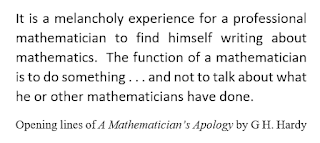
A posting early this month featured the noted Indian mathematician Ramanujan (1887-1920) who was mentored by the British mathematician G. H. Hardy (1877-1947).  In addition to his important achievements in number theory and mathematical analysis, Hardy is well-known for his book, A Mathematician's Apology (Cambridge Univ. Press, 1969).  Here are its opening lines:

Hardy's words seem to echo a phrase I heard long ago --  "if you can't do, teach" -- a phrase that belittles teachers and other communicators.  But now, in the 21st century, this attitude seems to be changing  and perhaps it will continue that we give attention to the work of artists and teachers and writers who share mathematical connections.   Math is important -- SHARE it!

A diamond's beauty                               
          depends on reflection                 
                    of outside light.    

Wednesday, January 26, 2022

Keep Exploring . . .

     In addition to its published magazine, Scientific American has a large variety of blogs.  One of my favorites was Roots of Unity by mathematician Evelyn Lamb.  The blog -- with several hundred postings -- adds to the also-frequent articles that Lamb has contributed to that magazine,  In her posting, "What T. S. Eliot Told Me about the Chain Rule," she quotes these lines from "Little Gidding" by T. S. Eliot (published in Eliot's 1966 collection, Four Quartets) and discusses the outcomes of difficulty and confusion coupled with curiosity, energy, and persistence -- frequent ingredients of the process of learning new mathematics.

     from Little Gidding     by T. S. Eliot (1888-1965)

       We shall not cease from exploration
       And the end of all our exploring
       Will be to arrive where we started
       And know the place for the first time.

Read more at Lamb's blog posting, "What T. S. Eliot Told Me about the Chain Rule."

Thursday, January 20, 2022

Celebrating mathematics with song . . .

     Some of the most memorable links between mathematics and the arts are found in song-lyrics.  For example, "That's Mathematics" by retired American musician, singer-songwriter, satirist, and mathematician   Tom Lehrer (now aged 93):  Here is the opening stanza (the complete lyrics are found at this link):

    Counting sheep
    When you're trying to sleep
    Being fair
    When there's something to share
    Being neat
    When you're folding a sheet
    That's mathematics!             More mathy lyrics (by Lehrer and others) are found here.

     A current math educator offers us lots more lyrics to learn from and enjoy; from Larry Lesser -- a professor at the University of Texas in El Paso -- is a long-time creator of math-music works.  Here's a link to a list.

 This blog also has previously published lots of Lesser's fine work; here's a link.

Monday, January 17, 2022

Eyes on the Prize

     Today, the 3rd Monday in January, we celebrate the birthday of civil rights leader, Rev Martin Luther King, Jr,, (1929-1968) -- and I have been refreshing my memory of his courageous activity by watching episodes of the award-winning television series about civil rights struggles in the US, "Eyes on the Prize."

Here, in King's words (from his 1957 book, Stride Toward Freedom):

       If
       you
       can't fly
       then run, if
       you can't run then walk,
       if you can't walk then crawl, but what-
       ever you do you have to keep moving forward . . .

Download of a pdf of Stride Toward Freedom is available here.
    Previous postings in this blog featuring Martin Luther King may be found here.

Thursday, January 13, 2022

+ plus magazine . . . living mathematics

     One of the very fine sources of interesting and new ideas from mathematics is +plus magazine -- available since 1997 from the University of Cambridge --  at this link.  Way back in 2010 they featured a Fib from this blog (at this link) and they have been generous in their mentions of Strange Attractors:  Poems of Love and Mathematics (A K Peters/CRC Press, 2008), edited by Sarah Glaz and me.  They also have introduced (at this link) a wonderful collection of scientific Haiku (SCIKU  Icon Books, 2014) -- edited by Simon Flynn, written by students at the Camden School for Girls.  Here are two samples from that collection:

          Gravity

               An attractive force
               Between all objects with mass
               Just like you and me.

          Dissolving confusion


               To some, solutions
               Are answers; to chemists they
               Are still all mixed up.


Enjoy exploring this innovative online mathy magazine.

Tuesday, January 11, 2022

Write to learn ... follow constraints ... find poems

     Some people (myself included) take lots of notes during a lecture or other program -- for it seems that the physical activity of placing the words on the page is part of the process of installing the ideas in memory.  For me, also, the creation of a paragraph or a poem depends on the teamwork of hands and brain.

     One of the ways that poets engage themselves in creating new thoughts is by accepting the guidance of formal constraints -- creating the fourteen lines of a sonnet or the nineteen lines of a villanelle with strict patterns of rhythm and rhyme and repetition.  Below I consider the question of what I want for my birthday  --  and use that in my struggle to write a sonnet:

You asked me
      for a birthday gift suggestion . . . 
by JoAnne Growney    

Thursday, January 6, 2022

Mathematics gives our world its shape . . . fractals

     Poet Robin Chapman and Julien Clinton Sprott both were professors at the University of Wisconsin-Madison when their art-poetry collection  Images of a Complex World -- The Art and Poetry of Chaos first appeared (World Scientific Publishing, 2005) -- and now both are emeritus professors: Chapman in the Department of Communication Studies and Disorders and Sprott in the Department of Physics.  Here is one of the poems from that collection: 

          Bifurcations     by Robin Chapman

           This is the path that pitchforks
           in the yellow wood -- the one
           where you wanted to travel both,
           science and poetry,
           physics and art,
           and so bounced unpredictably back and forth,
           taking each as far as you could.

Notes:  The pitchforking path in the opening lines draws my thoughts to Robert Frost's poem, "The Road Not Taken." A bifurcation is, in general, a division of a structure into two parts. But when it happens over and over, things might change from patterned to chaotic . . .  Here is a link to earlier postings in this blog on fractals and chaos; here is a link to previous postings of poems by Robin Chapman.  This link leads to discussion of "bifurcation" at WolframMathWorld.  On page 82 of the art-poetry collection by Chapman and Sprott is this comment about the term:  There are dozens of different types of bifurcations, and they represent an active area of current research.  Below (and appearing on page 83 of the collection) is the following illustration:
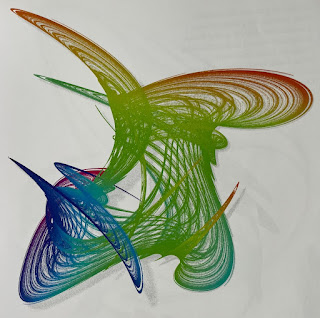
In the preface to Images of a Complex World -- The Art and Poetry of Chaos, Sprott describes his process of choosing mathematical patterns and colors that would appeal to the human eye and Chapman offers insight into the inspirations for her poems.
Monday, January 3, 2022

India's National Math Day -- Poetic Quotes

     A recent math holiday that I remembered after it had passed is National Mathematics Day in India -- held on December 22 and celebrating the birth anniversary of Indian mathematician Srinivasa Ramanujan (1870-1920).   (An interesting math-item from India is the claim that the first recorded use of zero occurred there.)

     Ramanujan is celebrated in a poem by Jonathan Holden.  Its opening lines: 

Holden's complete poem is found here in this posting from 2/19/2011.

Friday, December 31, 2021

Year-end Counting -- with Gratitude

     Year
     ends.
     I count --
     and count on --
     mathy poems shared
     here by countless poets. THANK YOU!

Monday, December 27, 2021

Amid uncertainties -- compose a Fib

How many Corona-virus cases will the new year bring?

Stop,
Think!       
Wonder
What to say . . .
I gather my thoughts
and hope I can make a poem.

Monday, December 20, 2021

Christmas is coming . . .

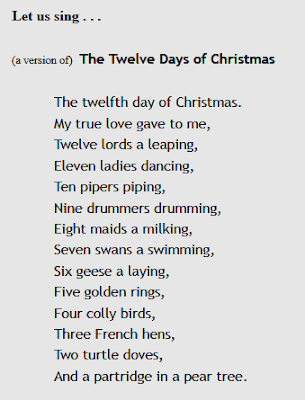
     This morning I did a blog search to see which of my previous posts included the word "Christmas" -- and this link leads to the results.  And, for me as for many, a very familiar favorite (also posted back in December 2015) -- linking Christmas and numbers -- is this:

This Wikipedia link offers some history of this song.

Wednesday, December 15, 2021

One-sentence Poems

     Recently I came across the website onesentencepoems.com and, enjoying the items' brevity, I did some browsing -- and term-searching -- looking for mathy poems.  Here are two samples by teacher and poet Jeffrey Park -- originally from Baltimore, now a teacher in Germany.

By Degrees   

She always sleeps with protractor and compass
on the bedside table, never knowing when
a sudden fit of geometry will strike in the night.

Numeric

Numbers pelt down from an infinite sky, neither irrational nor imaginary,
the angular ones, 4s and 7s, doing maximum damage.

These one-sentence poems -- and another --  by Jeffrey Park are found online here.

Monday, December 13, 2021

Mathematician with the Soul of a Poet

      One of my long-time math-poetry connections has been with math-teacher-artist-writer Sandra DeLozier Coleman (This link leads to her prior appearances in this blog.)  Coleman has had a long-term interest in the Russian mathematician-and-poet Sofia Kovalevskaya (1850-1891) and has recently published Mathematician with the Soul of a Poet -- Poems and Plays of Sofia Kovalevskaya  (Bohannon Hall Press, 2021, available here from amazon.com); this volume that contains Coleman's translations from Russian along with background and thoughtful commentary.  The opening section of the book begins with these words from Kovalevskaya:

     I understand that you are surprised I can work at the same time
     in both literature and mathematics.  Many who have not had the 
     chance to learn more about mathematics confuse it with arithmetic
     and consider it to be a dry and arid science.  In truth, however,
     this science requires the greatest imagination, and one of the most
     respected mathematicians of our century has very rightly said
     that it is not possible to be a great mathematician without having
     the soul of a poet.                                                     S V. Kovalevskaya

Thank you, Sandy Coleman, for sharing Kovalevskaya's words with us!

Wednesday, December 8, 2021

STEM Writing Contests -- reminders . . .

WRITING deepens UNDERSTANDING!

For the reason above -- and for the possibility of winning recognition and prizes --  please consider the following contests.

The NYTimes has announced its 3rd annual STEM Writing Contest -- information is found here and 500-word submissions are invited during the period Feb 2-March 9, 2022.

To increase awareness of women’s ongoing contributions to mathematics, the Association for Women in Mathematics and Math for America are cosponsoring an essay contest for biographies based on interviews of math-women working in or retired from mathematical careers. The contest is open to students in Grades 6–8, Grades 9–12, and Undergraduate.  For more information, please visit the contest webpage or  contact the organizer, Dr. Johanna Franklin, at johanna.n.franklin (at) hofstra.edu.   The submission deadline is February 1, 2022.