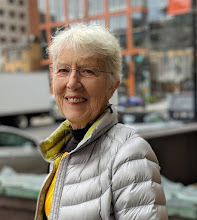
Colonel Stacey K. Vargas is a professor of Physics at the Virginia Military Institute. I found her poem -- with its vicious circles -- in the wonderful and provocative anthology, Raising Lilly Ledbetter: Women Poets Occupy the Workspace, edited by Carolyne Wright, M. L. Lyons, and Eugenia Toledo (Lost Horse Press, 2015).
Circle of Silence by Stacey K. Vargas
Like an electron trapped in an unstable orbit, I am seated in a circle of powerful men.
In an awkward moment small talk ends and the meeting abruptly begins.
The superintendent turns to me and says, "This was not sexual harassment."
I turn to the inspector general and say, "After everything you heard in this investigation,
you find this acceptable?"
The inspector general turns to my department head but remains silent.
Friday, March 10, 2017


Wednesday, March 8, 2017
Honor Math-Women ...
The first math-woman that inspired me was Laura Church; the first famous math-woman (someone with a theorem named after her) whom I came to admire -- and write a poem about -- was Emmy Noether (1882-1935). As a recent film featuring NASA mathematician, Katherine Johnson, points out, math-women are:
Hidden figures:
women no one
notices are
changing the world.
Other living mathematicians who deserve to be more well-known include:
Maryam Mirzakhani,
an Iranian mathematician at Stanford who in 2014 won the prestigious Fields Medal for her work related to the symmetry of curved surfaces.Moon Duchin, a Tufts University professor who is using geometry to fight gerrymandering.
Cathy O'Neil, a data scientist (and blogger at mathbabe.org) whose recent book Weapons of Math Destruction helps readers to understand the roles (and threats) of big data in our society.
TODAY is the International Women's Day!
Celebrate the day by getting to know some math-women. Try for ten. Learn their names, read their bios. Here are two websites that can help:
Monday, March 6, 2017
The Geometry of Wood
A recent email from Todd Sformo, a biologist living in Barrow, Alaska, alerted me to his prose poem "Knots" in the online publication Hippocampus Magazine; a sample from "Knots" is offered below.
Sformo's poem, which offers vivid descriptions of geometric patterns in wood, uses as epigraph several sentences from the Polish mathematician Stanislaw M Ulam (1909-1984). (Ulam was involved in the wartime Manhattan Project and in the design of thermonuclear weapons.)
Sformo's poem, which offers vivid descriptions of geometric patterns in wood, uses as epigraph several sentences from the Polish mathematician Stanislaw M Ulam (1909-1984). (Ulam was involved in the wartime Manhattan Project and in the design of thermonuclear weapons.)
When I was a boy, I felt that the role of rhyme in poetry
was to compel one to find the unobvious
because of the necessity of finding a word which rhymes.
Tuesday, February 28, 2017
Zero is three!
February's second weekend was a busy one with the AWP Writer's conference in downtown Washington, DC -- and one of the special treats of that weekend was browsing the Book Fair, renewing connections and finding special books. One of my great finds was the bilingual collection of Jean Cocteau's Grace Notes (The Word Works, 2017), translated by Mary-Sherman Willis. Cocteau surely is a challenge for translators as he plays with with connections between disparate images; in the poem I offer below I much enjoyed the mathy connections -- person and number, three and zero, triangle and oval, and so on.
Thursday, February 23, 2017
The Geometry of Poetry
Some poems lie around for A LONG TIME waiting for me to pick them up. Or I pick them up and put them down in a special place and then place something else on top of them. Such is the case with Janet Kirchheimer's "The Geometry of Poetry" -- several years ago Janet and I corresponded and then I didn't follow through with posting her poem. And now, this week, I am working on a paper for Bridges 2017 -- a math-arts conference to be held in Waterloo, Ontario at the end of July -- and my working title is the same as the title of Janet's poem. AND, this coincidence helped me to FIND her poem to give you to enjoy.
I first read "The Geometry of Poetry" by Janet R. Kirchheimer online in Poemeleon -- and her work also has appeared in many other journals, anthologies and websites. She is currently
producing AFTER, a film that explores poetry written about the Holocaust. Thanks, Janet, for this poem with its mathy comparisons.
The Geometry of Poetry by Janet R. Kirchheimer Tuesday, February 21, 2017
An old link but a GOOD one!
Today I have been working on some ideas for a paper for the 2017 BRIDGES Math-Arts Conference and I have needed to refer back to an old paper of mine, "Mathematics in Poetry," that I wrote for MAA's JOMA more than 10 years ago -- a survey article that introduces a variety of viewpoints and examples. Enjoy!
Thursday, February 16, 2017
The Infinite
On page 53 of the February 6 issue of The New Yorker I recently found and enjoyed a poem entitled "The Infinite" by Charles Simic. Here are its opening lines:
The infinite yawns and keeps yawning.
Is it sleepy?
Does it miss Pythagoras?
The infinite yawns and keeps yawning.
Is it sleepy?
Does it miss Pythagoras?
Monday, February 13, 2017
Love and Mathematics -- and Valentine's Day
Perhaps you need a love poem for a mathematician, or about a mathematician -- you might enter the words love and mathematician in the search box to the right and find what this blog has to offer. And here is a link to previous postings that celebrate Valentine's Day. Enjoy!!
Read it (math OR poem) more than once . ..
Recently my poet-friend, Millicent Borges Accardi, sent me a copy of her latest book, Only More So (Salmon Poetry, 2016). She mentioned a poem entitled "The Night of Broken Glass" for its mathematics -- indeed it includes several numbers as it movingly describes attempts at normalcy amid the horrors of urban attack; and it ends with this stanza :
The essential business of living well
Continues in shock waves
That fall into the ground of innocent
People, triggered inside a soul
Of nothingness that pretended
To solve an impossible equation.
My favorite poem in Accardi's collection is "Amazing Grace" which I give you below. It is a poem that, like an intriguing piece of mathematics, I have read, and read again, and again . .. each time getting more meaning than the time before.
For me, one of the similarities of poetry and math is their density, the need for several readings -- for reading both aloud and silently, for reading with pencil and paper for note-taking, for reading in the library and at the kitchen table, sitting or standing.
The essential business of living well
Continues in shock waves
That fall into the ground of innocent
People, triggered inside a soul
Of nothingness that pretended
To solve an impossible equation.
My favorite poem in Accardi's collection is "Amazing Grace" which I give you below. It is a poem that, like an intriguing piece of mathematics, I have read, and read again, and again . .. each time getting more meaning than the time before.
For me, one of the similarities of poetry and math is their density, the need for several readings -- for reading both aloud and silently, for reading with pencil and paper for note-taking, for reading in the library and at the kitchen table, sitting or standing.
Thursday, February 9, 2017
Like James Baldwin - refuse labels!
Last Sunday evening -- instead of watching Super Bowl LI -- in a crowded theater in downtown Silver Spring I watched the recently-released documentary "I Am Not Your Negro," narrated using words of writer James Baldwin (1924-1986). Baldwin was a contrarian, he avoided or contradicted labels and categories.
One of my favorite quotes -- that I see as intimately related to discovery in mathematics (from Hungarian-American Nobelist, Albert Szent-Gyorgyi (1893-1986)) -- applies also to Baldwin:
Discovery is seeing
what everybody else has seen, and thinking
what nobody else has thought.
And here, from Jimmy's Blues & Other Poems (Beacon Press, 2014) is Baldwin's little poem "Imagination" which captures the same sort of mind-play that occurs with mathematics.
One of my favorite quotes -- that I see as intimately related to discovery in mathematics (from Hungarian-American Nobelist, Albert Szent-Gyorgyi (1893-1986)) -- applies also to Baldwin:
Discovery is seeing
what everybody else has seen, and thinking
what nobody else has thought.
And here, from Jimmy's Blues & Other Poems (Beacon Press, 2014) is Baldwin's little poem "Imagination" which captures the same sort of mind-play that occurs with mathematics.
Monday, February 6, 2017
Celebrate Francis Su
In this morning's email I got a link (Thanks, Greg Coxson!) to this story that celebrates the talented mathematician and compassionate human being, Francis Su. Dr Su (of Harvey Mudd College) has recently completed a term as president of the Mathematical Association of America. Here is a link to Dr Su's retiring presidential address -- for which he received a standing ovation. Read. Learn. Admire. Celebrate. Imitate!
Scrolling down in this blog to my posting for January 11, 2017 will lead you to links to several poems that celebrate mathematicians. And a blog-SEARCH using "mathematician" will find even more such poems. Enjoy!
A thorough advocate in a just cause,
a penetrating mathematician facing the starry heavens,
both alike bear the semblance of divinity.
-- Goethe (1749-1832)
Scrolling down in this blog to my posting for January 11, 2017 will lead you to links to several poems that celebrate mathematicians. And a blog-SEARCH using "mathematician" will find even more such poems. Enjoy!
A thorough advocate in a just cause,
a penetrating mathematician facing the starry heavens,
both alike bear the semblance of divinity.
-- Goethe (1749-1832)
Thursday, February 2, 2017
Groundhog Day 2017
My scan of this morning's Washington Post did not find a mention of today's important status as Groundhog Day -- and I am worried that perhaps the new President 45 has banned these useful creatures. If you wish, you may search this blog for postings related to Groundhog Day and, if you do, you can get these results. Enjoy!
Tuesday, January 31, 2017
Life is Short
These recent days in the reign of the 45th US President have given new drama to the word survival. Looking for wisdom I revisited this poem, a survival-poem with a couple of numbers -- by Maggie Smith -- found at one of my favorite sources for poetry, PoetryFoundation.org.
Good Bones by Maggie Smith
Life is short, though I keep this from my children.
Life is short, and I’ve shortened mine
in a thousand delicious, ill-advised ways,
a thousand deliciously ill-advised ways
I’ll keep from my children. The world is at least
fifty percent terrible, and that’s a conservative
estimate, though I keep this from my children.
Good Bones by Maggie Smith
Life is short, though I keep this from my children.
Life is short, and I’ve shortened mine
in a thousand delicious, ill-advised ways,
a thousand deliciously ill-advised ways
I’ll keep from my children. The world is at least
fifty percent terrible, and that’s a conservative
estimate, though I keep this from my children.
Sunday, January 29, 2017
Girls can do EVERYTHING!
In a conversation years ago with one of my math colleagues at Bloomsburg University, each of us learned that the other had grown up on a farm. My colleague credited the problem-solving requirements of farm-life with being good training for mathematics. In time, I came to agree with him. Some environments EXPECT you to be a problem-solver and, in spite of yourself, you comply. I have tried to write poetically about this. My efforts so far include these 3x3 syllable-square poems.
And, here is a link to a recent NPR story about the underestimates that girls make about how smart they are -- so little has changed since I was a girl. Hoping I can help to change things for my granddaughters!
Girls who change
light-bulbs change
everything!
Girls who prove
theorems can
do it all!
And, here is a link to a recent NPR story about the underestimates that girls make about how smart they are -- so little has changed since I was a girl. Hoping I can help to change things for my granddaughters!
Thursday, January 26, 2017
Ultimately, all mathematics is poetry . . .
A popular vote on the truth of "all mathematics is poetry" might not lead to its affirmation. Because mathematics is a concise language, with emphasis on placing the best words in the best order, it often is described by mathematicians and scientists as poetry. Alternatively, and more accessible to most readers than poetic mathematics, we find verses by poets who include the objects and terminology of mathematics in their lines.
Perhaps due to aesthetic distance (featured in The Art of Mathematics by Jerry King), non-math poets like Christina M. Rau are able to be more playful in their uses of mathematical vocabulary than mathematicians dare to be. Enjoy below several stanzas from Rau's collection, Liberating the Astronauts -- which also includes titles like "Chasing Zero" and "Kepler's Laws" -- soon to be released by Aqueduct Press.
from: Overnight Rain by Christina M. Rau
Rain over Night
Equals
X over Autumn
Perhaps due to aesthetic distance (featured in The Art of Mathematics by Jerry King), non-math poets like Christina M. Rau are able to be more playful in their uses of mathematical vocabulary than mathematicians dare to be. Enjoy below several stanzas from Rau's collection, Liberating the Astronauts -- which also includes titles like "Chasing Zero" and "Kepler's Laws" -- soon to be released by Aqueduct Press.
from: Overnight Rain by Christina M. Rau
Rain over Night
Equals
X over Autumn
Monday, January 23, 2017
All Mathematicians are Equal!
Last Saturday's Women's March in Washington was one the great events of my lifetime -- the feeling of community that bonded us participants was palpable. We chatted and hugged and celebrated our differences and our common ideals. Here is a photo of the sign that I carried and, beneath the sign, are links to poems about women in mathematics who struggled to be considered equal.
This link leads to "Hanging Fire" by Audre Lorde. This link leads to a few words of mine, "Square Attitudes." A posting on girls and mathematics includes samples from Sharon Olds and Kyoko Mori and is available here.
 |
| This is the sign I carried at the Women's March on January 21, 2017. |
This link leads to "Hanging Fire" by Audre Lorde. This link leads to a few words of mine, "Square Attitudes." A posting on girls and mathematics includes samples from Sharon Olds and Kyoko Mori and is available here.
Subscribe to:
Posts (Atom)

 Posts
Posts