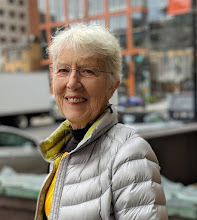
Today, March 23, 2015, Google celebrates the 133rd birthday of mathematician Emmy Noether. In support of the celebration here is a link to "My Dance is Mathematics," a poem I wrote to honor this pioneering mathematician. I hope that celebrations of Noether and other math-women will help to create a world in which these lines from my poem about her are no longer true:
If a woman's dance is mathematics,
she dances alone.
Monday, March 23, 2015


Sunday, March 22, 2015
March 21 -- World Poetry Day
Yesterday poetry was celebrated around the world -- the Guardian reported the event with mention of Cafés around the world that offered a cup of coffee in exchange for a poem. The occasion caused me to turn to one of my favorite international collections, The Horse Has Six Legs (Graywolf, 2010) -- an anthology of Serbian poetry translated and edited by poet Charles Simic. On 29 April 2011 I posted "Forgetful Number" by Yugoslav poet Vasko Popa (1922-1991) -- and here is another of Popa's poems. This one is part of a cycle of poems about "the little box" and it involves recursion.
Last News about the Little Box by Vasko Popa
The little box that contains the world
Fell in love with herself
And conceived
Still another little box.
Last News about the Little Box by Vasko Popa
The little box that contains the world
Fell in love with herself
And conceived
Still another little box.
Thursday, March 19, 2015
Multiplied by Rain
There are many mathematical terms that are used in daily life -- not only multiplied and divided and negative but also closure and identity and field and commute -- and it is fun for me, a math person, to see poets use such terms in new and thoughtful ways.
Poet Jane Hirschfield weaves words into fine tapestries that give us new dimensions of meaning. The Table of Contents of her new book, The Beauty (Knopf, 2015), is scattered with mathematical terms -- we find zero, plus, subtraction, and the final title, "Like Two Negative Numbers Multiplied by Rain." This poem first appeared in Poetry (2012) and is available at the Poetry Foundation website along with more than thirty additional Hirshfield poems.
Like Two Negative Numbers Multiplied by Rain b
Lie down, you are horizontal.
Stand up, you are not.
Poet Jane Hirschfield weaves words into fine tapestries that give us new dimensions of meaning. The Table of Contents of her new book, The Beauty (Knopf, 2015), is scattered with mathematical terms -- we find zero, plus, subtraction, and the final title, "Like Two Negative Numbers Multiplied by Rain." This poem first appeared in Poetry (2012) and is available at the Poetry Foundation website along with more than thirty additional Hirshfield poems.
Like Two Negative Numbers Multiplied by Rain b
Lie down, you are horizontal.
Stand up, you are not.
Tuesday, March 17, 2015
A Russian toast (with mathematics)
Several weeks ago I had the pleasure of visiting the Washington Museum of Poetry and Music -- a collection in Rockville, MD gathered and maintained in the home of Uli Zislin
who has lived in the US since 1996. (Among other treasures, the musuem has recordings of poets Anna Akhmatova, Boris Pasternak, Osip
Mandelstam, and Anastasia Tsvetaeva.) At the time of my visit, Zislin
presented me with one of his own poems that includes a bit of mathematics.
The original Russian version of Zislin's poem is at the bottom of this
post. Prior to that I offer a translation into English by Arlington poet,
teacher, and award-winning Russian translator, Katherine Young. Thank you, Katherine.
A Pedagogical Toast by Uli Zislin
translated by Katherine E. Young
Friends and colleagues, pedagogues!
We’re not philosophers, not gods.
We’re simply people, soldiers of God,
destined to suffer and to love.
A Pedagogical Toast by Uli Zislin
translated by Katherine E. Young
Friends and colleagues, pedagogues!
We’re not philosophers, not gods.
We’re simply people, soldiers of God,
destined to suffer and to love.
Friday, March 13, 2015
Three Greguerías
From Portugal, from Francisco -- who emailed me the gift of these lines:
Three Greguerías by Rámon Gómez de la Serna (1888-1963)
translated by Francisco J Craveiro de Carvalho and JoAnne
Holding her hoop the little girl goes to school and to the playground,
to play with the circle and its tangent.
Zeros are the eggs from which all the other numbers are hatched.
Numbers are the best acrobats in the world: they stand on top of each other without falling down.
Ramón Gómez de la Serna is considered the father of the greguería -- a one-liner in which he combined gentle humor with a metaphor.
Three Greguerías by Rámon Gómez de la Serna (1888-1963)
translated by Francisco J Craveiro de Carvalho and JoAnne
Holding her hoop the little girl goes to school and to the playground,
to play with the circle and its tangent.
Zeros are the eggs from which all the other numbers are hatched.
Numbers are the best acrobats in the world: they stand on top of each other without falling down.
Ramón Gómez de la Serna is considered the father of the greguería -- a one-liner in which he combined gentle humor with a metaphor.
Tuesday, March 10, 2015
Similar, self-similar -- fractals, a poem
In geometry two objects are said to be similar if they have the same shape --- which happens if their angles are the same size and occur in the same sequence. For example, any pair of triangles with angles 30, 60, and 90 degrees are similar; also, the lengths of pairs of corresponding sides of these triangles have the same ratio.
A term used in the terminology of fractals is self-similarity: a self-similar object has exactly (or approximately) the same shape as a part of itself. A variety of objects in the real world, such as ferns and coastlines, are approximately self-similar: parts of them show the same statistical properties at many scales. At the end of this post are a couple of diagrams that illustrate how a fractal may be developed. But first, experience the generative beauty of self-similarity via a poem by Maryland poet Greg McBride. Mathematician Benoit Mandelbrot (1924-2010), quoted in McBride's epigraph, often is nicknamed "the father of fractals."
A term used in the terminology of fractals is self-similarity: a self-similar object has exactly (or approximately) the same shape as a part of itself. A variety of objects in the real world, such as ferns and coastlines, are approximately self-similar: parts of them show the same statistical properties at many scales. At the end of this post are a couple of diagrams that illustrate how a fractal may be developed. But first, experience the generative beauty of self-similarity via a poem by Maryland poet Greg McBride. Mathematician Benoit Mandelbrot (1924-2010), quoted in McBride's epigraph, often is nicknamed "the father of fractals."
Saturday, March 7, 2015
The mathematician, she . . . .
Tomorrow, March 8, is the International Day of the Woman -- and I celebrate the day with mixed feelings. YES, there are many women I want to celebrate. BUT WHY are they not celebrated daily, equally with men? And a more specific concern, WHY, when the word "mathematician" is used, is the person assumed to be a man. (There is, on the other hand, a nice non-gendered neutrality in numbers -- as in this first stanza of "Numbers," by Mary Cornish, found below.)
In this posting I celebrate Grace Brewster Murray Hopper (1906-1992) -- a mathematician with a doctorate from Yale, a navy admiral, a computer scientist who led in the development of COBOL, an early (c.1959) programming language. A person I had the good fortune to meet when she visited Bloomsburg University in 1984 to receive an honorary Doctor of Science Degree. Hopper was imaginative and articulate; here is some poetry found in her words.
If it's a
good idea,
do it.
In this posting I celebrate Grace Brewster Murray Hopper (1906-1992) -- a mathematician with a doctorate from Yale, a navy admiral, a computer scientist who led in the development of COBOL, an early (c.1959) programming language. A person I had the good fortune to meet when she visited Bloomsburg University in 1984 to receive an honorary Doctor of Science Degree. Hopper was imaginative and articulate; here is some poetry found in her words.
If it's a
good idea,
do it.
Friday, March 6, 2015
Celebrate Pi -- write in Pilish
On 3/14/15 many of us will celebrate π - day; for those who like to gaze on the digits of π, one hundred thousand of them are available here. In honor of this upcoming special day I have composed a small stanza in Pilish (the language whose word-lengths follow the digits of π ).
3. 1 4
Get a list,
1 5
I shout,
9 2 6 5 3 5
Tuesday, March 3, 2015
Women in Maths -- on Facebook
Recently I prepared an item for Rachel Levy's Grandma Got STEM blog that told a bit about my granddaughters who like math. My preparation for that posting led me to focus on my wish to have math be a fun place for girls to hang out -- a place for lots of girls: feminine girls, sporty girls, popular girls, silly girls (as well as geek girls). Mathematics has mostly been a lonely place for females -- my first girl-friend who was also a math person was a colleague whom I met in my 40s (see my poem for Toni, "Girl-Talk"). I want mathematics to be a welcoming place for my granddaughters. A place with friends.
Related to this concern, wonderful news came in my email box recently from Susanne Pumpluen (video) at the University of Nottingham. She has started a Women in Maths page on Facebook . There one can find bios, videos, news links and FRIENDS. Visit. LIKE. Offer your comments and support.
Related to this concern, wonderful news came in my email box recently from Susanne Pumpluen (video) at the University of Nottingham. She has started a Women in Maths page on Facebook . There one can find bios, videos, news links and FRIENDS. Visit. LIKE. Offer your comments and support.
Saturday, February 28, 2015
Reflections on Logic
Miroslav Holub (1923-1998), Czech poet and immunologist who excelled in both endeavors, is one of my favorite poets. He combines scientific exactitude with empathy and absurdity. Here is a sample:
Brief Reflections on Logic by Miroslav Holub
translated by Stuart Friebert and Dana Habova
The big problem is everything has
its own logic. Everything you can
think of, whatever falls on your head.
Somebody will always add the logic.
In your head or on it.
Brief Reflections on Logic by Miroslav Holub
translated by Stuart Friebert and Dana Habova
The big problem is everything has
its own logic. Everything you can
think of, whatever falls on your head.
Somebody will always add the logic.
In your head or on it.
Subscribe to:
Posts (Atom)

 Posts
Posts