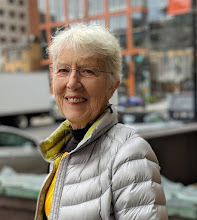
One thing leads to another . .. . poet Amy Eisner connected me to mathematician Jordan Ellenberg who knew of Easy Math (Sarabande Books, 2013) by Lauren Shapiro -- and Lauren gave me permission to post her "Bent Syllogism."
Bent Syllogism by Lauren Shapiro
There was a pattern to the way the mythical beasts
flew over the dreary town, but we were too dreary
to understand it. The psychologist, too, was in touch
with extraterrestrials, but she had to stand on the spire
of a church and wear 3-D glasses to see them.
Thursday, November 7, 2013


Tuesday, November 5, 2013
Love mathematics!
In the stanzas below, I have some fun with math terminology. Hope you'll enjoy it too.
Love! by JoAnne Growney
Love algebra! Through variable numbers
of factored afternoons and prime evenings,
party in and out of your circle of associates,
identify your identity, meet your inverse.
Love! by JoAnne Growney
Love algebra! Through variable numbers
of factored afternoons and prime evenings,
party in and out of your circle of associates,
identify your identity, meet your inverse.
Sunday, November 3, 2013
Neruda speaks of numeration
The collection, Late and Posthumous Poems, 1968-1974 (Grove Press, 1988) by Chilean Nobelist Pablo Neruda (1904-1973) offers to readers a collection of Neruda's later work, ably translated by Ben Belitt. Here is a poem that explores the vast world opened by the invention of numeration.
28325674549 by Pablo Neruda
A hand made the number.
It joined one little stone
to another, one thunderclap
to another,
one fallen eagle
to another, one
arrowhead to another,
and then with the patience of granite
the hand
made a double incision, two wounds,
and two grooves: and a
number was born.
28325674549 by Pablo Neruda
A hand made the number.
It joined one little stone
to another, one thunderclap
to another,
one fallen eagle
to another, one
arrowhead to another,
and then with the patience of granite
the hand
made a double incision, two wounds,
and two grooves: and a
number was born.
Thursday, October 31, 2013
On poetry and geometric truth . . .
On poetry and geometric truth
And their high privilege of lasting life,
From all internal injury exempt,
I mused; upon these chiefly: and at length,
My senses yielding to the sultry air,
Sleep seized me, and I passed into a dream.
William Wordsworth (1770-1850)
from The Prelude, Book 5
Tuesday, October 29, 2013
From order to chaos -- a sonnet
Fractals by Diana Der-Hovanessian
Euclid alone has looked on beauty bare
--Edna St. Vincent Millay
Euclid alone began to formulate
the relation of circle, plane and sphere
in equations making it quite clear
that symmetry is what we celebrate.
Euclid alone has looked on beauty bare
--Edna St. Vincent Millay
Euclid alone began to formulate
the relation of circle, plane and sphere
in equations making it quite clear
that symmetry is what we celebrate.
Saturday, October 26, 2013
Two cultures
The opening poem of Uneasy Relations by mathematician-poet Michael Bartholomew-Biggs is concerned with similarities and differences between mathematical and poetic cultures -- a topic of immense interest also to me and one that I too try to address in my verse. I wonder -- HOW can I show non-mathematicians that good mathematics is poetry??!! And, moreover, how can I (mostly a mathematician) write (as advocated by Wallace Stevens and agreed with by other poets) of things rather than (as mathematics wants) of ideas. OR, may one make poetry of ideas?
Two Cultures by Michael Bartholomew-Biggs
Graves claimed there isn't
much money in poetry:
and none vice-versa.
The first part stays true
if we replace poetry
by mathematics.
Two Cultures by Michael Bartholomew-Biggs
Graves claimed there isn't
much money in poetry:
and none vice-versa.
The first part stays true
if we replace poetry
by mathematics.
Tuesday, October 22, 2013
Two-line poems -- Landays -- from Afghanistan
Celebrate Activist Poetry -- At Nov. 1 Event
BE THERE on November 1, 2013 at the Goethe-Intitut in Washington DC when poet and journalist Eliza Griswold is honored with the Split this Rock Freedom Plow Award (register here for this important event) for Poetry and Activism for her work collecting and introducing the folk poems of Afghan women to America. The June issue of Poetry Magazine is entirely dedicated to landays -- two-line poems by Afghan women that capture dark, funny, and revealing moments that few outsiders ever witness. (Edited and introduced by Griswold, the poems are magnificently supplemented by photographs by Seamus Murphy.)
Here are three landays from Griswold's Poetry collection, each selected for inclusion here because it includes at least one number:
Monday, October 21, 2013
Topology for poets
The title of this posting ("Topology for Poets") comes from Maryland Poet Amy Eisner's poem "Lure" (offered below) -- a poem that plays with math concepts. (In mathematics, "topology" is a variant of geometry in two shapes are "equivalent" if one could be obtained from the other by stretching or bending.)
It was my pleasure to meet Amy when she read in the Takoma Park Third Thursday Poetry Series earlier this year. I like her work. Enjoy!
Lure by Amy Eisner
1.
My friend is crocheting a fishing line. This is not a gift and keeps no one warm.
This is withdrawing. Persisting in a flaw. Forfending.
She knows there’s something perverse in it. Like growing a mold garden.
Fishing does involve a hook, a line, and a net. But not like this.
It was my pleasure to meet Amy when she read in the Takoma Park Third Thursday Poetry Series earlier this year. I like her work. Enjoy!
Lure by Amy Eisner
1.
My friend is crocheting a fishing line. This is not a gift and keeps no one warm.
This is withdrawing. Persisting in a flaw. Forfending.
She knows there’s something perverse in it. Like growing a mold garden.
Fishing does involve a hook, a line, and a net. But not like this.
Friday, October 18, 2013
Mathematics of love . . .
"Mathematics of Love" is the title poem of a collection by John Edwin Cohen (1941-2012), published in 2011 by Anaphora Literary Press and presented here with press permission. Cohen has used mathematics playfully and does what a mathematician never dares to do, use a mathematical term with other than its precise meaning. Still, perhaps, even math folks may enjoy this application of geometric shape and poetic license!
Mathematics of Love by John Edwin Cohen
1.
Engine of joy
arithmetic and sincere
holding the hemisphere
and geometry of
youth
Mathematics of Love by John Edwin Cohen
1.
Engine of joy
arithmetic and sincere
holding the hemisphere
and geometry of
youth
Tuesday, October 15, 2013
Circle Power
Everything the Power of the World does is done in a circle
by Black Elk (1863-1950) (translated from Sioux)
Everything the Power of the World does
is done in a circle. The sky is round,
and I have heard that the earth is round
like a ball, and so are all the stars.
The wind, in its greatest power, whirls.
Monday, October 14, 2013
"My Proteins"
The mysteries of science are sometimes explored in poems and, in this vein, I was delighted to find "My Proteins" by Jane Hirshfield (a poet whose work I like and admire) on page 56 of the September 16, 2013 issue of The New Yorker. As she explores the riddles of who she is and where she came from, she has these lines-with-numbers (stanzas 3 and 4):
from My Proteins by Jane Hirshfield
Ninety percent of my cells, they have discovered,
are not my own person,
they are other beings inside me.
As ninety-six percent of my life is not my life.
. . .
Look for the entire poem; and enjoy!
Another exploration of what the self is and isn't may be found in Hirshfield's "My Skeleton" -- today's Poem-A-Day selection from Poets.org. Jane Hirshfield's poem "Mathematics" is available here in my post for 23 June 2010.
from My Proteins by Jane Hirshfield
Ninety percent of my cells, they have discovered,
are not my own person,
they are other beings inside me.
As ninety-six percent of my life is not my life.
. . .
Look for the entire poem; and enjoy!
Another exploration of what the self is and isn't may be found in Hirshfield's "My Skeleton" -- today's Poem-A-Day selection from Poets.org. Jane Hirshfield's poem "Mathematics" is available here in my post for 23 June 2010.
Subscribe to:
Posts (Atom)

 Posts
Posts