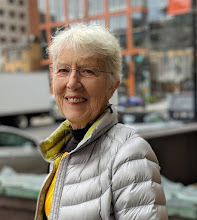
From John Dawson -- a professor emeritus of mathematics at the Penn State York campus and well-known for his publications in mathematical logic, often focusing on the life and work of Kurt Godel -- a poem on a topic that this blog visits from time to time, portraits of mathematicians.
Public Image by John W. Dawson, Jr.
Please,
I'm not an accountant.
No,
Mine doesn't always balance either.
What do I do then?
Well,
On good days
I prove theorems;
Tuesday, May 20, 2014


Friday, May 16, 2014
Pound on poetry and mathematics
HERE at PoetryFoundation.org we find an article by Carl Sandburg (1878-1967), published in POETRY Magazine in 1916, in which Sandburg offers highest praise to poet Ezra Pound (1885-1972). Sandburg includes this quote from a 1910 essay by Pound that connects poetry and mathematics.
The complete article is available here.
And, in a footnote* to the poem "In a Station of the Metro" -- found in my Norton Anthology of Modern Poetry we find a bit more of Pound's mathematical thinking.
"Poetry is a sort of inspired mathematics, which gives us equations,
not for abstract figures, triangles, spheres and the like, but equations
for the human emotions. If one have a mind which inclines to magic
rather than science, one will prefer to speak of these equations
as spells or incantations; it sounds more arcane, mysterious, recondite."
The complete article is available here.
And, in a footnote* to the poem "In a Station of the Metro" -- found in my Norton Anthology of Modern Poetry we find a bit more of Pound's mathematical thinking.
Tuesday, May 13, 2014
Land without a square
Here is a bit of light verse from the pen of John Updike (1932-2009).
ZULUS LIVE IN LAND
WITHOUT A SQUARE by John Updike
A Zulu lives in a round world. If he does not leave his reserve.
he can live his whole life through and never see a straight line.
--headline and text from The New York Times
In Zululand the huts are round,
The windows oval, and the rooves
Thatched parabolically. The ground
Is tilled in curvilinear grooves.
Saturday, May 10, 2014
Barbie (b 1959) said (c 1990) "math is hard"
On April 24 I had the pleasure of reading at the Nora School with Martin Dickinson and Michele Wolf. Back in March I had posted Dickinson's "Homage to Euclid" but mathematics is not a a focus of Wolf's work. However, her poem below about Barbie has numbers, and any mention of Barbie reminds me of the controversy over "math is hard" -- one of the speeches uttered by an early 90's version of this doll. (Please visit this posting from June 14, 2010 -- on "Girls and Mathematics" for additional Barbie-comments and more Barbie poetry.) Here, now, please enjoy Wolf's poem:
Barbie Slits Open Her Direct-Mail Offer to Join AARP
by Michele Wolf
My worth is most inflated when, on tiptoes, I pose
In my original box, never handled, especially if I date
Back to '59 or '60. But that is rare. I am more used
To breaking out, to being the damp flamingo
Pecking to leave the shell. I prefer moving forward.
I was an astronaut in '65, a surgeon in '73. Last year
Barbie Slits Open Her Direct-Mail Offer to Join AARP
by Michele Wolf
My worth is most inflated when, on tiptoes, I pose
In my original box, never handled, especially if I date
Back to '59 or '60. But that is rare. I am more used
To breaking out, to being the damp flamingo
Pecking to leave the shell. I prefer moving forward.
I was an astronaut in '65, a surgeon in '73. Last year
Wednesday, May 7, 2014
May 6, 1954
I learned about it via a news broadcast on Pittsburgh radio station KDKA and, for some reason, the event stuck firmly in my memory. I was 13 years old and on May 6, 1954 Roger Bannister ran a mile in less than 4 minutes. The integer 4 is a perfect square as was Bannister's age then -- 25. Alternatively, 13 is prime. As is 60 + 13 = 73. Yesterday marked 60 years since Bannister broke the record. I have come to love running. And playing with numbers.
I . . . never
will run out
of numbers.
I . . . never
will run out
of numbers.
Sunday, May 4, 2014
A pure mathematician (not!)
Poet Arthur Guiterman (1871-1943) was known for his humorous verse. Here is "A Pure Mathematician" -- a poem that stereotypes mathematicians in familiar, unflattering ways (from The Laughing Muse (Harper Brothers, 1915)). In contrast to Guiterman's verse that pokes fun at mathematicians, I invite you to visit this posting from 28 January 2011 to read Sherman Stein's "Mathematician" -- a poem that not only is more fair to the profession but also features a female mathematician.
A Pure Mathematician by Arthur Guiterman
Let Poets chant of Clouds and Things
In lonely attics!
A Nobler Lot is his, who clings
To Mathematics.
Sublime he sits, no Worldly Strife
His Bosom vexes,
Reducing all the Doubts of Life
To Y's and X's.
A Pure Mathematician by Arthur Guiterman
Let Poets chant of Clouds and Things
In lonely attics!
A Nobler Lot is his, who clings
To Mathematics.
Sublime he sits, no Worldly Strife
His Bosom vexes,
Reducing all the Doubts of Life
To Y's and X's.
Wednesday, April 30, 2014
Math, Magic, Mystery -- and so few women
Today, April 30, is the final day of Mathematics Awareness Month 2014; this year's theme has been "Mathematics, Magic and Mystery" and it celebrates the 100th anniversary of the birth of one of the most interesting men of mathematics; educated as a philosopher, Martin Gardner wrote often about mathematics and sometimes about poetry. Gardner described his relationship to poetry as that of "occasional versifier" -- he is the author, for example, of:
π goes on and on
And e is just as cursed
I wonder, how does π begin
When its digits are reversed?
π goes on and on
And e is just as cursed
I wonder, how does π begin
When its digits are reversed?
Monday, April 28, 2014
Words that warn
Somewhere in a high school English class was a small topic that intrigues me still -- "questions that expect the answer 'yes'." A door opened. Letting me see that what we say has expectations as well as information. In graduate school math classes we considered the warning word "obviously" -- in a proof, it was likely to mean "I'm sure it's true but am not able to explain."
As I muse today about language I am wondering how unsaid words affect the population of women in mathematics, affect the numbers (too small) of women publishing mathematics. Thinking about this in the light of a wonderful time on Saturday greeting visitors to an AWM (Association for Woman in Mathematics) booth at the biennial USA Science and Engineering Festival. Temple University professor and AWM member Irina Mitrea did an amazing job planning and coordinating the AWM booth where hundreds of young people got some hands-on experience with secret codes and ciphers.
As I muse today about language I am wondering how unsaid words affect the population of women in mathematics, affect the numbers (too small) of women publishing mathematics. Thinking about this in the light of a wonderful time on Saturday greeting visitors to an AWM (Association for Woman in Mathematics) booth at the biennial USA Science and Engineering Festival. Temple University professor and AWM member Irina Mitrea did an amazing job planning and coordinating the AWM booth where hundreds of young people got some hands-on experience with secret codes and ciphers.
Friday, April 25, 2014
Too many selves
In my childhood home, numbers were used with care and precision. There would be teasing when I would use the adverb "too" --- as if when I said "I had to walk too far" I had tried to describe an unbounded distance, greater than any possible span. Now as an adult I continue to be cautious (and intrigued) with use of that word. And I am drawn to the uses of "too many" and "count" in the following poem from David Orr, poetry columnist for the New York Times Book Review.
The Chameleon by David Orr
Alone among the superheroes,
He failed to keep his life in balance.
Power Man, The Human Shark--they knew
To hold their days and nights in counterpoise,
Their twin selves divided together,
As a coin bears with ease its two faces.
The Chameleon by David Orr
Alone among the superheroes,
He failed to keep his life in balance.
Power Man, The Human Shark--they knew
To hold their days and nights in counterpoise,
Their twin selves divided together,
As a coin bears with ease its two faces.
Monday, April 21, 2014
A Cento from Arcadia
Last week I had the enjoyable privilege of visiting with mathematician-poet Marion Cohen's math-lit class, "Truth and Beauty" at Arcadia University -- and the class members helped me to compose a Cento (given below), a poem to which each of us contributed a line or two of poetry-with-mathematics. Participants, in addition to Dr. Cohen and me, included these students:
Theresa, Deanna, Ian, Collin, Mary, Grace, Zahra, Jen, Jenna,
Nataliya, Adeline, Quincy, Van, Alyssa, Samantha, Alexis, Austin.
Big thanks to all!
Theresa, Deanna, Ian, Collin, Mary, Grace, Zahra, Jen, Jenna,
Nataliya, Adeline, Quincy, Van, Alyssa, Samantha, Alexis, Austin.
Big thanks to all!
Sunday, April 20, 2014
Remembering Nina Cassian
Exiled Romanian poet Nina Cassian (1924-2014) died last week in Manhattan. Cassian was an outspoken poet whom I admired for her political views; she also was connected to mathematics -- in her subject matter and her friends. (See, for example, this posting from January 31, 2011.)
Equality by Nina Cassian
If I dress up like a peacock,
you dress like a kangaroo.
If I make myself into a triangle,
you acquire the shape of an egg.
If I were to climb on water,
you'd climb on mirrors.
All our gestures
Belong to the solar system.
"Equality" is in Cheerleaders for a Funeral (Forrest Books, 1992), translated by the author and Brenda Walker.
Equality by Nina Cassian
If I dress up like a peacock,
you dress like a kangaroo.
If I make myself into a triangle,
you acquire the shape of an egg.
If I were to climb on water,
you'd climb on mirrors.
All our gestures
Belong to the solar system.
"Equality" is in Cheerleaders for a Funeral (Forrest Books, 1992), translated by the author and Brenda Walker.
Subscribe to:
Posts (Atom)

 Posts
Posts