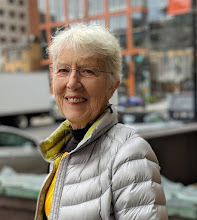
Most of Martin Gardner's fans are avid puzzler's -- my connection with him is also one of admiration (he was a thoughtful person who was a master at making connections among disparate things) but we are connected via poetry, including topics such as counting all possible rhyme schemes for a given stanza and the constraint-based poetry of OULIPO . . ..
Gardner (1914-2010) was not a poet -- although he penned a quatrain or two, his great contribution was collecting and publicizing parodies and puzzle-verses by others. Here is a link to Gardner's collection of poetic parodies, and here is a link to many of Gardner's puzzles, including the stanza below, "How Old is the Rose-Red City?"
Monday, February 15, 2016


Thursday, February 11, 2016
Visit JHM for Mathy Poems
Today I'd like to direct you to the Journal of Humanistic Mathematics, an online open-access journal that features poetry in each issue. The Table of Contents for the first issue of 2016 is now available here -- and I offer below a poem from Issue 1 of 2015. (Before sharing the poem "Prisoner's Dilemma" by Raymond Greenwell I want also to mention that JHM is looking for investigative journalists and that today's "Poem of the Day" at Poets.org is "Evolution" by Linda Bierds and inspired by the work of Alan Turing.)
I am particularly intrigued by Greenwell's poem because the Prisoner's Dilemma is a decision model close to my concerns about the environment. (More comments below.)
Prisoner's Dilemma by Raymond N. Greenwell
Your best choice is my demise.
My wise choice is your defeat.
I am particularly intrigued by Greenwell's poem because the Prisoner's Dilemma is a decision model close to my concerns about the environment. (More comments below.)
Prisoner's Dilemma by Raymond N. Greenwell
Your best choice is my demise.
My wise choice is your defeat.
Sunday, February 7, 2016
Using a Fano plane to create a poem
South Dakota mathematician Daniel May enjoys finding connections between his discipline and other arts -- and herein we consider a constraint-structure for poetry that he has developed using a Fano plane. In brief, a Fano plane (shown in the diagram below) consists of 7 points and 7 lines (the three sides of the triangle, the three altitudes of the triangle, and the circle) -- with each line containing 3 of the points.
May creates a poem by associating a word with each point of the Fano plane and then creates a three-line stanza for each line of the diagram. Here is a template for the poem "adore" -- and the poem itself is offered below the diagram:
 |
| Fano Plane Diagram |
May creates a poem by associating a word with each point of the Fano plane and then creates a three-line stanza for each line of the diagram. Here is a template for the poem "adore" -- and the poem itself is offered below the diagram:
Thursday, February 4, 2016
Visiting the Australian Poetry Library
An Australian poet (Erica Jolly) whom I have met through this blog has helped me to learn about the great variety of poetry and related activities that are available on her continent -- and today I want to link you to the Australian Poetry Library and to offer a mathy poem by Peter Goldsworthy that I enjoyed there.
1 by Peter Goldsworthy
Arithmetic divides
and rules the world,
freezing the flow
in single frames,
colourising each
by numbers.
1 by Peter Goldsworthy
Arithmetic divides
and rules the world,
freezing the flow
in single frames,
colourising each
by numbers.
Sunday, January 31, 2016
A sonnet for Napoleon's Theorem
In geometry, Napoleon's theorem (often attributed to Napoleon Bonaparte, 1769–1821) states that if equilateral triangles are constructed on the sides of any triangle, either all outward or all inward, the centers of those equilateral triangles themselves are the vertices of an equilateral triangle. In a 2015 lecture at the University of Maryland, mathematician Douglas Hofstadter (perhaps best known for Godel, Escher, Bach: an Eternal Golden Braid -- Basic Books, 1970) presented Napoleon’s theorem by means of a sonnet. Perhaps you will want to have pencil and paper available to draw as you read:
Napoleon's Theorem by Douglas Hofstadter
Equilateral triangles three we’ll erect
Facing out on the sides of our friend ABC.
We’ll link up their centers, and when we inspect
These segments, we find tripartite symmetry.
Napoleon's Theorem by Douglas Hofstadter
Equilateral triangles three we’ll erect
Facing out on the sides of our friend ABC.
We’ll link up their centers, and when we inspect
These segments, we find tripartite symmetry.
Wednesday, January 27, 2016
Rabbis should learn to solve quadratics
Thanks to mathemagician Colm Mulcahy who connected me with poet Lisa Dordal -- and thanks to her for permission to offer these lines, entertainingly seasoned with math words:
Why Rabbis Need to Know
How to Solve Quadratic Equations
for your logic muscles, which you’ll need
to work through those pesky J says-P says conflicts of text –-
the bumpy remains of a Torah affair.
Why Rabbis Need to Know
How to Solve Quadratic Equations
by Lisa Dordal (with help from Laurie Samuels)
Because they are good exercise for your logic muscles, which you’ll need
to work through those pesky J says-P says conflicts of text –-
the bumpy remains of a Torah affair.
Monday, January 25, 2016
Tartaglia solving the cubic -- in verse
Mathematical historians now credit both Cardano and Tartaglia with the formula to solve cubic equations, referring to it as the
"Cardano-Tartaglia Formula." Tartaglia is known for reporting solutions of three different forms of the cubic equation in a poem (1534). Below we offer Boston poet Kellie Gutman's English translation of Tartaglia's verse, followed by the original Italian.
When X Cubed by Niccolò Tartaglia (1500–1557) (Englished by Kellie Gutman)
When x cubed’s summed with m times x and then
Set equal to some number, a relation
Is found where r less s will equal n.
Now multiply these terms. This combination
rs will equal m thirds to the third;
This gives us a quadratic situation,
When X Cubed by Niccolò Tartaglia (1500–1557) (Englished by Kellie Gutman)
When x cubed’s summed with m times x and then
Set equal to some number, a relation
Is found where r less s will equal n.
Now multiply these terms. This combination
rs will equal m thirds to the third;
This gives us a quadratic situation,
Saturday, January 23, 2016
Not good at math . . .
Connecticut poet Joan Cannon is a senior who laments her lingering anxiety over mathematics in her poem, "Humility," below. I found Cannon's poem on Senior Women Web and it is accompanied there by selections from an article by Patrick Bahls entitled "Math and Metaphor: Using Poetry to Teach Mathematics." The complete article is available here.
Humility by Joan L. Cannon
Archetypes, mysteries, simple clues
that only fingers and toes, sticks and stones
and flashes of inspiration require
for universes to be disclosed ...
symbols for functions and formulae
for proof; logic so easy for some —
why am I innumerate?
Humility by Joan L. Cannon
Archetypes, mysteries, simple clues
that only fingers and toes, sticks and stones
and flashes of inspiration require
for universes to be disclosed ...
symbols for functions and formulae
for proof; logic so easy for some —
why am I innumerate?
Thursday, January 21, 2016
Math Anxiety
Recent comments from a friend describing anxiety that seems to freeze his attempts to understand and use a new mathematical concept have caused me to recall and dig out this old poem -- and, by recalling it, to increase my understanding of my friend.
The Math Teacher's Golf Lesson by JoAnne Growney
My practice swing was perfect -- slow start, easy
acceleration through the ball to finish high.
"Beautiful," he said. "It's time to hit a few."
I addressed a ball and settled down and swung --
and missed. "Concentrate," he said. I squinted
The Math Teacher's Golf Lesson by JoAnne Growney
My practice swing was perfect -- slow start, easy
acceleration through the ball to finish high.
"Beautiful," he said. "It's time to hit a few."
I addressed a ball and settled down and swung --
and missed. "Concentrate," he said. I squinted
Wednesday, January 20, 2016
Soon it will be February -- and Valentine's Day
Looking back: on February 12, 2011 I posted math-poetry suggestions for Valentine's Day at this link: Loving a mathematician (Valentine's Day and . . . ). This posting from Feb 9 2013 offers verse along with an animated drawing of a heart-curve --a cardioid. And this link goes to a mathematically poetic digital art exhibit (that includes a cardioid) by Guang Zhu.
For even more poetry related to the love-holiday, enter "Valentine" in the SEARCH box to the right. Enjoy!
For even more poetry related to the love-holiday, enter "Valentine" in the SEARCH box to the right. Enjoy!
Sunday, January 17, 2016
Poetry from a math teacher's son
In an earlier post I have noted how effectively mathematicians and their mathematics may be described by poets who are in the same family. This link, too, leads to portraits of mathematicians.
Poet and novelist John Updike (1932-2009) was the son of a math teacher and the selection below is a sonnet that begins in the style of a math-class word-problem linking his own age with that of his father.
from Midpoint by John Updike
FATHER, as old as you when I was four,
I feel the restlessness of nearing death
But lack your manic passion to endure,
Your Stoic fortitude and Christian faith.
Remember, at the blackboard, factoring?
Poet and novelist John Updike (1932-2009) was the son of a math teacher and the selection below is a sonnet that begins in the style of a math-class word-problem linking his own age with that of his father.
from Midpoint by John Updike
FATHER, as old as you when I was four,
I feel the restlessness of nearing death
But lack your manic passion to endure,
Your Stoic fortitude and Christian faith.
Remember, at the blackboard, factoring?
Subscribe to:
Posts (Atom)

 Posts
Posts