Thursday, March 23, 2017

Remember Emmy Noether!

     On today's date in 1882, mathematician Emmy Noether (1882-1935) was born.  Noether became fixed in my attention when, recently out of college, I saw her photo in a display at the New York World's Fair.  Her life and her pioneering work became inspiration for me as I followed her in mathematics. I wrote a poem, "My Dance is Mathematics," in her honor; it begins with these words:

        They called you der Noether, as if mathematics
        was only for men. In 1964, nearly thirty years
        past your death, I saw you in a spotlight
        in a World's Fair mural, "Men of Modern Mathematics."


The complete poem, "My Dance is Mathematics," is available here.  Its final statement is:
They say she was good / For a woman.

Scroll down -- or follow this link -- to still more poems that celebrate the women of mathematics.

Monday, March 20, 2017

Is unreasonableness ever reasonable?

     This morning I have been thinking about these words of George Bernard Shaw (1856-1950) that were part of the postings on the door of one of my mathematics colleagues at Bloomsburg (PA) University:

The reasonable man adapts himself to the world: 
the unreasonable one persists in trying to adapt the world to himself. 
Therefore all progress depends on the unreasonable man.

     My reflections on the word "unreasonable" also led me back to this important article from 1960 -- "The Unreasonable Effectiveness of Mathematics in the Natural Sciences."  (And I found here some analysis of the article.)
     As a final comment on unreasonableness I offer "Atomic Split" -- a poem by another voice named Bernard Shaw.  (Big thanks to mathematician, writer of both poetry and fiction, scholar extraordinaire -- and friend -- Robert Dawson, who alerted me to the fact that more than one writer carries this famous name.)  This following poem I found here at poemhunter.com.   

Atomic Split      by Bernard Shaw

What a terrible thing to do,
Man has split the atom in two.
For peaceful purposes so we are told,

Thursday, March 16, 2017

Julia . . . Set Aside Gender Roles . . .

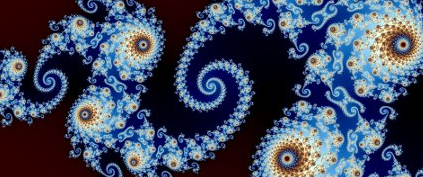
       For me there is a special pleasure in finding in my reading a word like "identity" or "prime" that has a special mathematical meaning in addition to its ordinary usage.  And, because poets work hard to capture multiple images in their work, poems are where such pleasure occurs most often.  Poet and songwriter and professor Lawrence M. Lesser has beautifully connected the Julia Set of fractal geometry with his grandmother, Julia -- and he has given me permission to share his poem, "Julia,"  offered below.  This poem is offered, along with other work by Lesser, in a Poetry Folder, "Moving Between Inner and Outer Worlds," in the most-recent issue of the Journal of Humanistic Mathematics.

For more about Julia Sets, visit http://www.karlsims.com/julia.html.

Sunday, March 12, 2017

Again we celebrate Pi !

 Now I give  -- I again enumerate π's digits, count out . . . 
3.141592653 . . . 

Tuesday, March 14, is Pi-day -- and I invite you to browse or SEARCH this blog for references to π / Pi and to learn more about Pilish (a language in which, as above, word-lengths follow the pattern of the digits of π).  Here are a links to several of the postings available:

       Rhymes to help you remember the digits of Pi
       Poetry that imagines auctioning the digits of Pi
       A Circle poem in Pilish 

Friday, March 10, 2017

Circle of Silence -- and sexual harassment

       Colonel Stacey K. Vargas is a professor of Physics at the Virginia Military Institute.  I found her poem -- with its vicious circles -- in the wonderful and provocative anthology, Raising Lilly Ledbetter:  Women Poets Occupy the Workspace, edited by Carolyne Wright, M. L. Lyons, and Eugenia Toledo (Lost Horse Press, 2015).

Circle of Silence     by Stacey K. Vargas

Like an electron trapped in an unstable orbit, I am seated in a circle of powerful men. 
In an awkward moment small talk ends and the meeting abruptly begins.
The superintendent turns to me and says, "This was not sexual harassment."
I turn to the inspector general and say, "After everything you heard in this investigation, 
       you find this acceptable?"
The inspector general turns to my department head but remains silent. 

Wednesday, March 8, 2017

Honor Math-Women ...

       The first math-woman that inspired me was Laura Church; the first famous math-woman (someone with a theorem named after her) whom I came to admire -- and write a poem about -- was Emmy Noether (1882-1935).  As a recent film featuring NASA mathematician, Katherine Johnson, points out, math-women are:

Hidden figures:
women no one
notices are
changing the world.

Other living mathematicians who deserve to be more well-known include:
         Maryam Mirzakhani, an Iranian mathematician at Stanford who in 2014 won the prestigious Fields Medal for her work related to the symmetry of curved surfaces.
         Moon Duchin, a Tufts University professor who is using geometry to fight gerrymandering.
         Cathy O'Neil, a data scientist (and blogger at mathbabe.org) whose recent book Weapons of Math Destruction helps readers to understand the roles (and threats) of big data in our society. 

 TODAY is the International Women's Day!

Celebrate the day by getting to know some math-women.  Try for ten. Learn their names, read their bios.  Here are two websites that can help:


And here is a link to a list of women who deserve, but do not have, Wikipedia Pages.  Can you help?

Monday, March 6, 2017

The Geometry of Wood

    A recent email from Todd Sformo, a biologist living in Barrow, Alaska, alerted me to his prose poem "Knots" in the online publication Hippocampus Magazine; a sample from "Knots" is offered below.
     Sformo's poem, which offers vivid descriptions of geometric patterns in wood, uses as epigraph several sentences from the Polish mathematician Stanislaw M Ulam (1909-1984). (Ulam was involved in the wartime Manhattan Project and in the design of thermonuclear weapons.)

When I was a boy, I felt that the role of rhyme in poetry 
was to compel one to find the unobvious 
because of the necessity of finding a word which rhymes. 

Tuesday, February 28, 2017

Zero is three!

     February's second weekend was a busy one with the AWP Writer's conference in downtown Washington, DC -- and one of the special treats of that weekend was browsing the Book Fair, renewing connections and finding special books.  One of my great finds was the bilingual collection of Jean Cocteau's Grace Notes (The Word Works, 2017), translated by Mary-Sherman Willis.  Cocteau surely is a challenge for translators as he plays with with connections between disparate images; in the poem I offer below I much enjoyed the mathy connections -- person and number, three and zero, triangle and oval, and so on.

Thursday, February 23, 2017

The Geometry of Poetry

     Some poems lie around for A LONG TIME waiting for me to pick them up.  Or I pick them up and put them down in a special place and then place something else on top of them.  Such is the case with Janet Kirchheimer's "The Geometry of Poetry" -- several years ago Janet and I corresponded and then I didn't follow through with posting her poem.  And now, this week, I am working on a paper for Bridges 2017 -- a math-arts conference to be held in Waterloo, Ontario at the end of July -- and my working title is the same as the title of Janet's poem.  AND, this coincidence helped me to FIND her poem to give you to enjoy.
     I first read "The Geometry of Poetry" by Janet R. Kirchheimer online in Poemeleon -- and her work also has appeared in many other journals, anthologies and websites. She is currently producing AFTER, a film that explores poetry written about the Holocaust.  Thanks, Janet, for this poem with its mathy comparisons.
The Geometry of Poetry    by Janet R. Kirchheimer  

Tuesday, February 21, 2017

An old link but a GOOD one!

     Today I have been working on some ideas for a paper for the 2017 BRIDGES Math-Arts Conference and I have needed to refer back to an old paper of mine, "Mathematics in Poetry," that I wrote for MAA's JOMA more than 10 years ago -- a survey article that introduces a variety of viewpoints and examples.  Enjoy!

Thursday, February 16, 2017

The Infinite

     On page 53 of the February 6 issue of The New Yorker I recently found and enjoyed a poem entitled "The Infinite" by Charles Simic.  Here are its opening lines:

     The infinite yawns and keeps yawning.
     Is it sleepy?
     Does it miss Pythagoras?