I am pleased when I see mathematics held up as an ideal -- and such was the case when I opened my June 19, 2017 issue of The New Yorker and found the lovely poem, "How to Build a Stradivarius" by Ilyse Kusnetz (1966 -2016). Here are its closing lines:
. . .
The truth could be found in the song itself—
how it was impossible to tell where
the wood ceased and the song began—notes pure
as a mathematical equation. Transposing mountain.
Valley. Mountain again.
The complete poem is available here.
Wednesday, August 30, 2017


Monday, August 28, 2017
How does the Triangle relate to the Circle?
One of the active promoters of poetry with links to mathematics is Californian Carol Dorf -- who teaches math at Berkeley High School AND is poetry editor for the online journal, TalkingWriting. Along with several other mathy poets, Carol participated in the poetry reading at the Bridges 2017 Math-Arts Conference in Waterloo, Ontario.
Here, playing with mathematical language -- from Carol's 2013 collection, enchantingly illustrated by Terri Saul, Every Evening Deserves a Title (Delirious Nonce, Berkeley, CA) -- is "Euclidean Shivers."
Here, playing with mathematical language -- from Carol's 2013 collection, enchantingly illustrated by Terri Saul, Every Evening Deserves a Title (Delirious Nonce, Berkeley, CA) -- is "Euclidean Shivers."
Euclidean Shivers by Carol Dorf
So, how does the Triangle
relate to the Circle?
Euclid and a radius prove points
that radiate from the center, a circle,
a method to navigate space.
So, how does the Triangle
relate to the Circle?
Euclid and a radius prove points
that radiate from the center, a circle,
a method to navigate space.
Tuesday, August 22, 2017
More solar numbers
Yesterday's eclipse is still on my mind -- and "solar" links me to a poem featured at the recent Bridges Math-Arts Conference in Waterloo -- a poem by Brazilian poet Marco Lucchesi, a much-honored and widely translated writer who is a professor of literature at the Federal University of Rio Di Janeiro.
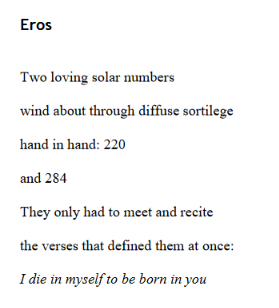 |
| by Marco Lucchesi |
Lucchesi's poem is found in Hinos Matematicos (Mathematical Hymns) -- and has been translated from the Portuguese by Renato Rezende. The numbers in the poem, 220 and 284, are in mathematics called amicable numbers -- the proper divisors of each one can be summed to give the other. For example: (2 + 110) + (4 + 55) + (5 + 44) + (10+22) + (11+20) + 1 = 284.
Thanks, Marco, for your poem.
Monday, August 21, 2017
The Sun's poem is infinite . . .
On this day during which many in the US experienced the totality of a solar eclipse, I stayed in Maryland and, on the roof of my condo-building -- along with one of my sons and two of my granddaughters and an array of neighbors -- saw the darkening as about 80% of the sun was covered by the moon. This event -- the view of the eclipsed sun, the darkened day -- was far more interesting and exciting than I had expected.
AND, thanks to my neighbor, poet and translator Yvette Neisser, I have been introduced to some poetry about the sun. She has shared Solar Poems by Homero Aridjis (City Lights, 2010, translated by George McWhirtier). Here are several stanzas from the opening poem . . .
The Sun’s poem is infinite,
we can only paint it in words,
said the painter
AND, thanks to my neighbor, poet and translator Yvette Neisser, I have been introduced to some poetry about the sun. She has shared Solar Poems by Homero Aridjis (City Lights, 2010, translated by George McWhirtier). Here are several stanzas from the opening poem . . .
The Sun’s poem is infinite,
we can only paint it in words,
said the painter
Wednesday, August 16, 2017
Seeking an EQUATION for LOVE . . .
One of the interesting and fun people I had the good fortune to meet at the 2017 Bridges Math-Arts Conference in Waterloo, Ontario, is Lisa Lajeunesse. At Capilano University, Lajeunesse teaches a course entitled "Math and Creative Arts" and presented at Bridges a thought-provoking paper entitled "The Golden Ratio: How Close is Close Enough?" My close connection with her came because we both were involved in a Bridges 2017 Math-Poetry Reading. She has given me permission to include her clever and mathy poem here.
It goes something like this
love equals attraction times compatibility to the power of opportunity
there’s more of course and there’s been much fiddling
with coefficients and lesser terms
involving age, pheromones and duration of eye contact
An Equation for Love by Lisa Lajeunesse
They’ve found an equation for loveIt goes something like this
love equals attraction times compatibility to the power of opportunity
there’s more of course and there’s been much fiddling
with coefficients and lesser terms
involving age, pheromones and duration of eye contact
Monday, August 14, 2017
The wisdom of grooks . . .
From Wikpedia, we have this definition: A grook ("gruk" in Danish) is a
form of short aphoristic poem or rhyming aphorism, created by the
Danish poet, designer, inventor and scientist Piet Hein (1905-1996), who wrote over
7000 of them, mostly in Danish or English. A couple mathy grooks are offered below -- and, below them, links to more.
PROBLEMS by Piet Hein
Problems worthy
of attack
prove their worth
by hitting back.
The grook shown above and more are found here:
Tuesday, August 8, 2017
Counting, women, loving mathematics
Here is another Cento from BRIDGES -- for background information, please see my August 4 posting -- this one composed by Erinn and Catherine. Authors of the four lines are Judy Green, Shakuntala Devi, Anonymous, and Mike Naylor.
How many women mathematicians can you name?
How many of you love mathematics?
Women count. Men count. People count.
Counting each and every step along this rocky shore.
How many of you love mathematics?
Women count. Men count. People count.
Counting each and every step along this rocky shore.
Friday, August 4, 2017
Centos from 2017 Bridges Math-Arts Conference
Last Monday evening I returned home from the 2017 Bridges Math-and-the-Arts Conference at the University of Waterloo. One of the special events in which I participated was a Sunday afternoon poetry reading; information about the reading (and links) are here in my July 17 posting .
Another conference activity -- machine-based and developed by Waterloo computer science grad student Erinn Atwater to work with a data-base of quotations I had gathered that relate to math or poetry -- was a machine set-up to invite conference attendees to compose a four-line Cento from a screen-selection of choices.
Here is a sample of the Cento poetry that was created; the assembler of these lines listed her name simply as Bianca:
Mathematics is not only connected to art; it is just art. (by Solomon Marcus)
There is always a third point between any two. (by Michael Rosen)
My imagination is still the same. It’s bad with large numbers. (by Wislawa Szymborska)
Though this be madness, yet there is method in it. (by William Shakespeare)
Another conference activity -- machine-based and developed by Waterloo computer science grad student Erinn Atwater to work with a data-base of quotations I had gathered that relate to math or poetry -- was a machine set-up to invite conference attendees to compose a four-line Cento from a screen-selection of choices.
Here is a sample of the Cento poetry that was created; the assembler of these lines listed her name simply as Bianca:
Mathematics is not only connected to art; it is just art. (by Solomon Marcus)
There is always a third point between any two. (by Michael Rosen)
My imagination is still the same. It’s bad with large numbers. (by Wislawa Szymborska)
Though this be madness, yet there is method in it. (by William Shakespeare)
Tuesday, July 25, 2017
from "The Half-Finished Heaven"
In 2011, Swedish poet Tomas Transtromer (1931-2015) won the Nobel Prize and this year Graywolf Press has issued a wonderful collection of his work The Half-Finished Heaven: Selected Poems (translated by Robert Bly). Here is the title poem; is it mathematical?
The Half-Finished Heaven by Tomas Transtromer
Cowardice breaks off on its path.
Anguish breaks off on its path.
The vulture breaks off in its flight.
The eager light runs into the open,
even the ghosts take a drink.
The Half-Finished Heaven by Tomas Transtromer
Cowardice breaks off on its path.
Anguish breaks off on its path.
The vulture breaks off in its flight.
The eager light runs into the open,
even the ghosts take a drink.
Monday, July 17, 2017
A CENTO from BRIDGES 2017 Poets
A cento is a literary work made from quotations from other works -- most often it is a poem, assembled from lines by other poets. Below I have created a cento from lines written by the poets who have been invited to participate in the July 30 Poetry Reading at the 2017 Bridges Math-Arts Conference in Waterloo, Ontario. A wonderful program is planned -- it's not too late to register and join us.
All is number, mysterious proportions
Like Egyptians burying gold with the dead
Golden Fear
that divides and leaves no remainder
All is number, mysterious proportions
Like Egyptians burying gold with the dead
Golden Fear
that divides and leaves no remainder
Sunday, July 16, 2017
Too soon -- Maryam Mirzakhani taken by cancer
The brilliant and celebrated mathematician -- and 2014 Fields Medal Winner -- Maryam Mirzakhani has, on July 14 at age 40, died after a long battle with cancer. I learned this sad news from NPR. The radio story tells that (as was the case also for me) early in her life, Mirzakhani had wanted to be a writer, but her mathematical talents won out. Her description of mathematics is a charming one and math deserves to be more-often pictured in this positive way:
It
is fun --
like solving
a puzzle or
connecting the dots
in a detective case.
This stanza-form, in which lines grow in length by one syllable at a time, is called a syllable-snowball.
It
is fun --
like solving
a puzzle or
connecting the dots
in a detective case.
This stanza-form, in which lines grow in length by one syllable at a time, is called a syllable-snowball.
Subscribe to:
Posts (Atom)

 Posts
Posts