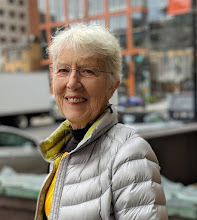
"... a metaphor is an equation between two words.”
Monday, January 21, 2019
A poetry equation . . . .
My recent attendance (January 16-19) at the Joint Mathematics Meetings in Baltimore has resulted in a pile of math-poetry items to sort and organize for offering here in my blog. While that sorting happens, here is an idea to ponder -- found in a recent article about Brooklyn-based poet and teacher Taylor Mali -- this thoughtful quote:


Wednesday, January 16, 2019
A Perfect Number
One of the things I love to find in a poem is the surprise of a double meaning -- especially involving a mathematical term such as "group" or "zero" or "identity." The following poem of mine aims to offer that surprise -- as it celebrates actor-inventor Hedy Lamarr while playing with the meanings of "perfect."
Looking
for Mathematics in Hedy Lamarr by JoAnne Growney
All my six husbands married me for different reasons.
---Hedy Lamarr
Perhaps Hedy Lamarr married so often because six
is a perfect number – the sum of all its proper
divisors, “proper” meaning “less than six,”
“divisor” meaning “a counting number
that divides and leaves
no remainder.”
After a perfect number of husbands, there is no
remainder. Six is the smallest perfect
number, the next is twenty-eight.
And twenty-eight
is too many
husbands.
Today I head to the 2019 Joint Mathematics Meetings in Baltimore
including a Poetry Reading Friday, January 18, 7 PM
-- hope to see you there!
Monday, January 14, 2019
Poems that Celebrate Mathematicians
Recently I received from John Golden (blogger at mathhombre.blogspot.com and math professor at Michigan's Grand Valley State University, this link to a collection of poems developed by students Ellen Audia and Connor Dudas as their senior project for degrees in Mathematics from Grand Valley State University. On page 6, we have their poem about Archimedes:
Archimedes
Everyone knows
The great Archimedes
One of the leading scientists
Of the classical antiquity
The area of a circle
Equals pi r squared
Archimedes also discovered
The volume of a sphere
Wednesday, January 9, 2019
Mathematical motherhood -- keeping count
The Journal of Humanistic Mathematics, with new issues coming twice a year, late in January and July, is a wonderful resource. Their latest issue (July 2018) was themed "Mathematics and Motherhood" and is an example of their wonderful support for expanding our images of mathematicians to recognize the vital contributions of women.
From that issue, here are opening stanzas of a poem by Nevada scientist and mathematician Marylesa Howard -- lines that offer a mathematical description of the constant adjustments of parenthood. Several decades ago, when I was a math professor and parent of young children, I needed to keep details of parenting away from my profession -- a divided life. I'm glad things are different now.
From that issue, here are opening stanzas of a poem by Nevada scientist and mathematician Marylesa Howard -- lines that offer a mathematical description of the constant adjustments of parenthood. Several decades ago, when I was a math professor and parent of young children, I needed to keep details of parenting away from my profession -- a divided life. I'm glad things are different now.
Friday, January 4, 2019
A poem . . . like a mathematical proof . . .
Mathematician-Poet Sarah Glaz has been active in bringing poetry events to the annual summer Math-Arts conference Bridges -- and she has given me permission to include this poem which appears in the Bridges 2018 Poetry Anthology and in her wonderful recent collection Ode to Numbers (Antrim House, 2017).
Like a Mathematical Proof by Sarah Glaz
A poem courses through me
like a mathematical proof,
arriving whole from nowhere,
from a distant galaxy of thought.
Like a Mathematical Proof by Sarah Glaz
A poem courses through me
like a mathematical proof,
arriving whole from nowhere,
from a distant galaxy of thought.
Wednesday, January 2, 2019
Celebrate a Science Woman -- and offer friendship!
Last weekend's Washington Post used the headline
When Nancy Grace Roman requested permission
to take a second algebra course in high school,
the teacher demanded to know, "what lady
would take mathematics instead of Latin?"
But Roman persisted in the challenging studies and was not dissuaded by biases. The obituary quotes an interview from Science magazine in which she said:
Astronomer celebrated as the 'mother' of the Hubble Space Telescope
for the obituary of Nancy Grace Roman. It opens with this sentence:When Nancy Grace Roman requested permission
to take a second algebra course in high school,
the teacher demanded to know, "what lady
would take mathematics instead of Latin?"
But Roman persisted in the challenging studies and was not dissuaded by biases. The obituary quotes an interview from Science magazine in which she said:
Monday, December 31, 2018
Celebrating winter with a Fibonacci poem
Another year ends . . . may 2019 bring good numbers for us all!
Counting on a December morning by JoAnne Growney
one chickadee, one squirrel
my own two feet left-right left-right on the soft track
around the soccer field three blocks from my home
sparkling bright against grey sky five crows alight
in the lacy spread of fractal branches of eight bare locust trees
when I am early morning’s first human to arrive at Shepherd Park
when I am first and the wind is gentle and the temperature
is not bitter cold
dozens of robins hop and flutter near me
as I plod some thirteen laps
smiling, maybe losing count
and loving my Fibonacci world
Thanks to mathematician-poet Sarah Glaz who has included this poem
Thursday, December 27, 2018
The square root of tomorrow . . .
The surprise of a mathy poem came into my email-box at 6 AM this morning, delivered as "Poem-of-the-Day" from the wonderful website, poets.org. The complete title of this poem by California poet giovanni singleton is "last cucumber from the garden (in conversation w/ julie ezelle patton)" and in a "More" link beside the posting of the poem, the author explains how the title relates to the mathy poem that moves from groundedness to ecstasy. Below are the opening lines . .. go here for the rest.
 |
| From " last cucumber from the garden . . . " |
Thursday, December 20, 2018
A Syllable-Snowball of Holiday Wishesl
o
This
Christmas
let us strive
to multiply
our understanding
of different neighbors --
each day add deeds of kindness,
subtract some carbon emissions,
integrate our commitments with love.
For more about snowball-poems, visit this prior blog-posting. For lots of background about poetry-constraints and the organization (OULIPO) that has popularized them, here is a link to Wikipedia's summary.
Monday, December 17, 2018
Examining boundaries for Math-Women
Mathematician Ursula Whitcher is a versatile and interesting person -- and currently an editor for the American Mathematical Society's Mathematical Reviews. It was my pleasure to meet and work with her at a conference on "Creative Writing in Mathematics . . ." in Banff in 2016. Like me, Whitcher writes some poetry -- and here is one of her poems -- this one recognizing the isolation of math-woman Sophie Germain.
Boundary Conditions by Ursula Whitcher
Royal Academy of Science, Paris, 1823
This is her moment of triumph:
a seat at the center, a node.
Mademoiselle Germain sits silent,
head upright, chaperoned.
Academy members rise
or dip; the speaker drones.
Boundary Conditions by Ursula Whitcher
Royal Academy of Science, Paris, 1823
This is her moment of triumph:
a seat at the center, a node.
Mademoiselle Germain sits silent,
head upright, chaperoned.
Academy members rise
or dip; the speaker drones.
Wednesday, December 12, 2018
Defending Poetry . . . .
With sadness I learned yesterday of the death of poet Meena Alexander (1951-2018) -- not only a fine poet but also one of my treasured teachers during my MFA studies at Hunter a bunch of years ago. As I browsed the works of Alexander online I found here in World Literature Today her essay "What Use Is Poetry?" which includes reference to Shelley's "In Defence of Poetry."
Shelley's words led me to think of mathematics; perhaps you will, too:
“It creates for us a being within our being.
It makes us inhabitants of a world to which
the familiar world is a chaos. It reproduces
the common universe of which we are portions and percipients,
and it purges from our inward sight the film of familiarity
which obscures from us the wonder of our being.”
Shelley's words led me to think of mathematics; perhaps you will, too:
“It creates for us a being within our being.
It makes us inhabitants of a world to which
the familiar world is a chaos. It reproduces
the common universe of which we are portions and percipients,
and it purges from our inward sight the film of familiarity
which obscures from us the wonder of our being.”
Monday, December 10, 2018
The Heart's Arithmetic
For me, the Christmas holiday season is a time for family gathering and a treasured time for that reason. Today my thoughts turn to one of my favorite poems of family and mathematics -- a poem by much-too-soon-departed poet Wilmer Mills (1969-2011), a poem first published in Poetry and also also found here at the Poetry Foundation website.
An Equation for My Children by Wilmer Mills
It may be esoteric and perverse
That I consult Pythagoras to hear
A music tuning in the universe.
My interest in his math of star and sphere
Has triggered theorems too far-fetched to solve.
An Equation for My Children by Wilmer Mills
It may be esoteric and perverse
That I consult Pythagoras to hear
A music tuning in the universe.
My interest in his math of star and sphere
Has triggered theorems too far-fetched to solve.
Friday, December 7, 2018
United by ice cream -- the sphere and cone
During recent months I have been part of an online course that has helped me and a dozen others to learn steps for editing Wikipedia -- with the goal that we will be able to add biographies of "Women in Science and Mathematics" to that enormous online encyclopedia (in which, currently, less than 18% of the biographies feature women). The course has led me to SEARCH Wikipedia using names of women I admire -- and it will be my intent to work toward addition of those missing. One such woman -- a mathematics PhD, a talented teacher, a poet -- is Katharine O'Brien (1905-1986). I introduce her below with one of her mathy poems (first published in The Mathematics Teacher in 1968).
Einstein and the Ice Cream Cone by Katharine O'Brien
His first day at Princeton, the legend goes,
he went for a stroll (in his rumpled clothes).
He entered a coffee shop -- moment of doubt --
then climbed on a stool and looked about.
Beside him, a frosh, likewise strange and alone,
consoling himself with an ice cream cone.
Einstein and the Ice Cream Cone by Katharine O'Brien
His first day at Princeton, the legend goes,
he went for a stroll (in his rumpled clothes).
He entered a coffee shop -- moment of doubt --
then climbed on a stool and looked about.
Beside him, a frosh, likewise strange and alone,
consoling himself with an ice cream cone.
Tuesday, December 4, 2018
By Claude Shannon -- a Poem for Rubik's Cube
Below I present the opening lines of an 80-line (plus footnotes) poetic creation by Claude Shannon (1916-2001). A mathematician, engineer and cryptographer, Shannon is often called "the father of information theory." My own acquaintance with Shannon's work came through the topic of error-correction codes. Shannon's poem on the Rubik Cube was first published here in a Scientific American blog posting by John Horgan.
A Rubric on Rubik Cubics (1) by Claude Shannon
Strange imports come from Hungary:
Count Dracula, and ZsaZsa G.,
Now Erno Rubik's Magic Cube
For PhD or country rube.
This fiendish clever engineer
Entrapped the music of the sphere.
A Rubric on Rubik Cubics (1) by Claude Shannon
Strange imports come from Hungary:
Count Dracula, and ZsaZsa G.,
Now Erno Rubik's Magic Cube
For PhD or country rube.
This fiendish clever engineer
Entrapped the music of the sphere.
Subscribe to:
Posts (Atom)

 Posts
Posts