Tuesday, July 5, 2022

Still Life with Mathematics

   The title of this blog post, "Still Life with Mathematics" is also the title of a mixed media artwork by Pacific Lutheran University math professor Jessica Sklar and displayed in Mathematical Art Galleries for the 2022 Joint Mathematics Meetings.  Included in the art (which Sklar describes as a tribute to her dissertation advisor and to mathematics) is Sklar's poem, "Disciple" -- first published here in the Journal of Humanistic Mathematics in 2017 and offered below;  Sklar describes it as "a love poem for mathematics."

     Disciple     by Jessica K. Sklar

     And when they ask why I love you,
     I divulge: in your universe,
     normality is special, naturality
     is contrived, fields can be infinite
     and singularities are as commonplace
     as odd primes.    

Tuesday, June 28, 2022

Learning from Poetry -- "The Courtesy of the Blind"

      Can difficulty with understanding mathematics be compared with physical blindness -- a difficulty that is biological rather than chosen?  This is a question that has come to my mind as a reaction to Wislawa Szymborska's poem (offered below) "The Courtesy of the Blind."  This Szymborska poem is part of a wonderful online collections of poetry, Poetry 180, a poem for each day of the 180-day public school year.  

Poem 119: The Courtesy of the Blind     by Wislawa Szymborska

Polish poet Wisława Szymborska (1923-2012)
was the 1996 recipient of the Nobel Prize in Literature
and the author of over 20 volumes of poetry.

     The poet reads his lines to the blind.
     He hadn’t guessed that it would be so hard.
     His voice trembles.
     His hands shake.

     He senses that every sentence
     is put to the test of darkness.
     He must muddle through alone,
     without colors or lights.

Thursday, June 23, 2022

Remembering Alan Turing

      A posting from Mathigon on Twitter reminded me that today is the birthday of pioneering computer scientist Alan Turing (1912-1954); a bio of Turing may be found here at MathigonThis link leads to several poems that celebrate Turing . . .

           Do machines think?

                    Do we?

More about Turing's life and career may be found here.

Monday, June 20, 2022

Mathy Poems on YouTube

      In a recent posting -- 6/08/2022 -- I tell of mathematician-poet Sarah Glaz and link to her website that has a collection of links to works by various mathy poets that have participated in BRIDGES math-arts conferences.  Glaz not only offers connections to poet-information, she also offers links to YouTube recordings of poems -- and recently, to supply her with that, I worked with my granddaughter, Serena Growney, who has just finished her freshman year at high school and knows a lot more about using YouTube than I do.  Here's a link to our Growney-Growney YouTube collaboration(I had intended for Serena to focus on the book cover and not to catch my elbow, etc, in the background -- but perhaps all of that makes it more interesting.)  For viewers who like to see the text of a poem as well as to hear it, here is a link to a blog posting of "Things to Count On" -- and below I offer the text of the poem (a very new one), "A Tragic Mathematical Romance."

A Tragic Mathematical Romance        by JoAnne Growney

     Abscissa, my darling, what is the
     basis for your discontent?  When I
     calculate the
     distance between us, I
     even have trouble seeing it as
     finite – its growth has a steep
     graph, climbing out of my

Friday, June 17, 2022

Word-Play with Mathematics -- On-Stage

      One of the rewards from time spent with mathematics or from time spent with poetry is the array of multiple meanings that we find . . . usually not all-at-once but accumulating.  A master of word-play with mathematical terms and ideas is Mathematics Professor Colin Adams of Williams College.  Each time I attend the annual Joint Mathematics Meetings I look on the schedule for Mathematically Bent Theater -- with a presentation by Adams and the Mobiusbandaid Players. Here is a link to an interview with Adams; and here on YouTube are videos of some of the mathy presentations; EXPLORE and ENJOY!

To add a bit of poetry to this post, I offer below a photo of a visual poem by scientist and writer Bern Porter, found in the anthology Against Infinity.

"Formula" -- by Bern Porter

Against Infinity is an anthology of mathy poems edited by Ernest Robson and Jet Wimp and published by Primary Press in 1979 -- now out of print but available at used-book websites.  Here is a link to other selections from Against Infinity in earlier postings in this blog.

Tuesday, June 14, 2022

The Windmill Proof

      From Alice Major, Canadian poet and first Poet Laureate of the city of Edmonton, Alberta, I learned of Welsh computer science professor emeritus Stephen Payne's new poetry collection, The Windmill Proof.   Here is a sample poem by Payne which appears on the book's back cover. 

Learn more here about Stephen Payne; The Windmill Proof was published by HappenStance Press -- and is available for purchase at this linkHere is a link to a review by Mat Riches and this link leads to a review by Adele Ward;  both reviews contains samples of mathy poems.

Wednesday, June 8, 2022

Many, many mathy poems -- THANK YOU, Sarah Glaz

      Sarah Glaz, mathematics professor emerita at the University of Connecticut, is also a poet.  AND, not only a poet but a coordinator of math-poetry activities for the annual BRIDGES Math-Arts conferenceThis year's conference will be held in Finland, August 1-5, 2022This link leads to Glaz' announcement of the poetry program at BRIDGES 2022 -- and includes bios and sample poems by poets who plan to attend the conference AND also includes samples of work from some of us poets who have been part of BRIDGES in the past but will be unable to attend this year.  Below are the opening lines from a poem by Glaz that is inspired by the mathematical field of Ring Theory.

The entire poem is available via Glaz's profile at this link.

Work by Sarah Glaz has been featured in a variety of previous posts in this blog.  Here is a link.

Friday, June 3, 2022

The Mobius Strip -- in a LIMERICK

     Mathematics offers brief, condensed language for many big ideas.  Even for small problems -- such as the word problems of a beginning algebra class -- translation of the words into a mathematical equation offers the chance to express the problem precisely and to solve it using established procedures.    

     And brief mathematical forms also are popular in poetry -- the six-line Fib and the five-line rhyming stanza called a limerick both have wide appeal.  And, because of the brevity, the language must be concise.  At this webpage, maintained by Joachim Verhagen, are lots and lots of mathy limericks.  Here is a sample:

          The Moebius strip is a pain,
          When you cut it again and again,
               But if you should wedge
              A large disk round the edge
          Then you just get a PROjective plane.

This link leads to an interesting article about a Mobius strip made of light (see also the photo below); this link leads to a Wikipedia article about a real projective plane.  And more of Verhagen's Mobius strip limericks may be found here.  

A Mobius strip from this NOVA article

This link leads to a website with instruction for construction and playful activities with a Mobius strip.  To enjoy limericks found in earlier postings in this blog, follow this link.

Monday, May 30, 2022

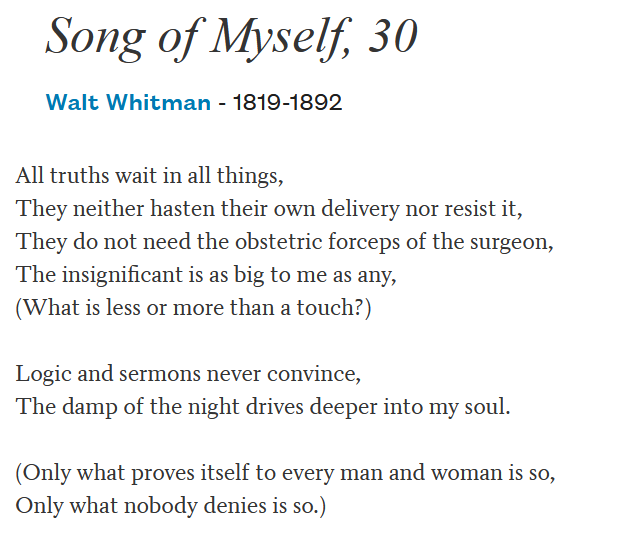
All truths wait in all things . . .

       Tomorrow, May 31, is the 130th anniversary of the birth of American poet, Walt Whitman.  Below I include a few Whitman lines (with the mathy terms "logic" and "proves") that offer food for thought.

The rest of this poem and lots more by Whitman are found here at poets.org.

 Whitman's complete Song of Myself (52 poems) is available at this link.
A SEARCH using Whitman will lead to more of his work in in this blog.

Friday, May 27, 2022

Mathematics might be dangerous!

       Censorship of Math Texts: A Syllable-Square with Questions
    
       Florida educators have banned
       Lots of mathematics texts because
       The books’ problems-to-solve include some
       REAL problems – bias and racism!
       Are the banners blind to their bias?
       Do they fear exposure and critique?
       Do they worry that knowing the need
       for drastic changes may open doors
       to fair, equal treatment of us all?

Here is a link to a news article about the Florida censorship -- written by Moriah Balingit, from 5/9/2022 in the The Washington Post.

Monday, May 23, 2022

Crisscrossing Infinity

     Poet and painter and literary theorist Paul Hartal was born in Hungary, with higher-education experiences in Israel and the U.S. -- and is now a long-term Canadian.  Recently Hartal contacted me to share a couple of his poems that involved mathematical topics -- and I offer one of these below, "Crisscrossing Infinity." Hartal's poem refers to a war memorial constructed using the pattern that first appeared in the sculpture "Endless Column" by Romanian artist Constantin Brancusi (1876-1957) and is on display at New York's MA, Museum of Modern Art.

       Crisscrossing Infinity       by Paul Hartal

       In the city of Targu Jiu, Romania,
       an abstract sculpture rises
       30 meters high.
       It is made of 15 zinc and cast iron
       rhomboidal modules
       (plus a half unit).

Wednesday, May 18, 2022

Math-Poetry -- when distinct worlds collide . . .

     Carol Dorf has been a long-time leader in math poetry projects.  A now-retired secondary school math teacher from California, Carol is the poetry editor of  the online journal Talking Writing -- an online journal that has included a variety of mathy poems.   Recently, at the Joint Mathematics Meetings, Carol gave a presentation entitled "Poetry of Mathematical Definitions" -- the abstract for this talk begins with this provocative sentence:

Mathematical poetry begins when worlds we consider distinct collide.

Carol's poetry-editorship for Talking Writing has led to many math-related poems being published therein.  Here is a link to those poems and a bit of other math-related content;  the following list includes names of writers whose work has been included there:  Robin Chapman,    Marion Deutsche Cohen,    Allison Hedge Coke,    Mary Cresswell,    Catherine Daly,    Carol Dorf,    Iris Jamahl Dunkle,    Sarah Glaz,    JoAnne Growney,    Athena Kildegaard,    Larry Lesser,      Elizabeth Langosy , Marco Maisto,    Alice Major,    Katie Manning,    Daniel May,    David Morimoto,    Giavanna Munafo,    Karen Ohlson,    Eveline Pye,    Stephanie Strickland,    Amy Uyematsu,    Sue Brannan Walker,    and Jean Wolff.  Some of the poets have been featured more than once and to find all work by a particular author, SEARCH is recommended.

And here, from Talking Writing,  is one of Carol Dorf's fascinating poems:

       Lost Information     by Carol Dorf

       Visualize groups: there’s the babysitting co-op,
       with slips of scrip the children color during
       quarterly potlucks; and more than enough churches
       each with study evenings, and fundraising committees;    

Monday, May 16, 2022

Bridges Math-Arts Conference 2022

      Founded by Reza Sarhangi (1952-2016) in 1998, the BRIDGES organization has had annual conferences and is an ongoing supporter of links between mathematics and the various arts.  This year's conference is scheduled for August 1-5, 2022 at Aalto University in Helsinki and Espoo, Finland.

Bridges Conference Information is available at this link.

Browsing and searching on the BRIDGES website can lead to a huge variety of math-arts connections -- including invited and contributed paper presentations, an exhibition of mathematical art, workshops, films, a poetry reading, music and theater -- including both descriptive and performance events.  Here is a link to a list of links to lots of exhibitions.   And this link leads to the results of a search in the Archive of BRIDGES papers that include the term "Poetry" in the title.

Adding to what the BRIDGES site includes is this rich source of math-poetry material at the University of Connecticut website of mathmatician-poet Sarah Glaz -- an active organizer of poetry at BRIDGES conferences.

               Poetry and
               mathematics
               build BRIDGES to
               understanding.  

Thursday, May 12, 2022

Poem of the Census Enumerator

          When I look at
          the person I
          meet on the street,
          what do I see?

One of the powerful and relevant poems that has come into my view recently is "Counting" by Margarita Engle.  Engle is the author of many children's books and, from June 2017 to June 2019, she served as the Poetry Foundation's Young People's Poet Laureate.  I offer this poem below -- and invite you to ponder the discrimination-issues it raises and the COMPLEXITY of counting -- and then to follow the links to explore more of Engle's work:

       Counting      by Margarita Engle  

                    Harry Franck, from the United States of America - Census Enumerator

       I came to Panama planning to dig
       the Eighth Wonder of the World,
       but I was told that white men
       should never be seen working
       with shovels, so I took a police job,
       and now I've been transferred
       to the census.

       I roam the jungle, counting laborers
       who live in shanties and those who live
       on the run, fugitives who are too angry
       to keep working for silver in a system
       where they know that others
       earn gold.