Monday, August 29, 2022

Mathematics -- not isolated STARS but COMMUNITY

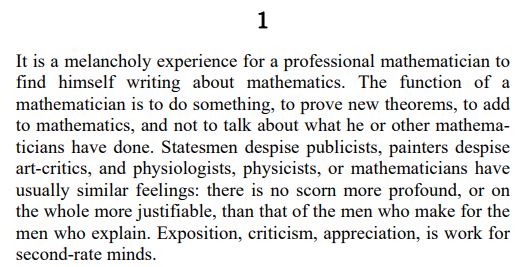
     In his 1940 book-length essay, A Mathematician's Apology, eminent British mathematician G. H Hardy minimizes the importance of those who communicate mathematics to those outside the research community   ... the book's opening paragraph is show below . . . it concludes with "Exposition, criticism, appreciation. is work for second rate minds."

The complete essay is available online here

Wednesday, August 24, 2022

Remembering Life on the Farm

      I grew up on a farm in western Pennsylvania -- and I think that farm life (at least as my father practiced it) was a strong introduction to mathematics.  Counting, calculating, predicting -- and, most of all, problem-solving -- prepared me for studies and for a complex world.  Today is the anniversary of my parents' marriage -- on August 24, 1939 -- and an important occasion for looking back!

     Last weekend I visited the farm (Meadow Lane Farm, now a golf course) and my rememberings drew me to this years-ago poem (previously posted here)

"Things to Count On" was included in my chapbook collection, My Dance is Mathematics  -- now out of print but available online here.   AND here is link to the results of a blog search for farm.

Monday, August 22, 2022

Celebrate poet Rita Dove

      In the KIDSPOST section of this morning's Washington Post I learned that next Sunday, August 28, is the birthday of poet Rita Dove (b. 1952) and Saturday, August 27 is the birthday of mathematician Giuseppe Peano (1858-1932).  Dove (who served as US Poet Laureate 1993-95) is author of one of my favorite mathy poems -- a poem about the EXCITEMENT of learning mathematics -- and I offer it below: 

from The Yellow House on The Corner (Carnegie Mellon University Press, 1980)

     Work by Rita Dove has also appeared in earlier postings in this blog.  This link leads to the results of a blog-search using her name.

Wednesday, August 17, 2022

HER Math Story

    Her Math Story” is a platform of three women mathematicians (Julia Kroos, Tamara Grossmann and Joana Grah) who want to empower young women through “stories and blog entries to pursue studies and careers in maths, spark their curiosity and transmit enthusiasm for technical subjects”, as described on their website.  The first outcome of their collaboration with “Her Math Story” (HMS) is this interview with Professor Shanti Venetiaan

I learned the information above from the European Women in Mathematics – The Netherlands (EWM-NL) website where I also found this poetic quote by mathematician Marta Pieropan:

          Proving a theorem gives me the same satisfaction
          as laying the last tile of a jigsaw puzzle
          that finally reveals the whole picture
          and highlights the relations
          between the various parts.          

Find some time . . . visit the EWM website . . . read . . . and reflect!

Monday, August 15, 2022

Do more to fight injustice!

     In this 5 x 3 syllable-rectangle we have an important and poetic reminder from Martin Luther King, Jr. (1929-1968); let us remember and act on his words:

                “Injustice
                  anywhere
                  is a threat
                  to justice
                  everywhere.”

 I have a dream . . .

Wednesday, August 10, 2022

Journal of Humanistic Mathematics -- latest issue

     Every six months a wonderful treasure appears in my email-box -- an announcement, with links, to the latest issue of the Journal of Humanistic MathematicsHere is a link to the Table of Contents for this latest (July 2022) issue.

     Gathered and edited by Mark Huber (Claremont McKenna College) and Gizem Karaali (Pomona College) this open access journal contains a variety of articles and fiction and poetry.  With topics such as "Math in the Time of COVID" and "A Report about a Speaker Series Connecting Mathematics and Religion," the journal offers both depth and variety as its contents explore the humanistic aspects of mathematics.  Following more than twenty articles, we come to these poems:

Monday, August 8, 2022

BRIDGES Conference 2022 -- Math-Poetry

      A couple of months ago (here in my June 8 posting) I offered a link to information about poetry to be offered at the 2022 Bridges Math-Arts Conference -- held last week in Finland.  This link leads to a series of YouTube recordings of Bridges mathy poems and this link (at the website of organizer Sarah Glaz) offers written information about Bridges poets as well as sample poems.  Visit, read and listen, learn, enjoy!

     One of my poems that is included on the Bridges poetry site is entitled "Three-fold Asylum" -- a poem that explores various roles of the number three.  I offer it below:

     Three-fold Asylum     by JoAnne Growney

     Third door left on level three, my room
     holds steel furniture—its items three:
     double platform bed (for dreamless sleep),

     square corner desk with three-castered chair
     that spins, loops, and glides from the barred door
     to the dark window that sees nowhere.

Thursday, July 28, 2022

Looking back to an old poem -- "Expectations"

      Years ago I wrote this poem -- recently I have rediscovered it and, once again, pondered the role of time in my life.  Here, from the 1980's is "Expectations" -- a poem that appears in my collection, Intersections (Kadet Press, 1993).

     Expectations     by JoAnne Growney

          Don't let mathematics
          teach you to expect two
          to be more than one.

          It's sad but true that two
          can get too near,
          can interfere,
          can reduce each other
          to less than one,
          to less than half.    

Monday, July 25, 2022

Einstein Defining Special Relativity

     Today I share a poem by poet A. Van Jordan that takes math-science terminology and mixes it into personal situations -- and offers varied ideas to consider.  Born in Ohio, Van Jordan became interested in poetry while studying for a masters degree at Howard University and attending readings in Washington, DC.  

Einstein Defining Special Relativity     by A. Van Jordan

INSERT SHOT: Einstein’s notebook 1905—DAY 1: a theory that is based on two postulates (a) that the speed of light in all inertial frames is constant, independent of the source or observer. As in, the speed of light emitted from the truth is the same as that of a lie coming from the lamp of a face aglow with trust, and (b) the laws of physics are not changed in all inertial systems, which leads to the equivalence of mass and energy and of change in mass, dimension, and time; with increased velocity, space is compressed in the direction of the motion and time slows down. As when I look at Mileva, it’s as if I’ve been in a space ship traveling as close to the speed of light as possible, and when I return, years later, I’m younger than when I began the journey, but she’s grown older, less patient. Even a small amount of mass can be converted into enormous amounts of energy: I’ll whisper her name in her ear, and the blood flows like a mallet running across vibes. But another woman shoots me a flirting glance, and what was inseparable is now cleaved in two.

The poem above was found here at poets.org along with other samples of Van Jordan's work.  His poem "Quantum Lyrics" was included in this blog (at this link) back in February 2019.
Friday, July 22, 2022

Worried about Climate Change

     When working with students in poetry workshops I often ask them to write to satisfy a constraint -- perhaps a Fib or a square poem -- in order to help them focus their thoughts.  This morning -- in the middle of a heat wave -- I focused my thoughts squarely on my growing concerns about climate.

       Steamy weather.  I count
       the degrees.  I count on
       air conditioning.  But
       my cooling system adds
       to global warming.  What
       is the right thing to do?

 Here is a link to previous postings in this blog that offer climate concerns.

Tuesday, July 19, 2022

Amelia Earhart -- a brave and pioneering woman!

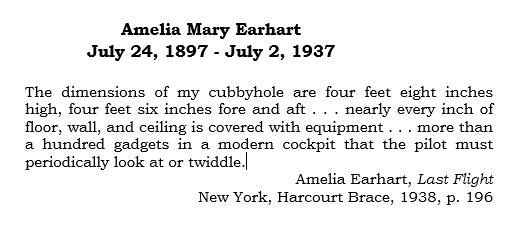
      Growing up on a farm in Western Pennsylvania, one of my heroes was Amelia Earhart (1897-1937) -- a brave and talented female who died too soon.  Fearlessly Earhart broke barriers for all women and my admiration for her led to the following poem (which is a tiny bit mathy -- since it contains several numbers).  The 125th anniversary of Earhart's birth occurs soon -- on July 24, 2022 -- and lots of years ago after reading about her life I wrote these lines to celebrate my appreciation for this remarkable woman.

Lost Star     by JoAnne Growney

Somewhere in Kansas,
seven years old,
belly slamming on ice --
a close call.

Set for collision
with a horse and cart,
that girl put down her head
and slid between the horse's legs.   

Thursday, July 14, 2022

Poems with multiple choices of what to read . . .

      When you pick up something to read -- a newspaper article, instructions for a new appliance, or a poem, or whatever  -- in what order do you read it?  For many of us, reading is not a beginning-to-end process but a jumping around in which we survey the scope of what's to be read, look for internal highlights, focus on particular terms, etc.  A fascinating exploration of multiple ways of reading a particular poem is a treasure I have found in a blog that I visit often, Poetry and Mathematics by Marian Christie.

      Born in Zimbabwe and now living in the UK, mathy poet Marian Christie offers a delightful and informative blog that thoughtfully explores various ways in which the arts of mathematics and poetry are linked.  In this January, 2022 blog posting Christie examines what she calls a "multiple choice" poem -- that is a poem that offers multiple ways of reading what the page presents. The poem she considers is one written in 1597 by Henry Lok in honor of Elizabeth I; below I offer a diagram of that poem, copied from Christie's blog.

Monday, July 11, 2022

CoronaVirus Fibs

     The threats of the coronavirus seem less now, but are not gone.  And, as I go through files, I have found these Fibs -- expressing concerns from worried days.

Lots of previous blog postings with Fibs can be found at this link.

Thursday, July 7, 2022

Poetry and the Fields Medal

     It has been exciting to learn that a woman -- Maryna Viazovska of Ukraine -- has won a Fields Medal (often called "the Nobel prize of mathematics"); Viazovska is one of four persons who have been recognized (announced on June 5) for her outstanding contributions to mathematics.  Fields medals were first awarded in 1936 and are awarded every four years to up to four mathematicians under the age of forty.  The only other female mathematician who has received this award was Maryam Mirzakhani in 2014.

One of my syllable-squares

     Also of much interest to me concerning this year's Fields Medal winners is that one of them, June Huh, was in high school interested in becoming a poet -- and dropped out of school to pursue that goal.  Later, however, in his university years, Huh began to see his future in mathematics.