Thursday, December 21, 2023

Counting on Christmas . . .

      One of my favorite memories of Christmas when I was a child involves recitation -- with family or classmates -- of this holiday rhyme, "The Twelve Days of Christmas."  I include a few lines below, and a here is a link to the entire poem:

       On the first day of Christmas,
       my true love sent to me
       A partridge in a pear tree.

       On the second day of Christmas,
       my true love sent to me
       Two turtle doves,
       And a partridge in a pear tree.

       On the third day of Christmas,
       my true love sent to me
       Three French hens,
       Two turtle doves,
       And a partridge in a pear tree.

       On the fourth day of Christmas,
       my true love sent to me
       Four calling birds,
       Three French hens,
       Two turtle doves,
       And a partridge in a pear tree.                   
            . . .                                                             Read more here.

Monday, December 18, 2023

Explore a new idea by writing a poem . . .

      Often I try to unravel the intricacies of a new idea by writing -- using communication with my fingers as steps toward understanding.  And when I found the poem below (here at the website VIA NEGATIVA) I saw it also as a poem of discovery -- and I offer it to you:

Every Line Intersects the Line
                           at Infinity at Some Point                       
by Luisa A. Igloria

"Out of nothing I have created a strange new universe."   - János Bolyai (1802-1860)

The optometrist asks you to look into 
the autorefractor: two dark lines form 

a road that stretches from where you sit
to a red barn at the horizon. If your brain 

tells you that you're looking at a point 
at infinity rather than just mere inches away, 

it helps the eyes focus. Things have to end 
somewhere, don't they? In projective geometry, 

Monday, December 11, 2023

Stories of Women and Girls in Science

The website for Agnes Scott College has a wonderful collection of biographies of math women  -- and today I focus particularly on the story of mathematician Marie-Sophie Germain (1776-1831).   I quote below a few words about Germain:

Sophie began teaching herself mathematics using the books in her father's library. Her parents felt that her interest was inappropriate for a female (the common belief of the middle-class in the 19th century) and did all that they could to discourage her.  

Related to the idea expressed in this quote is a thoughtful poem about Germain by Colorado poet Jessy Randall;  the poem is part of Randall's very special collection Mathematics for Ladies, Goldsmiths Press, 2022 and I offer it below:

Friday, December 8, 2023

A Must-Read Journal -- Humanistic Mathematics

    One of the very special online resources for connections between mathematics and poetry (and also other art forms) is the Journal of Humanistic Mathematics.  Edited by California mathematicians Mark Huber of Claremont McKenna College and Gizem Karaali of Pomona College, this free-access journal has online issues published each six months -- available here.

     Poetry of many different forms is available in JHM -- and a poem from the January, 2023 issue that I enjoyed rereading recently is "Mathematics" by Northwestern Math Professor Kim Regnier Jongerius -- a poem inspired by the song "Memories" from the musical Cats and describing some of the joys and frustrations inherent in doing mathematical work.  I offer one of its stanzas below and I invite you to go here (to the JHM website) to read more.

     from    Mathematics     by Kim Regnier Jongerius

     Mathematics!
     I must wait for an insight
     Try to think of connections
     That I haven't before.
     When the day breaks with no solution coming to me
     Then my courage sinks to the floor.

Enjoy all six stanzas of the poem here in JHM.

THANK YOU, Jongerius and JHM for sharing thought-provoking words.

Monday, December 4, 2023

Should I take notes?

One of the things about my learning process that I was not fully aware of during many of my school years was the role that my fingers play in my thinking and learning.  Taking notes -- as I read or as I listen to a teacher's presentation -- helps the ideas to become part of me, even if i do not reread and study the notes afterward.

A Fib about how I think and learn

When I began writing poetry I started to notice that my fingers also became part of the creative writing process . ..  sometimes my fingers wrote words before my mind knew them.  And I loved these discoveries!

Is this writing-thinking link also part of you?

Friday, December 1, 2023

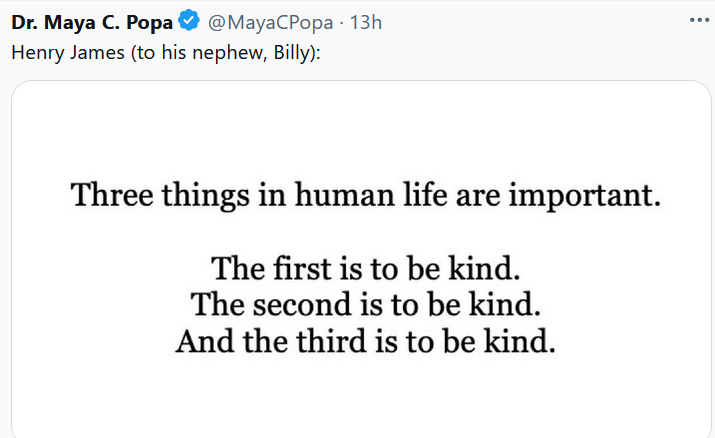
The First Thing . . .

Found in a posting on November 26 on Twitter the following thoughtful lines -- featuring counting -- by poet and editor Dr. Maya C. Popa,

Monday, November 27, 2023

A Proof in a Poem . . .

     I was led to this information by a recent (11/23/23) posting by @OxUniMaths on  𝕏 (at https://twitter.com/home)

     Mathematicians Germano Cardano and Nicolo Tartaglia  lived in Italy in the 16th century.  When Cardano tried to persuade Tartaglia to tell him the solution method for  to cubic equations, he received a description that he calls a poem. Andrew Wiles discusses this situation in a YouTube video, as part of his talk on the Langlands program.  The posting by @OxUniMaths on  𝕏 offers a brief section of that talk -- and includes this translation (from the original Italian) of Tartaglia's poem:

Tartaglia considers solving a cubic

To the right (above), Wiles has noted a symbolic translation of Tartaglia's words.  In his discussion of the poem, Wiles also notes that back in the 16th century all math was written using words.  

Thursday, November 16, 2023

Write about a MATH-WOMAN -- and WIN!

     Years ago -- when I was the only woman in the Bloomsburg University mathematics department --  I wrote a poem, "My Dance is Mathematics," about the mathematician Emmy Noether -- and it contained the following lines:

               If a woman's dance is mathematics,
               She dances alone.

But things are changing!  Founded in 1971, AWM (Association for Women in Mathematics) has been actively celebrating the lives of female mathematicians  -- and one of AWM's current and far-reaching activities is a STUDENT ESSAY CONTEST for which students -- in middle-school, high-school, and college categories -- are invited to interview a female mathematician and write about her.  The essay-submission period is December 1, 2023 - February 1, 2024.  Questions may be directed to AWM Essay Contest Organizer, Dr. Johanna Franklin (johanna.n.franklin@hofstra.edu). 

Monday, November 13, 2023

ADDING -- a List Poem

      Via an X (Twitter) posting by poet and blogger Marian Christie (@marian_v_o), I learned about a blog by writer Mike Ferguson entitled Gravy from the Gazebo -- available at this link.  Ferguson has posted a series of mathy list poems -- starting on November 10 with "Adding list poem".  The poem's opening lines are offered below and the complete poem is found at this link

The poem is introduced with these words:   Love a list poem, this is my latest – the kind of content and ideas I would like to introduce to students for writing their own:

Opening lines of a poem by Mike Ferguson -- the rest is here.

Ferguson next offered more lists: "Subtracting list poem" at this link AND "Multiplying list poem" at this link AND "Dividing list poem" at this link.

Read.  Reread.  Share.  Write your poetic response.  Share!

Thursday, November 9, 2023

A Mathy-Poetic Trajectory

      Carol Dorf is a retired math teacher and poet -- and at New Verse News I have discovered one of her recent mathy poems, "TRAJECTORY," posted on 10/09/2023.   I offer its opening lines below.

from   TRAJECTORY     by Carol Dorf

          The problem set gives us: a stone, force, an angle.
          Given this, predict when the stone will hit the ground.
          Outside the book this problem grows more complex
          even if there are no dragons to interfere with the trajectory.
          Imagine a missile. No don’t. There’s no need to imagine:
          haven’t you opened the paper today? Imagine a war
          where children’s bodies form the location of the necessary
          violence. Don’t authorities always say necessary?

                . . . . .              Dorf's complete TRAJECTORY is available at this link.

Carol Dorf is a Zoeglossia fellow, whose poetry has been published in several chapbooks and in a wide variety of journals; and she is a founding poetry editor of Talking Writing.  

Here is a link to the New Verse News website -- a collection of many, many poems.  This link leads to poems at that site by Carol Dorf, including "Trajectory." 

Monday, November 6, 2023

Take a Tour -- of Mathy Poems

       Recently I have discovered (at the website of the American Mathematical Society, AMS) a blog posting that features my blog.  Entitled "A Tour of Intersections:  Poetry with Mathematics," the posting by math and science writer Rachel Crowell.  Below I post a sample:

"MATH WOMAN"  -- acrostic poem by JoAnne Growney


AND . . .  readers are invited to EXPLORE THIS  BLOG for more!
AND
CREATE mathy poems!  and share them with joannegrowney (at) gmail (dot) com.

Thursday, November 2, 2023

Upcoming AMS Math-Poetry Contest

 Middle School Students

High School Students

College Students

Share YOUR POEMS via the 2024 Math-Poetry Contest

sponsored by the American Mathematical Society

Submit between November 27, 2023 and February 1, 2024

Detailed instructions for contest entries are found AT THIS LINK!  

Thursday, October 26, 2023

The Thirst to Know HOW MANY?

    One of the important math-poetry projects that I have been involved in is Strange Attractors:  Poems of Love and Mathematics, a poetry anthology collected and edited by mathematician-poet Sarah Glaz and me -- published by AK Peters/CRC Press in 2008 and now available on Kindle and at various online used-book sites.

     A poem in Strange Attractors that I have been drawn to again recently is "Ode to Numbers" by Chilean poet Pablo Neruda (1904-1973).  Here are its opening lines: 

from  Ode to Numbers     by Pablo Neruda

          Oh, the thirst to know
          how many!
          The hunger
          to know
          how many
          stars in the sky!   

Monday, October 23, 2023

Zero Man of India

     An interesting story that Google led me to is told in this article about "Zero Man of India" --  the article tells of  Shahbaz Khan, famously known as Shahbaz Hakbari, a multifaceted individual with talent in poetry, prose, mathematics, and education -- well-educated AND he he is a widely celebrated teacher.

"Mathematics and poetry may seem like two different worlds, but both require creativity, imagination, and thinking outside the box," Shahbaz Khan explained.

The article "Zero Man of India" contains many mentions of Khan/Hakbari's life as a poet -- but has no poems.  Nonetheless, the phrases quoted are poetic -- and, below, I have given two of them the shapes of  poems.