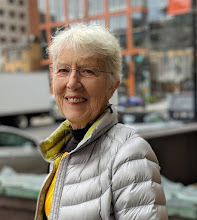
As the August days grow shorter in a hot summer of social distancing, here is a sample of my thoughts:
I learned to count
on my fingers.
Now, years later,
in twenty-twenty
what can I count on?
And I'd like also to make a quick mention of a project I've been part of -- with results that you are likely to enjoy. Gathered by Rosemary Winslow and Catherine Lee, a collection of thoughtful essays, DEEP BEAUTY -- Experiencing Wonder When the World Is on Fire (Woodhall Press, 2020). My essay, "When I'm Quiet Enough to See" tells of beauty's connection to my childhood on a farm, to poetry, to mathematics, and is available here.
Monday, August 24, 2020


Thursday, August 20, 2020
From an engineer who loves poetry . . .
João Augusto Sampaio is an Environmental and Civil Engineer who loves poetry; here is a sample:
 |
|
by João Augusto Sampaio
|
Sampaio has let me know that he is on Instagram using @jota_sampa; for another aspect of his work, this link leads to his lovely "visualizing math" posting of Ulam's Spiral, showing the distribution of primes.
Tuesday, August 18, 2020
Voting and being counted . . .
A story in the KIDSPOST section of today's Washington Post offers a reminder that 100 years ago today -- on August 18, 1920 -- the 19th Amendment to the US Constitution was officially ratified -- extending the right to vote to women.
Here is a link to a poem by Evie Shockley, women’s voting rights at one hundred (but who’s counting?) -- and, below, a few lines from that important poem:
* * *
one-mississippi
two-mississippis
* * *
one vote was all fannie lou
hamer wanted. in 1962, when
her constitutional right was
over forty years old, she tried
to register. all she got for her
trouble was literacy tested, poll
taxed, fired, evicted, & shot
at. a year of grassroots activism
nearly planted her mississippi
freedom democratic party
in the national convention.
* * *
For additional postings related to math and women and voting, here is a link to the results of a blog Search using the terms women and vote.
Monday, August 17, 2020
Heart Arithmetic
During these days of protest and politics and pandemic, a diversion -- some playful thoughts about LOVE from poet Carl Sandburg (1878-1967).
How Much? by Carl Sandburg
How much do you love me, a million bushels?
Oh, a lot more than that, Oh, a lot more.
And to-morrow maybe only half a bushel?
To-morrow maybe not even a half a bushel.
And is this your heart arithmetic?
This is the way the wind measures the weather.
Monday, August 10, 2020
Poems can help us teach/learn mathematics . . .
With increasing awareness of the value of integrating the arts in science and mathematics (expanding STEM to STEAM), numerous teachers are sharing their experiences of what works. Here, from the archive for BRIDGES 2020, is "Poetry in the Lesson of Mathematics"-- an article by Natalija Budinski and Zsolt Lavicza that describes a series of mathematical poetry activities for math and science students. Here's a sample of student lines (by F.T.):
Because when you practice math a lot,
it almost always pays off.
Because when you practice math a lot,
it almost always pays off.
Another article "Enrich Mathematics Discussions with Poems" (written by me and available here) suggests class-inclusion of poems about the nature of mathematics and its history, the lives and contributions of mathematicians -- including the work of women and minorities -- and similarities between mathematics and poetry. Discussion of student attitudes -- from excitement to math anxiety -- often can be facilitated by discussion of a poem; the article offers suggestions.
To find a host of additional poetry samples,
the blog Search offers a way to find poems on a topic of your choice.
Wednesday, August 5, 2020
Celebrate the Journal of Humanistic Mathematics
Recently Vol.10, No.2 of the online Journal of Humanistic Mathematics has become available online. This issue is a "Special Issue on Creativity in Mathematics" and the richly varied Table of Contents is available at this link.
Seven of the articles feature poetry with links to mathematics; these are:
Poetry: four seasons (haikus) by Stephen Luecking
Dear Arithmetic by Mary Soon Lee
Galileo's Verse by Bruce F. McGuffin
Hexagons by Barbara Quick
Changes and Deltas by Jim Wolper
Dear Arithmetic by Mary Soon Lee
Galileo's Verse by Bruce F. McGuffin
Hexagons by Barbara Quick
Changes and Deltas by Jim Wolper
And here are a couple of samples:
Monday, August 3, 2020
Point of Inflection -- and the coronavirus
In the UK, the Radical Statistics Group describes itself as "using statistics to support progressive social change." The June 2020 issue of their Journal -- Issue 126 -- is a "Coronavirus Special Issue" and it contains a poem by Texas professor-poet Lawrence Lesser. Here are the opening stanzas.
The Point of Inflection by Lawrence M. Lesser
is where towering terror of
cumulative cases
finally
slows its rise.
Wednesday, July 29, 2020
Census . . . correct counting is not easy. . .
One of the challenges of applying mathematics is doing it correctly. Each of us has a limited view, often affected by biases such as racism and sexism. And Covid-19 concerns have further-limited our access to accurate information in situations such as counting election-ballots or counting all Americans for the 2020 census. The following thoughtful poem, "Census," is not new; it was first published in 1981. What does it show us about counting?
Census by Carol Muske-Dukes
Here's how we were counted:
firstborn, nay-sayers,
veterans, slow-payers,
seditionists, convicts,
half-breeds, has-beens,
the nearly defined dead,
all the disenfranchised live.
firstborn, nay-sayers,
veterans, slow-payers,
seditionists, convicts,
half-breeds, has-beens,
the nearly defined dead,
all the disenfranchised live.
Monday, July 27, 2020
Prove it . . .
This post's title "Prove it" occurs several times within the poem,
DREAMers Mark Themselves by Maricielo Ampudia Gutiérrez,
a poem (found here, followed by an author bio) that arrived in a recent e-mail from the socially-engaged poetry group, Split This Rock -- and I have been reflecting on its use of the term "prove it" as compared with mathematical usage. The poem by Gutiérrez is included in a rich poetry database maintained by Split this Rock.
One of the editors of the online journal Better Than Starbucks, Joseph E. Petta, has let me know of his liking for poems with links to mathematics and encourages submissions. Petta's "Experimental & Form Poetry" section of the July August 2020 issue contains a thoughtful a thoughtful matrix poem, a word-prison:
Freedom by Stuthi Iyer
Both of these poems offer ideas for thoughtful contemplation -- for math people and for others!
Friday, July 24, 2020
A favorite recursion . . .
memories bring back
memories bring back
memories bring back
memories bring back
memories . . .
Wednesday, July 22, 2020
Finishing halfway . . .
Recently I have enjoyed thinking about the poem "Bunny Slope" by Polish poet Tadeusz Dabrowski (found here in The Paris Review, Issue 219, Winter 2016) and offered below.
When I write a poem, the first draft often is the longest -- I spill words onto the page and then attempt to edit out what does not need to be said. When I read poetry, I like it when the poem does not "tell all" but offers a framework for my discovery.
Bunny Slope by Tadeusz Dabrowski
(translated from Polish by Antonia Lloyd-Jones)
When I’m writing a poem,
there’s less and less of it.
As I approach the mountains,
they vanish behind a gentle hill,
behind the bunny slope.
When I’m writing a poem,
there’s less and less of it.
As I approach the mountains,
they vanish behind a gentle hill,
behind the bunny slope.
Monday, July 20, 2020
Math-Arts Connections -- links to rich reading . . .

The Table of Contents for the latest issue of the Journal of Mathematics and the Arts offers titles for a rich array of "Artists Viewpoints" -- brief articles (assembled under the leadership of Guest Editor, Susan Happersett) in which artists who link mathematics with various genres talk about their views and processes. (Access to these articles currently is FREE -- through 2020.)
One of the 53 artists' viewpoints contained therein is mine, and here is a permanent link to that brief article ("Everything Connects") that links my mathematics and poetry. Another math-poet whose work is featured is South Dakota mathematician Dan May, whose article "In the beginning all is null" features multiple-choice poetry.Friday, July 17, 2020
Poetry contest winners --- π-ku
The website Aperiodical.com is described as "a meeting-place for people who already know they like maths and would like to know more" -- and one of its organizing forces is Katie Steckles. Several weeks ago, Katie initiated a π-ku poetry contest -- looking for 3-line submissions that follow the digits of the π-approximation 3.14.
For example, Green grass and
blue
sky and sun's heat.
In π-ku
I
shrink what I think.
The numbers 3, 1, and 4 also may -- instead of counting syllables -- count words.
Today in July
sunshine
pushes the temperature skyward.
For example, Green grass and
blue
sky and sun's heat.
In π-ku
I
shrink what I think.
The numbers 3, 1, and 4 also may -- instead of counting syllables -- count words.
Today in July
sunshine
pushes the temperature skyward.
To enjoy the winning results in the Aperiodical π-ku contest, go here.
Wednesday, July 15, 2020
A thoughtful Fibonacci poem
An email message from Washington, DC poet and blogger Karren Alenier alerted me to this mathy Fibonacci poem found online in the Summer 2020 Issue (#36) of The Fib Review. The poet., Roberto Christiano, has given me permission to offer it to you here.
the irrational by Roberto Christiano
irrational
numbers
c'est moi?
a number that
cannot be expressed by the
ratio of two integers / and what's an integer?
the irrational by Roberto Christiano
irrational
numbers
c'est moi?
a number that
cannot be expressed by the
ratio of two integers / and what's an integer?
Subscribe to:
Posts (Atom)

 Posts
Posts