Wednesday, March 15, 2023

Poetry found in Scrabblegrams

      Poetry is often shaped by constraints -- syllable counts, patterns of rhythm and rhyme, and others -- and a writing constraint that has come to my attention recently is the "Scrabblegram."  I learned of the Scrabblegram in a blog posting by Marian Christie -- it is a collection of words that uses each of the 100 Scrabble-tile (including the pair of blank tiles, identified as needed) exactly once.

     Christie's blog introduced me to the work of David Cohen who -- using the Twitter handle @dc_scrabblegram -- posts a Scrabblegram daily.  Here is a link to Cohen's website.  And here is a mathy Scrabblegram verse that he posted on Twitter on World Maths Day, March 8, 2023.

A Scrabblegram from David Cohen.

Here is a link to another of David Cohen's Scrabblegrams -- this one features PI (and is also offered as a comment to my March 6 posting).        And here is one about the Fibonacci sequence.               

Monday, March 13, 2023

March is Women's History Month

Learn the history of MATH-WOMEN!

     A recently-released poetry collection that I have been excited to acquire is Jessy Randall's collection,  Mathematics for Ladies:  Poems on Women in Science (London: Goldsmiths Press, 2022).  I first met Jessy Randall's poetry when her poem ‘Elizabeth Cabot Agassiz (1822–1907)’ was published in the August, 2021 issue of Scientific American.

     After a thoughtful "Foreword" by Pippa Goldschmidt, we find 68 poetic snapshots of math women --going back as far as the 12th century and continuing into the the present.  Here is a sample:

CHARLOTTE ANGAS SCOTT (1858-1931)    by Jessy Randall

          When I was at college for mathematics
          I attended Cambridge lectures

          from behind a screen, of course.
          So the male students couldn't see me.

          (I might have distracted them.)   

Wednesday, March 8, 2023

International Women's Day

     Today, March 8, is International Women's Day -- a day to pause, recognize, and celebrate the achievements and abilities of women (and their equality with men).

In my poetry-stanza below I celebrate Laura Church -- my high school math teacher (in Indiana, PA)  a bold spokesperson for math-for-all back in the 1950s  AND the woman who led me into mathematics.

       Chalk in hand,
       she tosses her book,
       strides across the room,
       excited by trigonometry,
       excited that we,
       restless in our rows,
       caught some of it.
       Flamboyant, silver,
       fearless woman.

The stanza above is part of "The Ones I Best Remember" -- the full poem is available here.

Recognition and celebration of women in mathematics has increased dramatically since my high school days.  On of the important advocates is the Association for Women in Mathematics, founded in 1971, and often mentioned in this blogHere is a link to a poem that celebrates AWM.

Monday, March 6, 2023

Celebrate Pi-Day

 3 . 1 4 1 5 9 2 6 5 3  .  .  . 

March 14  -- that is, Pi-Day -- will soon be here.  One of the ways of celebrating  π  is with dessert pastries (pies)  -- but a  π-day  greeting often takes on the challenge of a message in Pilish -- a language whose word-lengths follow the digits of  π -- a challenge that students often enjoy!   An example:

Hug a tree, I shout -- hungering to defend trees and  . . .

Friday, March 3, 2023

FREE MINDS write and share . . .

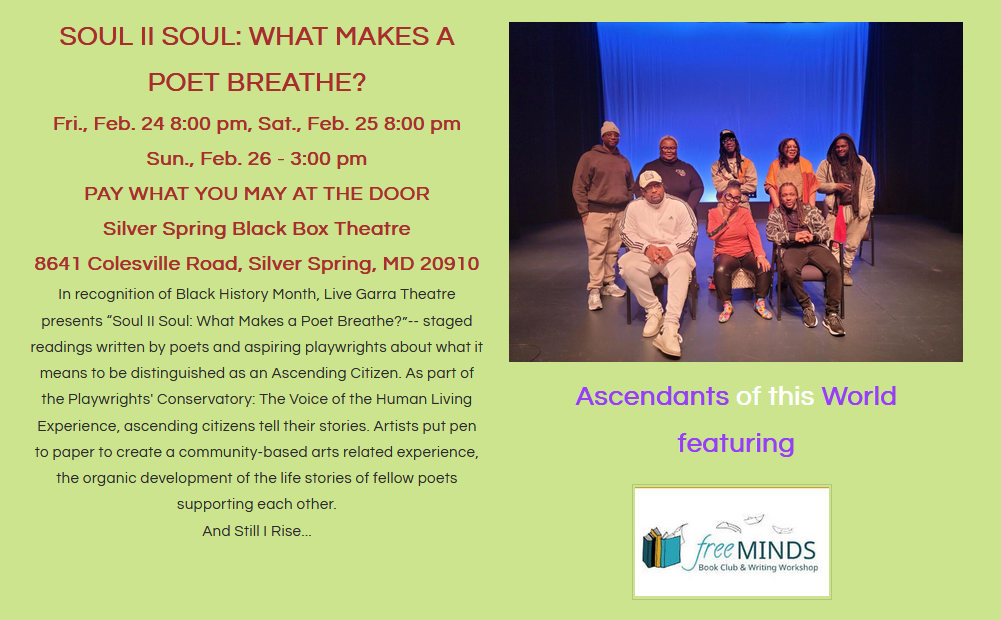
     Last weekend I attended a very special event at Live Garra Theatre in Silver Spring -- an event featuring poetry and drama from ascending citizens -- described in the image below.

Two organizations that endeavor to improve the lives of incarcerated and recently incarcerated persons are The Free Minds Book Club and Freedom Reads libraries

Wednesday, March 1, 2023

Is a proof the opposite of a poem?

      One of the valuable online sources from the MAA (Mathematical Association of America) is the Math Values blog -- found at this link -- a blog that explores COMMUNICATION, COMMUNITY, INCLUSIVITY, and TEACHING and LEARNING.  Using the SEARCH feature, I entered "poetry" and found this variety of resources -- including mention of the Steven Strogatz Prize for Math Communication -- SHARE YOUR LOVE OF MATH WITH THE WORLD -- a contest for high school students with deadline April 28, 2023.  Entry categories include Art, Audio, Performance, Social Media, Video, and Writing.  Guidelines are available here.

     Back in June, 2021 at this link I shared a portion of the poem by Julia Schanen that won in the Writing category that year.  It's second line is the title of this blog posting -- and the complete poem is available here.  A 2022 Strogatz winner was Wyeth Renwick -- and this blog posting features his poem.

     I close with two of my favorite lines of poetry:

        The Secret Sits     by Robert Frost (1874-1963)

               We dance around in a ring and suppose,
               But the Secret sits in the middle and knows.


Friday, February 24, 2023

Math-Poetry Word Cloud

      On this February Friday I became curious once-again about the frequency of various mathy-poetic words used here in my blog -- and I went to the website https://www.wordclouds.com to ask for a picture of my word-frequency.  Entering my blog-link (https://poetrywithmathematics.blogspot.com) led to the photo below:

Word Cloud for https://poetrywithmathematics.blogspot.com. 

So many of the words are too small to read -- "love" and "teachers" are two that I was delighted to be able to find.
A previous blog-work-cloud from several years ago is found at this link.


Tuesday, February 21, 2023

Celebrate Black Mathematicians

     In January, at the National Joint Mathematics Meetings in Boston, the National Association of  Mathematicians gave this year's Lifetime Achievement Award to Scott Williams, one of the organization's founders back in 1969.  NAM is  nonprofit professional organization in the mathematical sciences with membership open to all interested persons who support promoting excellence in the mathematical sciences for all Americans and promoting the mathematical development of all underrepresented American minorities, especially African Americans. (Learn more about NAM at this link.)

     My connection with Scott Williams began at a program at the headquarters of the MAA (Mathematical Association of America) in Washington, DC and it has continued because of the interest we share in poetry as well as mathematics.  Scott's Facebook postings often include poems -- and work by him is included in the latest issue of the Journal of Humanistic Mathematics --  about which I posted last week (at this link). 

Friday, February 17, 2023

More Math-Poetry from JHM

     Every six months a new issue of the open-access online publication, Journal of Humanistic Mathematics, becomes available.  And -- among lots of other inclusions -- it offers a rich variety of mathy poems.   Here is a link to the table of contents of the latest issue -- and I strongly suggest that you visit and explore.  Math-poetry items, listed at the bottom of the TC, are shown in the screen-shot below:

Monday, February 13, 2023

Happy Valentine's Day

      A perfect way for math-poetry fans to celebrate Valentine's Day is to visit the anthology, Strange Attractors: Poems of Love and Mathematics (AK Peters/CRC Pres, 2008), edited by Sarah Glaz and me.  Here is a sample from that collection, a limerick;

     There Was a Young Maiden    by Bob Kurosaka*

       There was a young maiden named Lizt
       Whose mouth had a funny half-twist.
            She'd turned both her lips
            Into Mobius strips . . .
        'Til she's kissed you, you haven't been kissed!

     *Of Japanese heritage, Kurosaka was born in Lake George, NW -- he became a college teacher and author of science fiction and limericks.

     Here is a link to previous Valentine-related postings:  
this link leads to blog-search results for "Strange Attractors."

Friday, February 10, 2023

The Power of Words -- from June Jordan

      One of the very special privileges that I had while taking classes  at Hunter College (1999-2001) was to attend a poetry reading by June Jordan (1936-2002) -- a reading that introduced me to the power of her fearless voice and the importance of her words.

     Jordan often uses repetition and the precision of numbers to  build  strength in her poems; here is a sample -- the opening lines of "The Bombing of Baghdad":

THE BOMBING OF BAGHDAD    

     began and did not terminate for 42 days
     and 42 nights relentless minute after minute
     more than 110,000 times
     ae bombed Iraq we bombed Baghdad
     we bombed Basra/we bombed military
     installations we bombed the National Museum
     we bombed schools we bombed air raid
     shelters we bombed water we bombed
     electricity we bombed hospitals we
     bombed streets we bombed highways
     we bombed everything that moved/we
     bombed everything that did no move we
     bombed Baghdad
     a city of 5.5 million human beings .  . .

The complete poem may be found here at poets.org.

At this link are numerous recordings of Jordan reading her poems.   Here is a link to an article by Hunter College professor Donna Masini, "Writing and Teaching in a Time of Crisis:  Lessons from June Jordan" -- and here is a link to previous mentions of Jordan and her work in this blog.

Monday, February 6, 2023

Remembering Linda Pastan

     On January 30, the wonderful and versatile poet, Linda Pastan (1932-2023) died.  Here at the Poetry Foundation website is a brief bio of Pastan along with ninety-six of her poems -- including the mathy poems "Arithmetic Lesson: Infinity" and "Counting Backwards".   This link leads to previous mentions of Pastan and her work in tis blog.  And below, one of my favorites of her poems, "Algebra" -- which I also posted at this link back in November, 2013.

Algebra     by Linda Pastan

        I used to solve equations easily.
        If train A left Sioux Falls
        at nine o'clock, traveling
        at a fixed rate,
        I knew when it would meet train B.
        Now I wonder if the trains will crash;
        or else I picture naked limbs
        through Pullman windows, each
        a small vignette of longing.   

Thursday, February 2, 2023

Celebrate Groundhog Day!

      Since my days as a girl on a farm near the town of Indiana, Pennsylvania -- not far from Punxsutawney, Pennsylvania -- I have long been familiar with Groundhog Day.  Here is a link that you can use to browse this blog's celebrations and memories of  this special holiday.

Wednesday, February 1, 2023

Daughters Can Also Be Heroic . . .

     A recent online Cultural Collective article featured the Chinese astronomer -- and mathematician and poet -- Wang Zhenyi (1768-1797) in an article entitled, "The Woman Genius Who Surpassed Da Vinci and History Forgot."   Although her poetry was mentioned, no samples were included -- here is a link to a stanza of hers that I posted back in February 2021 (a stanza that includes the title of this posting).  

     A well-known Qing dynasty scholar, Yuan Mei, commented on Wang’s poetry by saying it “had the flavor of a great pen, not of a female poet.”  Her poetry included her understanding of classics and history and experiences during her travels -- items such as scenery and the lives of those with whom she made acquaintances.   Here is a sample -- one of several of Zhenyi's poetic stanzas in Wikipedia:

       Transiting Tong Pass      by Wang Zhenyi

            So important is the doorway,
            occupying the throat of the mountain
            Looking down from the heaven,
            The sun sees Yellow river streaming.