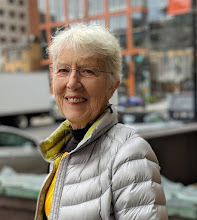
I first read "The Geometry of Poetry" by Janet R. Kirchheimer online in Poemeleon -- and her work also has appeared in many other journals, anthologies and websites. She is currently
producing AFTER, a film that explores poetry written about the Holocaust. Thanks, Janet, for this poem with its mathy comparisons.
The Geometry of Poetry by Janet R. Kirchheimer Thursday, February 23, 2017
The Geometry of Poetry
Some poems lie around for A LONG TIME waiting for me to pick them up. Or I pick them up and put them down in a special place and then place something else on top of them. Such is the case with Janet Kirchheimer's "The Geometry of Poetry" -- several years ago Janet and I corresponded and then I didn't follow through with posting her poem. And now, this week, I am working on a paper for Bridges 2017 -- a math-arts conference to be held in Waterloo, Ontario at the end of July -- and my working title is the same as the title of Janet's poem. AND, this coincidence helped me to FIND her poem to give you to enjoy.


Tuesday, February 21, 2017
An old link but a GOOD one!
Today I have been working on some ideas for a paper for the 2017 BRIDGES Math-Arts Conference and I have needed to refer back to an old paper of mine, "Mathematics in Poetry," that I wrote for MAA's JOMA more than 10 years ago -- a survey article that introduces a variety of viewpoints and examples. Enjoy!
Thursday, February 16, 2017
The Infinite
On page 53 of the February 6 issue of The New Yorker I recently found and enjoyed a poem entitled "The Infinite" by Charles Simic. Here are its opening lines:
The infinite yawns and keeps yawning.
Is it sleepy?
Does it miss Pythagoras?
The infinite yawns and keeps yawning.
Is it sleepy?
Does it miss Pythagoras?
Monday, February 13, 2017
Love and Mathematics -- and Valentine's Day
Perhaps you need a love poem for a mathematician, or about a mathematician -- you might enter the words love and mathematician in the search box to the right and find what this blog has to offer. And here is a link to previous postings that celebrate Valentine's Day. Enjoy!!
Read it (math OR poem) more than once . ..
Recently my poet-friend, Millicent Borges Accardi, sent me a copy of her latest book, Only More So (Salmon Poetry, 2016). She mentioned a poem entitled "The Night of Broken Glass" for its mathematics -- indeed it includes several numbers as it movingly describes attempts at normalcy amid the horrors of urban attack; and it ends with this stanza :
The essential business of living well
Continues in shock waves
That fall into the ground of innocent
People, triggered inside a soul
Of nothingness that pretended
To solve an impossible equation.
My favorite poem in Accardi's collection is "Amazing Grace" which I give you below. It is a poem that, like an intriguing piece of mathematics, I have read, and read again, and again . .. each time getting more meaning than the time before.
For me, one of the similarities of poetry and math is their density, the need for several readings -- for reading both aloud and silently, for reading with pencil and paper for note-taking, for reading in the library and at the kitchen table, sitting or standing.
The essential business of living well
Continues in shock waves
That fall into the ground of innocent
People, triggered inside a soul
Of nothingness that pretended
To solve an impossible equation.
My favorite poem in Accardi's collection is "Amazing Grace" which I give you below. It is a poem that, like an intriguing piece of mathematics, I have read, and read again, and again . .. each time getting more meaning than the time before.
For me, one of the similarities of poetry and math is their density, the need for several readings -- for reading both aloud and silently, for reading with pencil and paper for note-taking, for reading in the library and at the kitchen table, sitting or standing.
Thursday, February 9, 2017
Like James Baldwin - refuse labels!
Last Sunday evening -- instead of watching Super Bowl LI -- in a crowded theater in downtown Silver Spring I watched the recently-released documentary "I Am Not Your Negro," narrated using words of writer James Baldwin (1924-1986). Baldwin was a contrarian, he avoided or contradicted labels and categories.
One of my favorite quotes -- that I see as intimately related to discovery in mathematics (from Hungarian-American Nobelist, Albert Szent-Gyorgyi (1893-1986)) -- applies also to Baldwin:
Discovery is seeing
what everybody else has seen, and thinking
what nobody else has thought.
And here, from Jimmy's Blues & Other Poems (Beacon Press, 2014) is Baldwin's little poem "Imagination" which captures the same sort of mind-play that occurs with mathematics.
One of my favorite quotes -- that I see as intimately related to discovery in mathematics (from Hungarian-American Nobelist, Albert Szent-Gyorgyi (1893-1986)) -- applies also to Baldwin:
Discovery is seeing
what everybody else has seen, and thinking
what nobody else has thought.
And here, from Jimmy's Blues & Other Poems (Beacon Press, 2014) is Baldwin's little poem "Imagination" which captures the same sort of mind-play that occurs with mathematics.
Monday, February 6, 2017
Celebrate Francis Su
In this morning's email I got a link (Thanks, Greg Coxson!) to this story that celebrates the talented mathematician and compassionate human being, Francis Su. Dr Su (of Harvey Mudd College) has recently completed a term as president of the Mathematical Association of America. Here is a link to Dr Su's retiring presidential address -- for which he received a standing ovation. Read. Learn. Admire. Celebrate. Imitate!
Scrolling down in this blog to my posting for January 11, 2017 will lead you to links to several poems that celebrate mathematicians. And a blog-SEARCH using "mathematician" will find even more such poems. Enjoy!
A thorough advocate in a just cause,
a penetrating mathematician facing the starry heavens,
both alike bear the semblance of divinity.
-- Goethe (1749-1832)
Scrolling down in this blog to my posting for January 11, 2017 will lead you to links to several poems that celebrate mathematicians. And a blog-SEARCH using "mathematician" will find even more such poems. Enjoy!
A thorough advocate in a just cause,
a penetrating mathematician facing the starry heavens,
both alike bear the semblance of divinity.
-- Goethe (1749-1832)
Thursday, February 2, 2017
Groundhog Day 2017
My scan of this morning's Washington Post did not find a mention of today's important status as Groundhog Day -- and I am worried that perhaps the new President 45 has banned these useful creatures. If you wish, you may search this blog for postings related to Groundhog Day and, if you do, you can get these results. Enjoy!
Tuesday, January 31, 2017
Life is Short
These recent days in the reign of the 45th US President have given new drama to the word survival. Looking for wisdom I revisited this poem, a survival-poem with a couple of numbers -- by Maggie Smith -- found at one of my favorite sources for poetry, PoetryFoundation.org.
Good Bones by Maggie Smith
Life is short, though I keep this from my children.
Life is short, and I’ve shortened mine
in a thousand delicious, ill-advised ways,
a thousand deliciously ill-advised ways
I’ll keep from my children. The world is at least
fifty percent terrible, and that’s a conservative
estimate, though I keep this from my children.
Good Bones by Maggie Smith
Life is short, though I keep this from my children.
Life is short, and I’ve shortened mine
in a thousand delicious, ill-advised ways,
a thousand deliciously ill-advised ways
I’ll keep from my children. The world is at least
fifty percent terrible, and that’s a conservative
estimate, though I keep this from my children.
Sunday, January 29, 2017
Girls can do EVERYTHING!
In a conversation years ago with one of my math colleagues at Bloomsburg University, each of us learned that the other had grown up on a farm. My colleague credited the problem-solving requirements of farm-life with being good training for mathematics. In time, I came to agree with him. Some environments EXPECT you to be a problem-solver and, in spite of yourself, you comply. I have tried to write poetically about this. My efforts so far include these 3x3 syllable-square poems.
And, here is a link to a recent NPR story about the underestimates that girls make about how smart they are -- so little has changed since I was a girl. Hoping I can help to change things for my granddaughters!
Girls who change
light-bulbs change
everything!
Girls who prove
theorems can
do it all!
And, here is a link to a recent NPR story about the underestimates that girls make about how smart they are -- so little has changed since I was a girl. Hoping I can help to change things for my granddaughters!
Thursday, January 26, 2017
Ultimately, all mathematics is poetry . . .
A popular vote on the truth of "all mathematics is poetry" might not lead to its affirmation. Because mathematics is a concise language, with emphasis on placing the best words in the best order, it often is described by mathematicians and scientists as poetry. Alternatively, and more accessible to most readers than poetic mathematics, we find verses by poets who include the objects and terminology of mathematics in their lines.
Perhaps due to aesthetic distance (featured in The Art of Mathematics by Jerry King), non-math poets like Christina M. Rau are able to be more playful in their uses of mathematical vocabulary than mathematicians dare to be. Enjoy below several stanzas from Rau's collection, Liberating the Astronauts -- which also includes titles like "Chasing Zero" and "Kepler's Laws" -- soon to be released by Aqueduct Press.
from: Overnight Rain by Christina M. Rau
Rain over Night
Equals
X over Autumn
Perhaps due to aesthetic distance (featured in The Art of Mathematics by Jerry King), non-math poets like Christina M. Rau are able to be more playful in their uses of mathematical vocabulary than mathematicians dare to be. Enjoy below several stanzas from Rau's collection, Liberating the Astronauts -- which also includes titles like "Chasing Zero" and "Kepler's Laws" -- soon to be released by Aqueduct Press.
from: Overnight Rain by Christina M. Rau
Rain over Night
Equals
X over Autumn
Monday, January 23, 2017
All Mathematicians are Equal!
Last Saturday's Women's March in Washington was one the great events of my lifetime -- the feeling of community that bonded us participants was palpable. We chatted and hugged and celebrated our differences and our common ideals. Here is a photo of the sign that I carried and, beneath the sign, are links to poems about women in mathematics who struggled to be considered equal.
This link leads to "Hanging Fire" by Audre Lorde. This link leads to a few words of mine, "Square Attitudes." A posting on girls and mathematics includes samples from Sharon Olds and Kyoko Mori and is available here.
 |
| This is the sign I carried at the Women's March on January 21, 2017. |
This link leads to "Hanging Fire" by Audre Lorde. This link leads to a few words of mine, "Square Attitudes." A posting on girls and mathematics includes samples from Sharon Olds and Kyoko Mori and is available here.
Thursday, January 19, 2017
Dickens, from A Tale of Two Cities
Today I am facing tomorrow and the inauguration ceremony of Donald Trump as the 45th President of the United States. With many uncertainties and little mathematics in mind (see, however, math-poem link below), I have looked back to the opening words of A Tale of Two Cities by Charles Dickens (1812-1870). Published in 1859, these words echo some of my thoughts today.
It was the best of times,
it was the worst of times,
it was the age of wisdom,
it was the age of foolishness,
it was the epoch of belief,
it was the epoch of incredulity,
it was the season of Light,
it was the season of Darkness,
it was the spring of hope,
it was the winter of despair,
we had everything before us,
we had nothing before us . . .
Here is a link to a poem posted in 2014 that also features the words of Dickens. Written by Halifax mathematician and poet Robert Dawson, that 2014 poem was formed by applying a mathematical procedure to a passage from Dickens' Great Expectations.
It was the best of times,
it was the worst of times,
it was the age of wisdom,
it was the age of foolishness,
it was the epoch of belief,
it was the epoch of incredulity,
it was the season of Light,
it was the season of Darkness,
it was the spring of hope,
it was the winter of despair,
we had everything before us,
we had nothing before us . . .
Here is a link to a poem posted in 2014 that also features the words of Dickens. Written by Halifax mathematician and poet Robert Dawson, that 2014 poem was formed by applying a mathematical procedure to a passage from Dickens' Great Expectations.
Monday, January 16, 2017
Celebrate Martin Luther King
Today is our public celebration of the January 15 birthday of Martin Luther King, Jr (1929-1968) who was both preacher and poet in the "I have a dream" speech he delivered on the steps at the Lincoln Memorial in Washington D.C. on August 28, 1963.
Dr King's speech began with:
Five score years ago, a great American,
in whose symbolic shadow we stand
signed the Emancipation Proclamation.
This momentous decree came as a
great beacon light of hope
to millions of Negro slaves who had been
seared in the flames of withering injustice.
Dr King's speech began with:
Five score years ago, a great American,
in whose symbolic shadow we stand
signed the Emancipation Proclamation.
This momentous decree came as a
great beacon light of hope
to millions of Negro slaves who had been
seared in the flames of withering injustice.
Wednesday, January 11, 2017
Poems starring mathematicians
One of the challenges posed by a multi-year blog is locating interesting old posts. One of my frequent early topics was "poems starring mathematicians" and I offer links to several of these from 2011 below:
December 8 "Monsieur Probability" by Brian McCabe
November 13 My abecedarian poems, "I Know a Mathematician" and "Mathematician"
July 5 "Fixed Points" by Susan Case -- about mathematicians in Poland during WWII
July 2 "To Myself" by Abba Kovner
January 30 "Mr Glusenkamp," a sonnet to a geometry teacher by Ronald Wallace
January 28 "Mathematician" by Sherman K Stein
And, here is a link, via PoemHunter.com to "The Mathematician in Love," a poem by William John Macquorn Rankine, a poem that appears also in the multi-variable anthology, Strange Attractors: Poems of Love and Mathematics (AK Peters, 2008), edited by Sarah Glaz and me. Here is the first (of 8) stanza of Rankine's entertaining poem:
A mathematician fell madly in love
With a lady, young, handsome, and charming:
By angles and ratios harmonic he strove
Her curves and proportions all faultless to prove.
As he scrawled hieroglyphics alarming.
December 8 "Monsieur Probability" by Brian McCabe
November 13 My abecedarian poems, "I Know a Mathematician" and "Mathematician"
July 5 "Fixed Points" by Susan Case -- about mathematicians in Poland during WWII
July 2 "To Myself" by Abba Kovner
January 30 "Mr Glusenkamp," a sonnet to a geometry teacher by Ronald Wallace
January 28 "Mathematician" by Sherman K Stein
And, here is a link, via PoemHunter.com to "The Mathematician in Love," a poem by William John Macquorn Rankine, a poem that appears also in the multi-variable anthology, Strange Attractors: Poems of Love and Mathematics (AK Peters, 2008), edited by Sarah Glaz and me. Here is the first (of 8) stanza of Rankine's entertaining poem:
A mathematician fell madly in love
With a lady, young, handsome, and charming:
By angles and ratios harmonic he strove
Her curves and proportions all faultless to prove.
As he scrawled hieroglyphics alarming.
Friday, January 6, 2017
2017 is prime!
For her December 31 posting in Roots of Unity (Scientific American blog) mathematician Evelyn Lamb wrote about favorite primes -- and starring in her list is our new year-number, 2017.
My own relationship with primes also is admiring-- here is an excerpt from my poem, "Fool's Gold," (found in full here) that suggests a prime as a suitable birthday gift:
Select and give a number. I like large primes—
they check my tendency to subdivide
myself among the dreams that tease
like iron pyrites in declining light.
"Fool's Gold" appears in my chapbook, My Dance is Mathematics (Paper Kite Press, 2006); the collection is now out-of-print but is available online here.
Several poems about primes have been included in earlier postings in this blog. For example, here is a link to a 2013 posting of "The Sieve of Erastosthenes" by Robin Chapman. And, for further exploration, here is a link to the results of searching the six years of postings using the term "prime."
My own relationship with primes also is admiring-- here is an excerpt from my poem, "Fool's Gold," (found in full here) that suggests a prime as a suitable birthday gift:
Select and give a number. I like large primes—
they check my tendency to subdivide
myself among the dreams that tease
like iron pyrites in declining light.
"Fool's Gold" appears in my chapbook, My Dance is Mathematics (Paper Kite Press, 2006); the collection is now out-of-print but is available online here.
Several poems about primes have been included in earlier postings in this blog. For example, here is a link to a 2013 posting of "The Sieve of Erastosthenes" by Robin Chapman. And, for further exploration, here is a link to the results of searching the six years of postings using the term "prime."
Tuesday, January 3, 2017
December 2016 (and prior) -- titles, dates of posts
Here are the titles and dates of previous blog postings,
moving backward from the present.
For mathy poems related to a particular mathy topic -- such as women in math or climate or triangle or circle or teacher or . . . -- click on a selected title below or enter the desired term in the SEARCH box in the right-hand column. For example, here is a link to a selection of poems found using the pair of search terms "women equal." For poems about calculus, follow this link. To find a list of useful search terms, scroll down the right-hand column.
Dec 31 Happy New Year! -- Resolve to REWARD WOMEN!
Dec 27 Celebrate Vera Rubin -- a WOMAN of science!
Dec 26 Post-Christmas reflections from W. H. Auden
Dec 19 Numbers for Christmas . . .
Dec 15 Remembering Thomas Schelling (1921-2016)
Dec 12 When one isn't enough ... words from a Cuban poet
Dec 31 Happy New Year! -- Resolve to REWARD WOMEN!
Dec 27 Celebrate Vera Rubin -- a WOMAN of science!
Dec 26 Post-Christmas reflections from W. H. Auden
Dec 19 Numbers for Christmas . . .
Dec 15 Remembering Thomas Schelling (1921-2016)
Dec 12 When one isn't enough ... words from a Cuban poet
Saturday, December 31, 2016
Happy New Year! -- Resolve to REWARD WOMEN!
My December 27 post celebrated the life of Vera Rubin (b 1928) who died on Christmas Day -- and a more recent Washington Post article by columnist Petula Dvorak has used the example of Vera Rubin to call further attention to ongoing discrimination against high-achieving women.
On a different note, my e-mail "poem-a-day" from poets.org is "Earthy Anecdotes" by Reading, Pennsylvania poet Wallace Stevens (1879-1955)-- follow this link to visit the poem (with its morsel of mathematics) and see the vivid image of Oklahoma bucks moving in "a swift, circular line".
On a different note, my e-mail "poem-a-day" from poets.org is "Earthy Anecdotes" by Reading, Pennsylvania poet Wallace Stevens (1879-1955)-- follow this link to visit the poem (with its morsel of mathematics) and see the vivid image of Oklahoma bucks moving in "a swift, circular line".
Happy New Year, 2017!
Tuesday, December 27, 2016
Celebrate Vera Rubin -- a WOMAN of science!
This morning's Washington Post carried an obituary of Vera Rubin (1928-2016), a pioneering astronomer who confirmed the existence of dark matter. Yesterday's NPR feature -- noting Rubin's death and celebrating her life -- contained several quotes from this outstanding scientist about women's roles. Two of these poetic statements I have shaped into syllable-square stanzas:
World wide, half
of all brains
are women's.
Monday, December 26, 2016
Post-Christmas reflections from W. H. Auden
A favorite writer whose works I enjoy again and again is English poet Wystan Hugh Auden (1907-1973). Here is a mathy excerpt from a very long Auden poem (around 1500 lines) entitled "FOR THE TIME BEING: A Christmas Oratorio," written during World War II and available in his Collected Poems.
The Christmas Feast is already a fading memory,
And already the mind begins to be vaguely aware
Of an unpleasant whiff of apprehension at the thought
Of Lent and Good Friday which cannot, after all, now
Be very far off. But, for the time being, here we all are,
Back in the moderate Aristotelian city
Of darning and the Eight-Fifteen, where Euclid's geometry
And Newton's mechanics would account for our experience,
And the kitchen table exists because I scrub it.
Another mathy Auden poem, "Numbers and Faces," is available here. And this link leads to more of his work.
The Christmas Feast is already a fading memory,
And already the mind begins to be vaguely aware
Of an unpleasant whiff of apprehension at the thought
Of Lent and Good Friday which cannot, after all, now
Be very far off. But, for the time being, here we all are,
Back in the moderate Aristotelian city
Of darning and the Eight-Fifteen, where Euclid's geometry
And Newton's mechanics would account for our experience,
And the kitchen table exists because I scrub it.
Another mathy Auden poem, "Numbers and Faces," is available here. And this link leads to more of his work.
Monday, December 19, 2016
Numbers for Christmas . . .
*
o n
t o p
g i v e
l i g h t
f r e e l y
f o r e v e r
a b u n d a n t
b r i l l i a n t
e v e r y w h e r e
o n
t o p
g i v e
l i g h t
f r e e l y
f o r e v e r
a b u n d a n t
b r i l l i a n t
e v e r y w h e r e
LOVE MATH!
Christmas is coming and I have looked back to earlier posts for holiday greetings -- a version of the growing snowball poem above was first posted in 2012 and here, from 2010, is a Christmas verse that celebrates pi:
Thursday, December 15, 2016
Remembering Thomas Schelling (1921-2016)
On December 13, Nobel-prize-winning economist Thomas Schelling (b 1921) died. I had the privilege of meeting this outstanding scholar in Cambridge, MA back in 1980 when I dropped by his office after hearing him lecture at the Kennedy School of Government. I became very interested in his ideas of critical mass (found along with lots of other good stuff in Micromotives and Macrobehavior and eventually included the topic in a textbook that I wrote for a liberal arts mathematics course, "Mathematical Thinking," that I helped to develop at Bloomsburg University.
I want to honor Schelling with a poem, but . . .
I
can’t
find a
poem for
Thomas Schelling – thus
I am compelled to write this Fib.
Thanks for thinking well, for sharing your keen thoughts with us.
I want to honor Schelling with a poem, but . . .
I
can’t
find a
poem for
Thomas Schelling – thus
I am compelled to write this Fib.
Thanks for thinking well, for sharing your keen thoughts with us.
(Fibonacci Numbers: 1, 1, 2, 3, 5, 8, 13 . . .)
Monday, December 12, 2016
When one isn't enough ... words from a Cuban poet
Last week I traveled (as part of an organized people-to-people program) to Cuba. I will need many days to sort and digest and organize the details of that experience.
Neither poetry nor mathematics was part of our Cuba schedule but I did have a chance to visit the sparse collection at La Moderna Poesia in Havana and to purchase their only two bilingual poetry collections (by poets José Martí and Nicolás Guillén). The PoetryFoundation website has introduced me to the work of Cuban poet Omar Pérez (son of Ernesto "Che" Guevara) and I found there, at this link, Pérez's poem "The Progression" -- which includes some mathematical ideas.
The Progression by Omar Pérez
translated by Kristin Dykstra
When one isn’t enough, you need two
when two aren’t enough, you need four
with four the progression begins, moving toward a number
that schoolteachers will call absurd.
Neither poetry nor mathematics was part of our Cuba schedule but I did have a chance to visit the sparse collection at La Moderna Poesia in Havana and to purchase their only two bilingual poetry collections (by poets José Martí and Nicolás Guillén). The PoetryFoundation website has introduced me to the work of Cuban poet Omar Pérez (son of Ernesto "Che" Guevara) and I found there, at this link, Pérez's poem "The Progression" -- which includes some mathematical ideas.
The Progression by Omar Pérez
translated by Kristin Dykstra
When one isn’t enough, you need two
when two aren’t enough, you need four
with four the progression begins, moving toward a number
that schoolteachers will call absurd.
Monday, November 28, 2016
Celebrate MATH-POETRY at JMM (1-5-17) in Atlanta
Repeating what has become an annual tradition, the Joint Mathematics Meetings of 2017 in Atlanta will include a poetry reading.
Thursday January 5, 2017, 5:30 p.m.-7:00 p.m.
Regency Ballroom VII, Ballroom Level, Hyatt Regency
Here is info about the reading and how to participate: Poetry + Math, organized by Gizem Karaali, Pomona College; Lawrence M. Lesser, University of Texas at El Paso; and Douglas Norton, Villanova University; Thursday, January 5, 5:30–7:00 pm. All who are interested in mathematical poetry and/or mathematical art are invited. Though we do not discourage last-minute decisions to participate, we invite and encourage poets to submit poetry (no more than three poems, no longer than five minutes) and a bio in advance—and, as a result, be listed on our printed program. Inquiries and submissions (by December 15, 2016) may be made to Gizem Karaali (gizem.karaali@pomona.edu). Sponsors for this event are the Journal of Humanistic Mathematics and SIGMAA ARTS. A complete program for the Mathematics Meetings is available here.
Regency Ballroom VII, Ballroom Level, Hyatt Regency
Friday, November 25, 2016
Number-rhymes from Muriel Spark
A dozen years ago I visited Edinburgh and there became acquainted with the poetry of Scottish writer Muriel Spark (1918-2006) -- prior to that visit I had known Spark only as a novelist. Today -- prompted by Thanksgiving celebration with grandchildren -- I have remembered an English rhyme that my own grandmother teased me with in childhood, "Going to St Ives" and, from there, I've recalled a pair of Spark's rhymes that follow a similar pattern. I offer them below; despite strong rhyme, these are not entirely light fare--instead, they make us aware of the sad multiplication of bonds and wounds . . .
Conundrum by Muriel Spark
As I was going to Handover Fists
I met a man with seven wrists.
The seven wrists had seven hands;
Conundrum by Muriel Spark
As I was going to Handover Fists
I met a man with seven wrists.
The seven wrists had seven hands;
Monday, November 21, 2016
An immeasurable continuum
This poem by Emily Warn (a founder of PoetryFoundation.org) uses mathematical terminology to introduce us to the immeasurable horror of death by slow torture. May our nation never again engage in such atrocities!
The Vanishing Point by Emily Warn
You slow down to watch cumulus clouds stream across the
sky. You choose a more circuitous route home and pass a
tree with white bags tied around random apples. The apples
remind you of clouds, how each hangs in the sky, singular
yet part of a flock. Each item in the flock is a coordinate of
earth and sky, enumerating space. The flocks of apples and
clouds are actual infinities, an endless collection of discrete
items that one can conceivably count to the end. This is
The Vanishing Point by Emily Warn
You slow down to watch cumulus clouds stream across the
sky. You choose a more circuitous route home and pass a
tree with white bags tied around random apples. The apples
remind you of clouds, how each hangs in the sky, singular
yet part of a flock. Each item in the flock is a coordinate of
earth and sky, enumerating space. The flocks of apples and
clouds are actual infinities, an endless collection of discrete
items that one can conceivably count to the end. This is
Friday, November 18, 2016
A well-constructed language
California math teacher, poet and editor, Carol Dorf is a vital force in the production and dissemination of mathy poems. A blog SEARCH using her name will find links to all of my mentions of her activity. Here is one such link -- to my list of titles of mathy poems in Talking-Writing, an online journal for which Dorf is poetry editor. Dorf's poem below speaks of Ada Lovelace, a math-woman who has been featured herein on July 16, 2015 and September 18, 2015.
 |
| Mathematics is "a well-constructed language." |
Dorf's "Ada" first appeared in Volume 14 of The Mom Egg Review.
Tuesday, November 15, 2016
Poetry and Protest
One of the fine new anthologies of 2016 is Of Poetry and Protest: From Emmett Till to Trayvon Martin, published by W W Norton -- put together by Phil Cushway (Compiler), Michael Warr (Editor), and Victoria Smith (Photographer). Here, from that collection, are the opening stanzas of Marilyn Nelson's "Cells and Windows" -- a poem that gains much of its power from the awful truth conveyed by its numbers.
Cells and Windows by Marilyn Nelson
after work by neogeo painter Peter Halley
Black men in their prime
working years, especially
those without a high school
diploma, are much more likely
to be in jail than white men are.
(a) true (b) true
Cells and Windows by Marilyn Nelson
after work by neogeo painter Peter Halley
Black men in their prime
working years, especially
those without a high school
diploma, are much more likely
to be in jail than white men are.
(a) true (b) true
Subscribe to:
Posts (Atom)

 Posts
Posts