Wednesday, September 4, 2019

Poems of Mathematics -- recalling some old posts

     Today I have been browsing some old posts, and offer below a few links to remind us of mathy poems posted in this blog more than five years ago

     “Compromise” by Charles S Allen     
           “Give Me an Epsilon and I Will Treat It Well” by Ray Bobo 
     “The Icosasphere” by Marianne Moore   
          “Mandelbrot Set” by Jonathan Coulton 
     “Numbers”  by JoAnne Growney (a syllable-snowball) 
          “Numerical Landscape” by Eveline Pye 
     “Talking Big” by John Bricuth 
         “Zito the Magician” by Miroslav Holub  
     "Gaps" by Philip Holmes

AND, please go on to SEARCH this blog for lots more poems by Eveline Pye and Miroslav Holub -- and for other names that you find listed in the right-hand column (under Labels . . .).

Tuesday, September 3, 2019

Is this Fib true?


     Is
     it
     true that
     among folks
     not anchored to math
     by study or career choice, more
     people show delight in being poor at math than good ?

The lines above have syllable counts that follow the first seven Fibonacci numbers: 1,1,2,3,5,8,13.

Thursday, August 29, 2019

Enrich Mathematics Classes with Poems

    In my mathematics classrooms, I have found it a challenge to include the history and spirit of mathematics -- and its people -- along with the math topics to be covered.  Because I love poetry -- and also write some -- I gradually became aware of poems that could enrich my classes and I began to incorporate poetry in outside readings and essay topics and class discussions.

Here are links to poems that introduce the lives of four math-women:
     Sophie Germain (1776-1831)
     Florence Nightingale  (1820-1910)
     Amalie "Emmy" Noether  (1882-1935)
     Grace Murray Hopper (1906 - 1988)
And here is a poem about four influential teachers of mine; three of them math-people; three of them women.

Math Anxiety can be a hard topic for student or teacher to bring up -- but airing of views and healing might come from discussion.  Poems to consider include: 

Wednesday, August 28, 2019

The personal becomes mathematical -- in poetry

     Elizabeth Barrett Browning (1806-1861) used counting in her description of love in her sonnet that begins "How do I love thee?  Let me count the ways."  Contemporary artist, poet, and retired math professor Sandra DeLosier Coleman finds relationships a bit more complicated -- and builds her description in the poem below on the square root of two.

       Between You and the Root of Two     by Sandra DeLozier Coleman

       I have less chance of knowing you
       than of writing out the root of two.
       How e're I start, it never ends,
       exploring how love lies, pretends.   

Monday, August 26, 2019

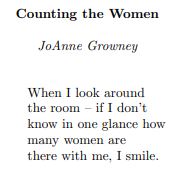
Counting the Women . . .

     Sometimes a professional group or a meeting-agenda or a table of contents contains so few women's names that they are easily counted.  In this syllable-square stanza, I praise the absence of that condition: 

     This stanza and others with similar attitude appear in "Give Her Your Support" -- a poetry-page published recently in Math Horizons.  For the entire collection, follow this link.

Wednesday, August 14, 2019

Journal of Humanistic Mathematics--a TREASURE

     Online and available FREE, the Journal of Humanistic Mathematics is a wonderful source of poems and stories and articles that connect mathematics to life.  Thanks to editors Mark Huber and Gizem Karaali who lead the effort to bring us new issues each January and July.  Here is a link to the Table of Contents for the July 2019 issue.   Included in this issue is a thoughtful article by Sarah Mayes-Tang entitled "Telling Women's Stories:  A Resource for College Mathematics Instructors" -- and, related to this, here is a link to postings in this blog found using a SEARCH for "mathematics and women and poem."  (Scroll down the list of postings to find individual poems.)
     This current issue of JHM also offers a selection of five poems and also a folder with insightful reflections in both prose and poetry -- "A Life of Equations Shifting to a Life of Words" by Thomas Willemain.

Follow the links.  And enjoy!

Monday, August 12, 2019

Celebrating Paul Erdos

     One of the most interesting and productive mathematicians of all time was Paul Erdos (1913-1996).  He was author of more than 1416 papers, and his name became associated with a labeling process for mathematicians, an idea called the Erdos Number.  A mathematician who co-authored a paper with Erdos could claim Erdos Number 1.  A mathematician who co-authored with a co-author of Erdos had Erdos Number 2.  And so on.  
     Tatiana Bonch-Osmolovskaya (one of the poets at the 2019 Bridges MathArts  Conference) has written a wonderful poem to celebrate Erdos;  I offer below the central stanza of Bonch-Osmolovskaya's poem; the complete poem is available here.

from:   Paul Erdos     by Tatiana Bonch-Osmolovskaya

          he inhaled and exhaled mathematics   

Wednesday, August 7, 2019

Poetry and Science

     Originally from Scotland, Alice Major is a celebrated Canadian poet whose work often focuses on key ideas in mathematics and science. (Visit her website for lots of links.)  The following lines of Major's verse appear in the Canadian magazine Prairie Fire (offering Major's presentation in the Anne Szumigalski lecture series entitled "Scansion and Science"); they are taken from Major's latest collection, Welcome to the Anthropocene."  Enjoy this sample, then follow the links and read much more:

 . . . poetry by Alice Major . . .

Also from Welcome to the Anthropocene, Major's poem  "Zero divided by zero" is available at this link here in my blog "Intersections -- Poetry with Mathematics" -- and a blog-search leads to lots more of her work.

Monday, August 5, 2019

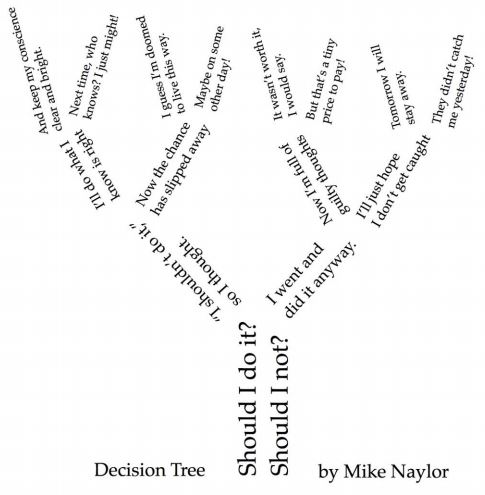
A visual poem -- Decision tree

From Norwegian math-poet Mike Naylor, this fascinating visual poem. 
(Thanks, Mike -- from JoAnne Growney -- for permission to post.)

Naylor presented this poem at the 2019 BRIDGES Math-Art conference
More information about the poets and poems for the 2019 BRIDGES Poetry reading is available here.

Wednesday, July 31, 2019

Recursion . . . in a life . . . in a poem . . .

     The New Yorker offers a rich variety of poetry and in their print issue of 22 July 2019 they give a poem that I love:  "Sentence" -- by Tadeusz Dabroswski  (translated from the Polish by Antonia Lloyd-Jones) plays with two meanings of the word "sentence" and also embodies the concept of recursion -- so important in mathematics.  Below I offer the opening lines; at this link may be found the entire poem (both a print version and an audio recording).

Sentence     by Tadeusz Dąbrowski

It’s as if you’d woken in a locked cell and found
in your pocket a slip of paper, and on it a single sentence
in a language you don’t know.   

Monday, July 29, 2019

What is beauty? Is mathematics beautiful?

     My thoughts have been turned to the beauty of mathematics by stumbling onto a very fine article, "Beauty Bare: The Sonnet Form, Geometry and Aesthetics," by Matthew Chiasson and Janine Rogers -- published in 2009 in the Journal of Literature and Science and available online here.
      The article opens with this quote from A Mathematician's Apology (see p. 14) by G. H. Hardy:       Beauty is the first test:  there is no permanent place 
                                                   in the world for ugly mathematics.

Today I'm puzzling over what "beauty" means . . .   

Thursday, July 25, 2019

As in mathematics--a lot in a few words--in Haiku

     Recently on a visit to the website Singapore Math I found dozens of "mathematical" Haiku -- and I offer several below.   Still more Haiku may be found at "The Republic of Mathematics" (a blog curated by Gary E. Davis), including a link to Haiku by Daniel Mathews.
     Haiku are three-line poems that often -- but not always -- conform to a 5-7-5 syllable count.  With their brevity they often resemble mathematics in that they have condensed a large amount of meainng into a few words.

Monday, July 22, 2019

Mathematicians are not just white dudes . . .

     Recently I found the wonderfully informative website arbitrarily close: musings on math and teaching -- my first visit to the site was to this 2016 posting about "The Mathematician's Project" -- a project and posting that offers lots of resources and links to introduce us to female mathematicians, black mathematicians, and more . . . 
     The following lines are from a puzzle-poem by mathematician-poet Benjamin Banneker -- a non-white dude; the sample has been obtained from a website that celebrates Banneker -- a website compiled by Washington, DC high school teacher John Mahoney.  These lines come from Puzzle 5:

A snip from a puzzle by Benjamin Banneker

Thursday, July 18, 2019

Math-Poetry -- Linz, Austria -- 07/19/2019

     On Friday, July 19, 2-4 PM at the 2019 Bridges Math-Arts Conference in Linz, Austria will be a Reading of Mathematical Poetry that features these poets:

Tatiana Bonch-Osmolovskaya 
     Susan Gerofsky
          Emily Grosholz 
               Lisa Lajeunesse 
                    Marco Lucchesi 
                         Iggy McGovern 
                               Mike Naylor and
                                   Eveline Pye 
reading mathy selections from their work.

And here is a sample of the stanzas you will enjoy at the reading -- from "First Test" by Marco Lucchesi, translated from the Portuguese by Renato Rezende: