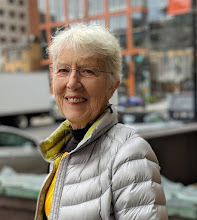
I have been visiting my hometown of Indiana, Pennsylvania and not finding time to complete a new post -- and so I have looked back. On July 9, 2010 I offered a sonnet by Australian poet Jordie Albiston that begins with these lines:
math (after)
first you get the number-rush as anyone
might do you watch your world turn to
nought put your foot upon the path re
what cannot be said I’ve heard before
. . .
I invite you to go to the original post and read the rest.
Wednesday, July 9, 2014


Sunday, July 6, 2014
Poetry as Pure Mathematics
A recent email from Portuguese mathematician-poet F J "Francisco" Craveiro
de Carvalho brought a 40-year-old stanza to my attention. First published in the May, 1974 issue of POETRY Magazine, we have these enigmatic lines by William Virgil Davis. Enjoy!
The Science of Numbers: Or Poetry as Pure Mathematics
Whatever you add you add at your peril.
It is far better to subtract. In poetry,
Multiplication borders on madness.
Division is the mistress we agree to sleep with.
The Science of Numbers: Or Poetry as Pure Mathematics
Whatever you add you add at your peril.
It is far better to subtract. In poetry,
Multiplication borders on madness.
Division is the mistress we agree to sleep with.
Thursday, July 3, 2014
Mathematician and Poet
Should I do it? Should I do a blog post on a novel by Brazilian poet Hilda Hilst (1930-2004) that I have begun to read but don't yet know how to understand?
Hilst's novel, With My Dog-Eyes, newly translated by Adam Morris (Melville House, 2014), attracted my attention because its narrator is a mathematician and a poet. Here are the lines with which the novel begins:
from With My Dog-Eyes by Hilda Hilst
The cross on my brow
The facts of what I was
Of what I will be:
I was born a mathematician, a magician
I was born a poet.
Hilst's novel, With My Dog-Eyes, newly translated by Adam Morris (Melville House, 2014), attracted my attention because its narrator is a mathematician and a poet. Here are the lines with which the novel begins:
from With My Dog-Eyes by Hilda Hilst
The cross on my brow
The facts of what I was
Of what I will be:
I was born a mathematician, a magician
I was born a poet.
Monday, June 30, 2014
A recent butterfly effect
The term butterfly effect has entered everyday vocabulary from the mathematics of chaos theory and refers to the possibility of a major event (such as a tornado) starting from something so slight as the flutter of a butterfly wing. This sensitivity to small changes is a characteristic of chaotic systems. Recent news in Science magazine (9 May 2014) has drawn my attention to sea butterflies -- and the effect that ocean acidification is having on the lives of these tiny, fragile creatures -- and the environmental warning that this portends. From the details offered in Science, I have constructed this poem of 4x4 square-stanzas:
Warned by Sea Butterflies by JoAnne Growney
Sea butterflies --
no larger than
a grain of sand,
named for the way
Warned by Sea Butterflies by JoAnne Growney
Sea butterflies --
no larger than
a grain of sand,
named for the way
Friday, June 27, 2014
Of all geometries, feathery is best . . .
The title for this post comes from Twinzilla (The Word Works, 2014), by Charleston poet Barbara Hagerty. The title character of this collection is one of several poetic personalities that inhabit Hagerty's verse, and she offers a playful view of life's dualities -- sometimes versed in mathematical terminology. Here's a sample.
Twinzilla Cautions * by Barbara G. S. Hagerty
Do not accept packages from unknown persons.
Beware non-native strangers who may be concealing
hazardous contraband "down there."
Question algebra. Dismantle thoughts traveling
the brain's baggage carousel in parabolas.
Twinzilla Cautions * by Barbara G. S. Hagerty
Do not accept packages from unknown persons.
Beware non-native strangers who may be concealing
hazardous contraband "down there."
Question algebra. Dismantle thoughts traveling
the brain's baggage carousel in parabolas.
Tuesday, June 24, 2014
Is mathematics discovered or invented?
My neighbor, Glenn, is fond of asking math-folks that he meets the question "Is mathematics discovered or invented?" -- and when he asked the question of MAA lecturer William Dunham the response was one word, delivered with a smile, "Yes." The question of invention versus discovery -- which may apply to poetry or to mathematics -- is thoughtfully considered in "Notes toward a Supreme Fiction" by Wallace Stevens (1879-1955); here are a few lines from that poem.
from It Must Give Pleasure, VII by Wallace Stevens
He imposes orders as he thinks of them,
As the fox and the snake do. It is a brave affair.
Next he builds capitols and in their corridors,
from It Must Give Pleasure, VII by Wallace Stevens
He imposes orders as he thinks of them,
As the fox and the snake do. It is a brave affair.
Next he builds capitols and in their corridors,
Friday, June 20, 2014
Three thousand, and two
Here is a small poem richly vivid with the contrasts of opposites:
beside a stone three
thousand years old: two
red poppies of today
by Christine M. Krishnasami, India, found in This Same Sky: A Collection of Poems from around the World (selected by Naomi Shihab Nye, Aladdin Paperbacks, 1996).
beside a stone three
thousand years old: two
red poppies of today
by Christine M. Krishnasami, India, found in This Same Sky: A Collection of Poems from around the World (selected by Naomi Shihab Nye, Aladdin Paperbacks, 1996).
Tuesday, June 17, 2014
Found: Elementary Calculus
Here is a poem by Saskatchewan poet Karen Solie.
Found by Karen Solie
Elementary Calculus
From Elementary Calculus A. Keith and W. J. Donaldson.
Glasgow: Gibson, 1960.
Speed (like distance)
is a magnitude and has no
direction; velocity (like displacement)
has magnitude and direction.
Found by Karen Solie
Elementary Calculus
From Elementary Calculus A. Keith and W. J. Donaldson.
Glasgow: Gibson, 1960.
Speed (like distance)
is a magnitude and has no
direction; velocity (like displacement)
has magnitude and direction.
Saturday, June 14, 2014
Number theory is like poetry
Austrian-born Olga Taussky-Todd (1906-1995) was a noted and prolific mathematician who left her homeland for London in 1935 and moved on to California in 1945. Her best-known work was in the field of matrix theory (in England during World War II she started to use matrices to analyze vibrations of airplanes) and she also made important contributions to number theory. In the math-poetry anthology, Against Infinity, I found a poem by this outstanding mathematician.
Wednesday, June 11, 2014
And Now I See . . .
One of the ways we overcome our nervous shyness about our disabilities is by talking about them, and writing about them. And by encountering the poetry of Kathi Wolfe. I enjoy her work out-loud -- she is a frequent performer of her poems at local DC-area venues -- and on the page.
Kathi's "Blind Ambition" (in which she speaks of the monsters in arithmetic) is offered below; I first discovered this poem when it was posted by Split this Rock as poem of the week.
Kathi's "Blind Ambition" (in which she speaks of the monsters in arithmetic) is offered below; I first discovered this poem when it was posted by Split this Rock as poem of the week.
Sunday, June 8, 2014
Impossible Things Before Breakfast
Literary works by Charles Lutwidge Dodgson (1832-1898, aka Lewis Carroll) are crammed with mentions of mathematics. One of my favorites (found here with numerous others, including "Ambition, Distraction, Uglification, Derision") is this exchange from Carroll's Alice in Wonderland.
"Alice laughed: "There's no use trying," she said; "one can't believe impossible things."
"I daresay you haven't had much practice," said the Queen. "When I was younger, I always did it for half an hour a day. Why, sometimes I've believed as many as six impossible things before breakfast."
Alice in Wonderland
"Alice laughed: "There's no use trying," she said; "one can't believe impossible things."
"I daresay you haven't had much practice," said the Queen. "When I was younger, I always did it for half an hour a day. Why, sometimes I've believed as many as six impossible things before breakfast."
Alice in Wonderland
Wednesday, June 4, 2014
Behind the cards -- mathematics
A couple of weeks ago at an MAA math lecture by Alissa Crans on the Catalan numbers, I sat near card-trick mathematician Colm Mulcahy. And I asked him if he knew any poems about card tricks and their mathematics.
Though he at first said "no," Mulcahy turned out to have a couple of connections up his sleeve. From Matthew Wright he learned of "The Card Players" -- a colorful sonnet from Philip Larkin's 1974 collection High Windows and available here with selections of Adriaen Brouwer's art.
And Bruce Reznick reminded him of the lyrics for "The Gambler" by Kenny Rogers. The complete lyrics may be found here; I include below a stanza that offers some instruction about counting.
Though he at first said "no," Mulcahy turned out to have a couple of connections up his sleeve. From Matthew Wright he learned of "The Card Players" -- a colorful sonnet from Philip Larkin's 1974 collection High Windows and available here with selections of Adriaen Brouwer's art.
And Bruce Reznick reminded him of the lyrics for "The Gambler" by Kenny Rogers. The complete lyrics may be found here; I include below a stanza that offers some instruction about counting.
Friday, May 30, 2014
Squirrel Arithmetic
My maternal grandfather, James Edgar Black (1871-1931) was a western Pennsylvanian, a carpenter, and a man I never knew. But Ed, one of my cousins, found among our grandfather's long-stored things a scrapbook of collected poems and other miscellany that he recently passed on to me.
Thursday, May 29, 2014
Phenomenal Woman
Yesterday morning Maya Angelou (1928-2014) left us. But she has not left us alone. Her voice is with us, cheering us to be more than we were, to be all that we can become. Places to read her words and words about her include PoetryFoundation.org (scroll down past the bio for links to poems), Poets.org, The Washington Post, and Angelou's website.
Angelou's poetry is filled with the geometry and motion of womanhood. For example:
Angelou's poetry is filled with the geometry and motion of womanhood. For example:
Sunday, May 25, 2014
How many grains of sand?
Recently one of my friends used "all the grains of sand" as an example of an infinite set "because it is impossible to count them all" and -- even as I rejected his answer -- I wondered how many of my other friends might agree with it. In the following poem, mathematician Pedro Poitevin considers a similar question as he reflects on the countability of the birds in the night sky.
Divertimentum Ornithologicum by Pedro Poitevin
After Jorge Luis Borges's Argumentum Ornithologicum.
A synchrony of wings across the sky
is quavering its feathered beats of flight.
Their number is too high to count -- I try
Divertimentum Ornithologicum by Pedro Poitevin
After Jorge Luis Borges's Argumentum Ornithologicum.
A synchrony of wings across the sky
is quavering its feathered beats of flight.
Their number is too high to count -- I try
Friday, May 23, 2014
Math rap
Harry Baker is a Slam Champion who studies Maths at Bristol University, UK -- and his poetry sometimes features math, often having fun with the topic. His web page has a link to a rap about maths and at the JMM reading in Boston in 2012, Baker submitted this rap, 59 (a love story, now on YouTube), for presentation that evening.
Subscribe to:
Posts (Atom)

 Posts
Posts