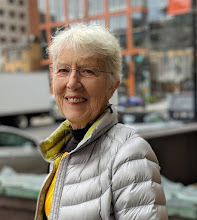
Today's posting features work by Punya Mishra, professor and administrator at Arizona State University -- a writer who offers explanations of mathematical concepts in his poems, explanations that can appeal to students! Mishra's website features several mathy poems and in our email correspondence he said that "The Mathematical i" is his favorite. Here are are several stanzas:
from The Mathematical i by Punya Mishra
The negative numbers were full of dismay
We have no roots, they were heard to say
What, they went on, would be the fruit
of trying to find our square root?
Matters seem to be getting out of hand
Since the negatives have taken a stand,
On the fact that positives have two roots, while they have none.
They plead, would it have killed anybody to give us just one?
The square roots of 4 are + and – 2! As for -4 ? How unfair,
He has none! None at all. Do the math gods even care?
Wednesday, January 29, 2020


Monday, January 27, 2020
Remembering Leonardo da Vinci
One of the readers featured at the recent 1/17/2020 JMM math-poetry reading was Italian mathematician/poet Rosanna Iembo. Below, with Iembo's permission, I offer a sample from her poem, "A New Dawn" -- a poetic narrative in the voice of Leonardo da Vinci, a genius of the Italian Renaissance. Here are a few lines from this narrative; the entire work is available from the poet (contact information is offered here on her website.).
Referring to Luca Pacioli, the poet's voice of da Vinci says:
With him
a common feeling
that did not end over the years.
And in the "Proportion"
which he decided to call
"Divine"
where I drew
my polyhedra,
understanding
reached maximum splendor.
Referring to Luca Pacioli, the poet's voice of da Vinci says:
With him
a common feeling
that did not end over the years.
And in the "Proportion"
which he decided to call
"Divine"
where I drew
my polyhedra,
understanding
reached maximum splendor.
Wednesday, January 22, 2020
Focus on FOUR
Numerous poems by Canadian poet Alice Major connect to science and mathematics, and Major has connected me with Ottawa poet and mechanical engineer Sneha Madhavan-Reese -- who has shared with me not only poetry but also the new-to-me fact that her home city of Ottawa lies on the traditional and unceded territory of the Algonquin Nation. Here is Madhavan-Reese's poem, "Four," a thoughtful reminder of the vast versatility of mathematical notions.
Four by Sneha Madhavan-Reese
Is 4 the same 4 for everybody? -- Pablo Neruda, The Book of Questions
My mother draws her four with a right angle;
my father's is pointed on top. My daughter's four,
half the time, is backwards. Her sister signs,
tucking a thumb into her raised palm.
Monday, January 20, 2020
Remember -- and Celebrate
Today as we remember Martin Luther King, I invite you to visit postings in this blog that celebrate his life -- follow this link.
And here is a link to
And one more link --
this one to The Mathematician's Project
("Mathematicians Are Not Just White Dudes.")
Thursday, January 16, 2020
Math-Poetry tomorrow (1/17) -- in Denver at JMM
You are invited:
Sponsored by
SIGMAA-ARTS
and the Journal of Humanistic Mathematics

After the reading, the poetry program will be archived at this site.
Monday, January 13, 2020
The world of Math Girls . . .
This past weekend my oldest granddaughter turned sixteen -- and I intensely want every career door to be open to her and to my other granddaughters (and my grandson). The times are changing, new doors are opening for girls and women, Still, these syllable-square thoughts are on my mind this morning.
Math Girls
A math girl must be
smarter than the rest –-
yet must be modest
and never claiming.
Math-World is not fair.
And here are more of my mathy-perhaps-poetic thoughts.
When you’re a math girl you may be the only girl in the room.
A math girl must be three times as good to be equal.
Math Girls
A math girl must be
smarter than the rest –-
yet must be modest
and never claiming.
Math-World is not fair.
And here are more of my mathy-perhaps-poetic thoughts.
When you’re a math girl you may be the only girl in the room.
A math girl must be three times as good to be equal.
Wednesday, January 8, 2020
Browse Math-Poetry Links . . .
Today I invite you to browse -- to spend a moment reading titles, clicking on a title that intrigues you. ENJOY!
Monday, January 6, 2020
We become what we think . . .
Browsing a recent issue of World Literature Today, I have found a thought-provoking activist poem by Linda Hogan that considers the ways we are shaped by "our numbers." I offer below its opening stanzas:
Embodied by Linda Hogan
I am embodied first by the numbers
given my grandparents,
no choice but to sign the Dawes Act.
Embodied by Linda Hogan
I am embodied first by the numbers
given my grandparents,
no choice but to sign the Dawes Act.
Thursday, January 2, 2020
With bits of mathematics, a poem for a New Year
Here -- containing bits of mathematical terminology -- is an excerpt from "A Poem for the New Year" by Nigerian poet Christopher Okigbo (1932-1967).
from A Poem for the New Year by Christopher Okigbo
Where then are the roots, where the solution
To life’s equation?
The roots are nowhere
There are no roots here
Probe if you may
From now until doomsday
We have to think of ourselves as forever
from A Poem for the New Year by Christopher Okigbo
Where then are the roots, where the solution
To life’s equation?
The roots are nowhere
There are no roots here
Probe if you may
From now until doomsday
We have to think of ourselves as forever
Monday, December 30, 2019
Poetry made visual with math terms

As the year ends I have been revisiting books not seen for a while -- and one of them is Concert for Violin and Loneliness (Criterion Publishing, 2002) by the Romanian poet Mircea Goga (b. 1948). This collection was translated by Doru Radu and me. Here are several samples in which Goga uses mathematical imagery to enrich his poems.
Poems by Mircea Goga
Proportions
Like an iceberg
of which only an eighth is visible --
of death we show only
life . . .
Friday, December 27, 2019
Math-poetry in support of immigrants
Winner of the Ted Hughes poetry award, British poet Hollie McNish has been in the news recently as she has been commissioned to write a new version of Antigone. Also of note is that her poem "Mathematics" -- about immigration -- has had over 2 million viewers on You Tube.
Here are a few lines from McNish's "Mathematics":
I desperately want to scream
“Your maths is stuck in primary”
Cos one who comes here also spends
And one who comes here also lends
And some who comes here also tend
Here are a few lines from McNish's "Mathematics":
I desperately want to scream
“Your maths is stuck in primary”
Cos one who comes here also spends
And one who comes here also lends
And some who comes here also tend
Monday, December 23, 2019
Counted syllables --> holiday wishes . . .
*
My
wish for
My
wish for
you is peace
and happiness
and whatever else
will count for you. THANK YOU
for all you share with
me. My nights and
days are rich
from your
gifts!
gifts!
Thursday, December 19, 2019
Where are you from?
A question often asked when meeting someone new is "Where are you from?" -- one of my neighbors, who was born in India and now lives in Maryland, has written a poem that considers many ways one might answer that question. Today, I have been thinking about it too. Here are several of my beginning thoughts . . .
I am from the barn yard, counting chickens
I am from arithmetic, multiplying
I am from algebra, solving
I am from calculus, integrating
I am from poetry, looking for words . . .
I am from the barn yard, counting chickens
I am from arithmetic, multiplying
I am from algebra, solving
I am from calculus, integrating
I am from poetry, looking for words . . .
Monday, December 16, 2019
Writing to Learn -- try Haiku
Some of us learn a concept best when we write about it -- taking notes in class or while reading OR simply exploring our mind's thoughts. Recently I discovered (in AAAS Science Magazine) these "Elemental Haiku" by Mary Soon Lee -- offering a Haiku for each element in the periodic table.
For example, for Silicon (Si, atomic number 13) we find this:
Trying to find a Haiku to describe ALGEBRA, I came up with this:
For example, for Silicon (Si, atomic number 13) we find this:
Locked in rock and sand,
age upon age awaiting
the digital dawn.
Trying to find a Haiku to describe ALGEBRA, I came up with this:
Learn to represent
problems using equations--
then learn to solve them!
To explore previous postings of Haiku in this blog, here's a link!
Subscribe to:
Posts (Atom)

 Posts
Posts