The lines below are copied from a posting made on September 20, 2014 -- posted as I finalized plans to travel to New York City for a climate march. From that March I saw some positive action BUT I am grieving over the changes in the last 100 days.
To have a small carbon footprint I will march tomorrow with only a
small sign -- one that wears a 3x3-square reminder that dates back to a 1968 essay, "Tragedy of the Commons," by ecologist Garrett Hardin (1915-2003).
There is no
place to throw
that ' s away.
WHY
is it taking us so long to act to preserve a habitable planet? Do we
not care about the world we are leaving for our grandchildren?
Friday, April 28, 2017


Wednesday, April 26, 2017
Math-Arts Journal -- Free Access
Sometimes an email contains a wonderful gift -- such was the case recently when I got a message from the Journal of Mathematics and the Arts giving me access AT THIS LINK to a generous collection of outstanding articles from the 10-year history of this important publication. One of the articles relates to poetry: Niccolò Tartaglia's poetic solution to the cubic equation, by Arielle Saiber of Bowdoin College in Maine.
The collection of free articles notes this history of JMA: "The journal took shape following a meeting arranged by the late Reza Sarhangi at the 2005 Bridges [Math-Arts] Conference, where Kate Watt from Taylor & Francis met with a group of interested conference participants. Following a group proposal led by Gary Greenfield, the journal launched in 2007 with Gary as editor for the first five volumes. Craig S Kaplan then took over as editor in 2012, until he handed the reins to current editor Mara Alagic at the beginning of 2017. BIG THANKS to all of you for this noteworthy journal!
Here, from Saiber's article, are a few lines from
Veronica Gavagna's translation of Tartaglia's Quando chel cubo:
The collection of free articles notes this history of JMA: "The journal took shape following a meeting arranged by the late Reza Sarhangi at the 2005 Bridges [Math-Arts] Conference, where Kate Watt from Taylor & Francis met with a group of interested conference participants. Following a group proposal led by Gary Greenfield, the journal launched in 2007 with Gary as editor for the first five volumes. Craig S Kaplan then took over as editor in 2012, until he handed the reins to current editor Mara Alagic at the beginning of 2017. BIG THANKS to all of you for this noteworthy journal!
Here, from Saiber's article, are a few lines from
Veronica Gavagna's translation of Tartaglia's Quando chel cubo:
Monday, April 24, 2017
Poetry and Science -- Allies in Discovery
Poet Jane Hirshfield read onstage as part of the March for Science in Washington, DC on Saturday April 22. Science and poetry both arise from the same desire for exploration, Hirshfield opined. “If you don’t think at all, you think of them as opposites,” she said. “They are allies in discovery.”
Hirshfield's staged poem, "On the 5th Day," appeared in the Washington Post a few days before the march. Here are its opening stanzas (visit the Post link for the complete work.)
On the Fifth Day by Jane Hirshfield
On the fifth day
the scientists who studied the rivers
were forbidden to speak
or to study the rivers.
The scientists who studied the air
were told not to speak of the air,
Hirshfield's staged poem, "On the 5th Day," appeared in the Washington Post a few days before the march. Here are its opening stanzas (visit the Post link for the complete work.)
On the Fifth Day by Jane Hirshfield
On the fifth day
the scientists who studied the rivers
were forbidden to speak
or to study the rivers.
The scientists who studied the air
were told not to speak of the air,
Thursday, April 20, 2017
Remembering Karl Patten
From my Lewisburg, PA friend, Ruta Karelis, I have recently learned of the April 16 death of my beloved first poetry teacher, Bucknell professor and poet, Karl Patten (1927-2017). Karl's oft-repeated phrase (and poem title) "Every Thing Connects" -- found on my shelf in The Impossible Reaches (Dorcas Press, 1992) -- is on my mind daily. Another poem from that collection -- "The Play" -- I am reading and rereading today, remembering the poet. Here it is, from Karl Patten, for you.
The Play by Karl Patten
You're tired? I'm tired too. Let's forget we're people, forget all that.
You be a horizon, infinite, flat, a forever-place,
I'll be double, gray-blue ocean, gray-blue sky, touching you, just.
The Play by Karl Patten
You're tired? I'm tired too. Let's forget we're people, forget all that.
You be a horizon, infinite, flat, a forever-place,
I'll be double, gray-blue ocean, gray-blue sky, touching you, just.
Tuesday, April 18, 2017
Poetry by Victorian Scientists
Thanks to Greg Coxson who has recently alerted me to this 2011 article by Paul Collins in New Scientist, "Rhyme and reason: The Victorian poet scientists." In the article, Collins is reviewing an anthology edited by Daniel Brown entitled The Poetry of Victorian Scientists: Style, Science and Nonsense (Cambridge University Press, Reprint-2015).
The article has links to poetry by James Clerk Maxwell (1831-1879), William J. Macquorn Rankine (1820-1872), and James Joseph Sylvester (1814-1897). Below I offer two of the eight entertaining stanzas from Rankine's poem, "The Mathematician in Love." (This poem and Maxwell's "A Lecture on Thomson's Galvanometer" also appear in the wonderful anthology that Sarah Glaz and I edited -- Strange Attractors: Poems of Love and Mathematics (A K Peters/CRC Press, 2008, now available as an e-book.)
from The Mathematician in Love by William J Macquorn Rankine
The article has links to poetry by James Clerk Maxwell (1831-1879), William J. Macquorn Rankine (1820-1872), and James Joseph Sylvester (1814-1897). Below I offer two of the eight entertaining stanzas from Rankine's poem, "The Mathematician in Love." (This poem and Maxwell's "A Lecture on Thomson's Galvanometer" also appear in the wonderful anthology that Sarah Glaz and I edited -- Strange Attractors: Poems of Love and Mathematics (A K Peters/CRC Press, 2008, now available as an e-book.)
from The Mathematician in Love by William J Macquorn Rankine
Friday, April 14, 2017
A Fib for Easter
Recently a reader commented privately to me that she did not like the Fib as a poem-style since it seems to allow almost any prose statement to be formed into a poem. My opposite reaction to her comment stems, in part, from my use of the Fib with workshop students -- many of them join me with delight at the way the Fib syllable-count format has guided them to pleasing word-selections.
As Easter approaches, my thoughts have been shaped into these lines:
Soon
comes
Easter,
holiday
to celebrate spring's
victory of life over death.
As Easter approaches, my thoughts have been shaped into these lines:
Soon
comes
Easter,
holiday
to celebrate spring's
victory of life over death.
Tuesday, April 11, 2017
Mathematics and Poetry are . . .
This week between Palm Sunday and Easter is a school vacation week for six of my grandchildren -- Carly and Emma, Shaya and Daniel, Serena and Caroline -- who live in the Washington, DC area. And so I am enjoying their company rather than developing new blog posts. But I do have a few relevant Poetry-Math words (found at goodreads.com) from Amit Ray:
“Mathematics and poetry are the two ways
to drink the beauty of truth.”
― Amit Ray
Thursday, April 6, 2017
Prime -- with rhythm and rhyme
Earlier this year, an email from James D. Herren let me know about his recent e-book, Wit and Wonder, Poetry with Rhythm and Rhyme -- a collection developed to be enjoyed by readers from 5th grade onward. Herren is an advocate of energetic rhyming verse, AND his collection has some mathy stuff -- including these two little poems. Thanks, Dave!
Prime by James D Herren
Our love is prime –
Divisible by none
But you and I,
For you and I Are One.
Prime by James D Herren
Our love is prime –
Divisible by none
But you and I,
For you and I Are One.
Monday, April 3, 2017
Math-Stat Awareness Month -- find a poem!
APRIL is Mathematics and Statistics Awareness Month
AND
National Poetry Month!
Celebrate with a MATHY POEM, found here in this blog! Scroll down!
AND
National Poetry Month!
Celebrate with a MATHY POEM, found here in this blog! Scroll down!
If you are looking for mathy poems on a particular topic, the SEARCH box in the right-column may help you find them. For example, here is a link to posts found when I searched using the term "parallel." And here are posts that include the term "angle." To find a list of additional useful search terms, scroll down the right-hand column.
For your browsing pleasure, here are the titles and dates of previous blog postings,
moving backward from the present. Enjoy!
Mar 31 Math and poetry in filmMar 28 Split this Rock, Freedom Plow Award, April 21
Mar 27 Math-themed poems at Poets.org
Mar 23 Remember Emmy Noether!
Friday, March 31, 2017
Math and poetry in film
One of my delights in the last year has been viewing films about poets and mathematicians. First, "The Man Who Knew Infinity" -- about the mathematician, Srinivasa Ramanujan (1887-1920) and, more recently "Neruda" about the Chilean politician and poet, Pablo Neruda. And also, the film "Paterson" -- about a bus-driver poet named Paterson in the city of Paterson, NJ -- a city well-known for its earlier poet, William Carlos Williams (1883-1963) who immortalized his hometown in his very long poem, "Paterson."
At the website Poets.org one may find 38 poems by William Carlos Williams and 11 poems by Pablo Neruda. At PoetryFoundation.org one may find find 27 poems by Pablo Neruda and 120 poems by William Carlos Williams and 15 poems by Ron Padgett.
Here is a link to my earlier posting of a poem by Jonathan Holden, "Ramanaujan."
I have included elsewhere in this blog several poems by Pablo Neruda
and offer links here: "28325674549," from "The Heights of Macchu Pichu,"
and here are links to my previous postings of two of his poems:
"The Roman Numerals" and "The Giraffe."
At the website Poets.org one may find 38 poems by William Carlos Williams and 11 poems by Pablo Neruda. At PoetryFoundation.org one may find find 27 poems by Pablo Neruda and 120 poems by William Carlos Williams and 15 poems by Ron Padgett.
Tuesday, March 28, 2017
Split this Rock, Freedom Plow Award, April 21
SPLIT THIS ROCK is a wonderful activist poetry organization -- based near to me in Washington, DC -- with a name based on a line by Langston Hughes.* As a strong supporter of their mission to use poetry for positive social change, I want to announce one of their very special programs:
In October, 2013, the Freedom Plow Award was won by Eliza Griswold -- see this blog posting to learn a bit about her work with the poetry of Afghan women.
*The name "Split This Rock" is pulled from a line in “Big Buddy,” a poem from Langston Hughes.
Don’t you hear this hammer ring?
I’m gonna split this rock
And split it wide!
When I split this rock,
Stand by my side.
And for a tiny mathy poem by Langston Hughes, go here.
Friday, April 21 | 6 pm |Arts Club of Washington, DC
The 2017 Freedom Plow Award for Poetry and Activism
Read about this years finalists,
Francisco Aragón, Andrea Assaf,
JP Howard, and Christopher Soto (aka Loma)
on Split This Rock's Website. Tickets may be purchased here. ($25 General, $10 Students).
In October, 2013, the Freedom Plow Award was won by Eliza Griswold -- see this blog posting to learn a bit about her work with the poetry of Afghan women.
*The name "Split This Rock" is pulled from a line in “Big Buddy,” a poem from Langston Hughes.
Don’t you hear this hammer ring?
I’m gonna split this rock
And split it wide!
When I split this rock,
Stand by my side.
And for a tiny mathy poem by Langston Hughes, go here.
Monday, March 27, 2017
Math-themed poems at Poets.org
The poetry website Poets.org is a wonderful source of thousands of poems. During one recent visit to the site, I saw that they have a collection of themes and, when I examined these themes, I found that one of these is "Math" -- and I enjoyed taking time to explore.
When I read mathy poems by non-maths often I am intrigued by their alterations of correct mathematical statements -- part of "poetic license." Non-maths can use intriguing language that I, with my mathematics background, could not allow myself to say. For example, George David Clark's poem "Kiss Over Zero" has this opening line:
I was delighted to find in this math-themed group several old favorites, one of which is "Counting" by Douglas Goetsch -- a poem among those Sarah Glaz and I gathered a few years back for the anthology, Strange Attractors: Poems of Love and Mathematics (A K Peters / CRC Press, 2008) -- now available as an e-book.
When I read mathy poems by non-maths often I am intrigued by their alterations of correct mathematical statements -- part of "poetic license." Non-maths can use intriguing language that I, with my mathematics background, could not allow myself to say. For example, George David Clark's poem "Kiss Over Zero" has this opening line:
anything over zero is zero
I was delighted to find in this math-themed group several old favorites, one of which is "Counting" by Douglas Goetsch -- a poem among those Sarah Glaz and I gathered a few years back for the anthology, Strange Attractors: Poems of Love and Mathematics (A K Peters / CRC Press, 2008) -- now available as an e-book.
Thursday, March 23, 2017
Remember Emmy Noether!
On today's date in 1882, mathematician Emmy Noether (1882-1935) was born. Noether became fixed in my attention when, recently out of college, I saw her photo in a display at the New York World's Fair. Her life and her pioneering work became inspiration for me as I followed her in mathematics. I wrote a poem, "My Dance is Mathematics," in her honor; it begins with these words:
They called you der Noether, as if mathematics
was only for men. In 1964, nearly thirty years
past your death, I saw you in a spotlight
in a World's Fair mural, "Men of Modern Mathematics."
The complete poem, "My Dance is Mathematics," is available here. Its final statement is:
Scroll down -- or follow this link -- to still more poems that celebrate the women of mathematics.
They called you der Noether, as if mathematics
was only for men. In 1964, nearly thirty years
past your death, I saw you in a spotlight
in a World's Fair mural, "Men of Modern Mathematics."
The complete poem, "My Dance is Mathematics," is available here. Its final statement is:
They say she was good / For a woman.
Scroll down -- or follow this link -- to still more poems that celebrate the women of mathematics.
Monday, March 20, 2017
Is unreasonableness ever reasonable?
This morning I have been thinking about these words of George Bernard Shaw (1856-1950) that were part of the postings on the door of one of my mathematics colleagues at Bloomsburg (PA) University:
My reflections on the word "unreasonable" also led me back to this important article from 1960 -- "The Unreasonable Effectiveness of Mathematics in the Natural Sciences." (And I found here some analysis of the article.)
As a final comment on unreasonableness I offer "Atomic Split" -- a poem by another voice named Bernard Shaw. (Big thanks to mathematician, writer of both poetry and fiction, scholar extraordinaire -- and friend -- Robert Dawson, who alerted me to the fact that more than one writer carries this famous name.) This following poem I found here at poemhunter.com.
Atomic Split by Bernard Shaw
What a terrible thing to do,
Man has split the atom in two.
For peaceful purposes so we are told,
The reasonable man adapts himself to the world:
the unreasonable one persists in trying to adapt the world to himself.
Therefore all progress depends on the unreasonable man.
My reflections on the word "unreasonable" also led me back to this important article from 1960 -- "The Unreasonable Effectiveness of Mathematics in the Natural Sciences." (And I found here some analysis of the article.)
As a final comment on unreasonableness I offer "Atomic Split" -- a poem by another voice named Bernard Shaw. (Big thanks to mathematician, writer of both poetry and fiction, scholar extraordinaire -- and friend -- Robert Dawson, who alerted me to the fact that more than one writer carries this famous name.) This following poem I found here at poemhunter.com.
Atomic Split by Bernard Shaw
What a terrible thing to do,
Man has split the atom in two.
For peaceful purposes so we are told,
Thursday, March 16, 2017
Julia . . . Set Aside Gender Roles . . .
For me there is a special pleasure in finding in my reading a word like "identity" or "prime" that has a special mathematical meaning in addition to its ordinary usage. And, because poets work hard to capture multiple images in their work, poems are where such pleasure occurs most often. Poet and songwriter and professor Lawrence M. Lesser has beautifully connected the Julia Set of fractal geometry with his grandmother, Julia -- and he has given me permission to share his poem, "Julia," offered below. This poem is offered, along with other work by Lesser, in a Poetry Folder, "Moving Between Inner and Outer Worlds," in the most-recent issue of the Journal of Humanistic Mathematics.
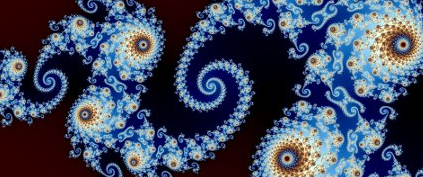 |
| For more about Julia Sets, visit http://www.karlsims.com/julia.html. |
Sunday, March 12, 2017
Again we celebrate Pi !
Now I give -- I again enumerate π's digits, count out . . .
3.141592653 . . .
Tuesday, March 14, is Pi-day -- and I invite you to browse or SEARCH this blog for references to π / Pi and to learn more about Pilish (a language in which, as above, word-lengths follow the pattern of the digits of π). Here are a links to several of the postings available:
Rhymes to help you remember the digits of Pi
Poetry that imagines auctioning the digits of Pi
A Circle poem in Pilish
Subscribe to:
Posts (Atom)

 Posts
Posts