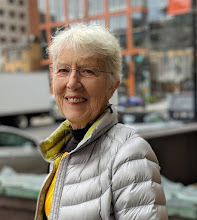
Publishing a blog about poetry and mathematics brings me new connections -- it is not unusual for a day to begin with an email from another poetry-math enthusiast who wants to share a link or a poem. One of these is retired USC biochemist Paul Geiger.
Using as raw material a poem by Shel Silverstein, Geiger created a 9x9 syllable-square:
S.C.S. STOUT by Paul Geiger
Apologizing and Acknowledging Shel Silverstein's 1974 poem
"SARAH CYNTHIA SYLVIA STOUT WOULD NOT TAKE THE GARBAGE OUT"
Wednesday, September 3, 2014


Saturday, August 30, 2014
Mathy Poetry from Bridges 2014
This year's math-arts conference, Bridges 2014, was in Korea. And a dozen of us who write poetry-with-mathematics -- unable to attend in person -- worked with coordinator Sarah Glaz to offer (on August 16, hosted by Mike Naylor) a virtual reading of work videotaped in advance by the poets and edited into a coherent whole by Steve Stamps.
The virtual reading is here on YouTube.
The virtual reading is here on YouTube.
Wednesday, August 27, 2014
Grandma Got STEM
It was my good fortune last weekend to meet the sister-in-law of one of my neighbors, mathematician and Harvey Mudd professor, Rachel Levy. Levy is also a blogger and her postings in Grandma Got
STEM tell of achievements of women in science.
I have looked for a poem to pair with my mention here of Grandma Got STEM. Although the following poem by Tami Haaland (found at the Poetry Foundation website) is not mathematical, it nicely brings to life a relationship between a grandmother and granddaughter -- and we wish for both of them "places to explore beyond the frame."
Little Girl by Tami Haaland
She’s with Grandma in front
of Grandma’s house, backed
by a willow tree, gladiola and roses.
Who did she ever want
to please? But Grandma
seems half-pleased and annoyed.
I have looked for a poem to pair with my mention here of Grandma Got STEM. Although the following poem by Tami Haaland (found at the Poetry Foundation website) is not mathematical, it nicely brings to life a relationship between a grandmother and granddaughter -- and we wish for both of them "places to explore beyond the frame."
Little Girl by Tami Haaland
She’s with Grandma in front
of Grandma’s house, backed
by a willow tree, gladiola and roses.
Who did she ever want
to please? But Grandma
seems half-pleased and annoyed.
Saturday, August 23, 2014
Changing colors, counting syllables
Changing Colors
by JoAnne Growney
Blue
yoyo --
awkwardly
stopping-starting,
rising-plummeting,
seeking self-control. Please,
mother-friend-lover-child, don't
pull string. Let me collect myself.
I lift myself to the treetops,
soar with the golden eagle,
find rest on fleecy clouds.
My orb embraces
everybody --
powerful,
yellow
sun.
Tuesday, August 19, 2014
Poetry in Math Journals
The Mathematical Intelligencer (publisher of the poem by Gizem Karaali given below) and the Journal of Humanistic Mathematics (an online, open-access journal edited by Mark Huber and Gizem Karaali) are periodicals that include math-related poetry in each issue. For example, in the most recent issue of JHM, we have these titles:
Articles:
Joining the mathematician's delirium to the poet's logic'': Mathematical Literature and Literary Mathematics by Rita Capezzi and Christine Kinsey
How Do I Love Thee? Let Me Count the Ways for Syllabic Variation in Certain Poetic Forms by Mike Pinter
Poems:
And here, from Gizem Karaali, is a poetic view of the process of mathematical discovery: the blank white page, the muddy flow of thoughts, the clarity that eventually (sometimes) blooms:
Articles:
Joining the mathematician's delirium to the poet's logic'': Mathematical Literature and Literary Mathematics by Rita Capezzi and Christine Kinsey
How Do I Love Thee? Let Me Count the Ways for Syllabic Variation in Certain Poetic Forms by Mike Pinter
Poems:
Computational Compulsions by Martin Cohen
Jeffery's Equation by Sandra J. Stein
The Math of Achilles by Geoffrey A. Landis
And here, from Gizem Karaali, is a poetic view of the process of mathematical discovery: the blank white page, the muddy flow of thoughts, the clarity that eventually (sometimes) blooms:
Friday, August 15, 2014
My best dream is floating . . .
Today I want to urge you to visit several sites in addition to my blog. For example, there is the recent announcement of 2014 Fields Medal (equivalent to a Nobel prize) winners -- the four winners include the first female mathematician (Maryam Mirzakhani) ever to be selected as a Fields Medalist (equivalent to a Nobel Prize) and a mathematician who loves poetry (Manjul Bhargava).
With the help of a "Google Alert" I found a YouTube video of Alexandria Marie reading "The Mathematics of Heartbreak" at a Dallas Poetry Slam. A link in an email from Texas computer scientist, Dylan Shell, alerted me to these mathematical lyrics (new words for old tunes) in a mathbabe posting by Cathy O'Neil.
As we have been floating from topic to topic, it may be apt to end with the final stanza of my relevantly titled poem:
With the help of a "Google Alert" I found a YouTube video of Alexandria Marie reading "The Mathematics of Heartbreak" at a Dallas Poetry Slam. A link in an email from Texas computer scientist, Dylan Shell, alerted me to these mathematical lyrics (new words for old tunes) in a mathbabe posting by Cathy O'Neil.
As we have been floating from topic to topic, it may be apt to end with the final stanza of my relevantly titled poem:
Monday, August 11, 2014
Narrated by a mathematician
Recently translated by Adam Morris, the novel With My Dog-Eyes (Melville House, 2014) by Brazilian writer Hilda Hilst (1930-2004) is narrated by a mathematician-poet. That fact of narration is what first drew me to the book. (See also this July 3 posting.) And then there is (related in Morris's introduction to the translation) Hilst's sad life, perhaps mirrored in her characters. These are the opening lines from the novel's narrator:
The cross on my brow
The facts of what I was
Of what I will be:
I was born a mathematician, a magician
I was born a poet.
The cross on my brow
The facts of what I was
Of what I will be:
I was born a mathematician, a magician
I was born a poet.
Friday, August 8, 2014
Squaring the Circle
Reminding us of the ancient unsolvable problem that so many attempted, the July/August 2014 issue of Poetry Magazine contains "Squaring the Circle," a poem by Philip Fried. Here are the opening lines; please follow the Poetry Magazine link above to enjoy the full poem.
from Squaring the Circle by Philip Fried
It's a little-known fact that God's headgear --
A magician's collapsible silk top hat,
When viewed from Earth, from the bottom up
Is, sub specie aeternitatis,
A pluperfect halo, both circle and square,
. . .
from Squaring the Circle by Philip Fried
It's a little-known fact that God's headgear --
A magician's collapsible silk top hat,
When viewed from Earth, from the bottom up
Is, sub specie aeternitatis,
A pluperfect halo, both circle and square,
. . .
Two previous posts that also consider the circle-squaring problem include 10 May 2010 and 21 April 2010.
Wednesday, August 6, 2014
Divided selves, some of them savvy
For social connections, it is desirable not to be pegged as a member of an outcast group. And thus a mathematician is likely to have at least two selves -- one who lives in the world of mathematics and another separate social self that negotiates that rest-of-the-world where many fear and shun mathematics. I found a situation somewhat similar when I studied at Hunter College in Manhattan: I needed a separate self who negotiated the city. The problem-solving farm girl who knew small towns well and big cities slightly seemed better equipped to adapt to city conversations than her fellow students could chat about anything west of the Hudson. How many hundred miles must you drive to get to Pennsylvania? they wondered. (The Delaware River boundary of PA is about 75 miles west of the George Washington Bridge.)
In this vein, I present a poem that focuses on the country vs city divide -- and it involves a square look and a number.
Green Market, New York by Julia Spicher Kasdorf
In this vein, I present a poem that focuses on the country vs city divide -- and it involves a square look and a number.
Green Market, New York by Julia Spicher Kasdorf
Sunday, August 3, 2014
A math prof's lament
The mathematical connection for this poem is the fact that it was inspired by regrets for a missed opportunity in a mathematics class -- an opportunity missed by me and thus by one of my students. There are so many ways to be wrong!
Lament of a Professor
at the End of the Spring Semester by JoAnne Growney
I took an extra step to bridge the gap
between us, blind to your matching backward step.
We've moved in tandem until I'm angry
at you, and at me — I thought you needed
lenience, but reprimands instead
would have changed the direction of our cadence
and given you a chance to lead the dance.
A poem about another of my students, "The Prince of Algebra" is available here. And this link will take you to the poems in my collection, My Dance is Mathematics (Paper Kite Press, 2006).
Lament of a Professor
at the End of the Spring Semester by JoAnne Growney
I took an extra step to bridge the gap
between us, blind to your matching backward step.
We've moved in tandem until I'm angry
at you, and at me — I thought you needed
lenience, but reprimands instead
would have changed the direction of our cadence
and given you a chance to lead the dance.
A poem about another of my students, "The Prince of Algebra" is available here. And this link will take you to the poems in my collection, My Dance is Mathematics (Paper Kite Press, 2006).
Tuesday, July 29, 2014
Fixing something wrong
If there's something
wrong with the third
act, it's really
in the first act.
This quote from Billy Wilder, Austrian-born writer and film-director (1906-2002), reminds me of a similar observation I have made about my mathematical work -- when a reviewer notes a problem near the end, usually the fix is near the beginning. And so it goes . . .
Sunday, July 27, 2014
Each equation is a playful catch . . .
A mathematician is probably too close to her subject matter to speak playfully about it -- and thus she, even more than others, appreciates a phrase like "each equation is a playful catch, like bees into a jar," offered by Lisa Rosenberg in the poem below. In "Introduction to Methods of Mathematical Physics," Rosenberg uses a child's anxiety about insects as a way to describe fear of mathematics and offers a smidgen of respect for "those few" who are fearless.
Introduction to Methods of Mathematical Physics by Lisa Rosenberg
You must develop a feeling for these symbols
that crawl across a page, for the text overrun
with scorpions. Like those books about insects
you read as a child, scared to touch the magnified photos,
Friday, July 25, 2014
Poems with "equation" in the title
One of the ways to explore this blog is to go to the right hand column and find the instruction, SEARCH.
A few moments ago I did this and entered the word "equation" and found a long list of links, many of the latter ones redundant since they are picking up archive listings of earlier postings. But the early ones can be fun to explore. Here are five of the first six items that the SEARCH BOX produced. And the first two of these links yield poems with "equation" in the title. Enjoy!
A few moments ago I did this and entered the word "equation" and found a long list of links, many of the latter ones redundant since they are picking up archive listings of earlier postings. But the early ones can be fun to explore. Here are five of the first six items that the SEARCH BOX produced. And the first two of these links yield poems with "equation" in the title. Enjoy!
Saturday, July 19, 2014
Mathematicians are not free to say . . .
The poetry of a mathematician is constrained by the definitions she knows from mathematics. Even though all but one of the prime integers is odd, she cannot use the words "prime" and "odd" as if they are interchangeable. She cannot use the words "rectangle" and "box" as synonyms. But the ways that non-math poets dare to engage with math words can be delightful to mathematical ears and eyes. For example:
The Wasp on the Golden Section by Katy Didden
The Wasp on the Golden Section by Katy Didden
Wednesday, July 16, 2014
Palindromes
Palindromic numbers are not uncommon -- recently (in the July 12 posting) power-of-eleven palindromes are mentioned. Palindromic poems are more difficult to find but see, for example, the postings for October 6, 2010 and October 11, 2010.
At a recent Kensington Row Bookshop poetry reading, Hailey Leithauser revealed that all but one of the poems in her recent collection Swoop (Graywolf Press, 2014) contain a palindrome.
And here are a couple of my favorite palindromic phrases:
(the impossible integer)
Never
odd or
even.
odd or
even.
(the mathematician's answer when she is offered cake)
"I prefer pi."
"I prefer pi."
Saturday, July 12, 2014
Prove It
After observing that
1 = 1
and 1 + 3 = 4
and 1 + 3 + 5 = 9
and 1 + 3 + 5 + 7 = 16
and 1 + 3 + 5 + 7 + 9 = 25
it seems easy to conclude that, for any positive integer n, the sum of the first n odd integers is n2.
1 = 1
and 1 + 3 = 4
and 1 + 3 + 5 = 9
and 1 + 3 + 5 + 7 = 16
and 1 + 3 + 5 + 7 + 9 = 25
it seems easy to conclude that, for any positive integer n, the sum of the first n odd integers is n2.
Subscribe to:
Posts (Atom)

 Posts
Posts