Wednesday, September 4, 2019

Poems of Mathematics -- recalling some old posts

     Today I have been browsing some old posts, and offer below a few links to remind us of mathy poems posted in this blog more than five years ago

     “Compromise” by Charles S Allen     
           “Give Me an Epsilon and I Will Treat It Well” by Ray Bobo 
     “The Icosasphere” by Marianne Moore   
          “Mandelbrot Set” by Jonathan Coulton 
     “Numbers”  by JoAnne Growney (a syllable-snowball) 
          “Numerical Landscape” by Eveline Pye 
     “Talking Big” by John Bricuth 
         “Zito the Magician” by Miroslav Holub  
     "Gaps" by Philip Holmes

AND, please go on to SEARCH this blog for lots more poems by Eveline Pye and Miroslav Holub -- and for other names that you find listed in the right-hand column (under Labels . . .).

Tuesday, September 3, 2019

Is this Fib true?


     Is
     it
     true that
     among folks
     not anchored to math
     by study or career choice, more
     people show delight in being poor at math than good ?

The lines above have syllable counts that follow the first seven Fibonacci numbers: 1,1,2,3,5,8,13.

Thursday, August 29, 2019

Enrich Mathematics Classes with Poems

    In my mathematics classrooms, I have found it a challenge to include the history and spirit of mathematics -- and its people -- along with the math topics to be covered.  Because I love poetry -- and also write some -- I gradually became aware of poems that could enrich my classes and I began to incorporate poetry in outside readings and essay topics and class discussions.

Here are links to poems that introduce the lives of four math-women:
     Sophie Germain (1776-1831)
     Florence Nightingale  (1820-1910)
     Amalie "Emmy" Noether  (1882-1935)
     Grace Murray Hopper (1906 - 1988)
And here is a poem about four influential teachers of mine; three of them math-people; three of them women.

Math Anxiety can be a hard topic for student or teacher to bring up -- but airing of views and healing might come from discussion.  Poems to consider include: 

Wednesday, August 28, 2019

The personal becomes mathematical -- in poetry

     Elizabeth Barrett Browning (1806-1861) used counting in her description of love in her sonnet that begins "How do I love thee?  Let me count the ways."  Contemporary artist, poet, and retired math professor Sandra DeLosier Coleman finds relationships a bit more complicated -- and builds her description in the poem below on the square root of two.

       Between You and the Root of Two     by Sandra DeLozier Coleman

       I have less chance of knowing you
       than of writing out the root of two.
       How e're I start, it never ends,
       exploring how love lies, pretends.   

Monday, August 26, 2019

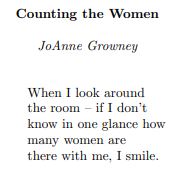
Counting the Women . . .

     Sometimes a professional group or a meeting-agenda or a table of contents contains so few women's names that they are easily counted.  In this syllable-square stanza, I praise the absence of that condition: 

     This stanza and others with similar attitude appear in "Give Her Your Support" -- a poetry-page published recently in Math Horizons.  For the entire collection, follow this link.

Wednesday, August 14, 2019

Journal of Humanistic Mathematics--a TREASURE

     Online and available FREE, the Journal of Humanistic Mathematics is a wonderful source of poems and stories and articles that connect mathematics to life.  Thanks to editors Mark Huber and Gizem Karaali who lead the effort to bring us new issues each January and July.  Here is a link to the Table of Contents for the July 2019 issue.   Included in this issue is a thoughtful article by Sarah Mayes-Tang entitled "Telling Women's Stories:  A Resource for College Mathematics Instructors" -- and, related to this, here is a link to postings in this blog found using a SEARCH for "mathematics and women and poem."  (Scroll down the list of postings to find individual poems.)
     This current issue of JHM also offers a selection of five poems and also a folder with insightful reflections in both prose and poetry -- "A Life of Equations Shifting to a Life of Words" by Thomas Willemain.

Follow the links.  And enjoy!

Monday, August 12, 2019

Celebrating Paul Erdos

     One of the most interesting and productive mathematicians of all time was Paul Erdos (1913-1996).  He was author of more than 1416 papers, and his name became associated with a labeling process for mathematicians, an idea called the Erdos Number.  A mathematician who co-authored a paper with Erdos could claim Erdos Number 1.  A mathematician who co-authored with a co-author of Erdos had Erdos Number 2.  And so on.  
     Tatiana Bonch-Osmolovskaya (one of the poets at the 2019 Bridges MathArts  Conference) has written a wonderful poem to celebrate Erdos;  I offer below the central stanza of Bonch-Osmolovskaya's poem; the complete poem is available here.

from:   Paul Erdos     by Tatiana Bonch-Osmolovskaya

          he inhaled and exhaled mathematics   

Wednesday, August 7, 2019

Poetry and Science

     Originally from Scotland, Alice Major is a celebrated Canadian poet whose work often focuses on key ideas in mathematics and science. (Visit her website for lots of links.)  The following lines of Major's verse appear in the Canadian magazine Prairie Fire (offering Major's presentation in the Anne Szumigalski lecture series entitled "Scansion and Science"); they are taken from Major's latest collection, Welcome to the Anthropocene."  Enjoy this sample, then follow the links and read much more:

 . . . poetry by Alice Major . . .

Also from Welcome to the Anthropocene, Major's poem  "Zero divided by zero" is available at this link here in my blog "Intersections -- Poetry with Mathematics" -- and a blog-search leads to lots more of her work.

Monday, August 5, 2019

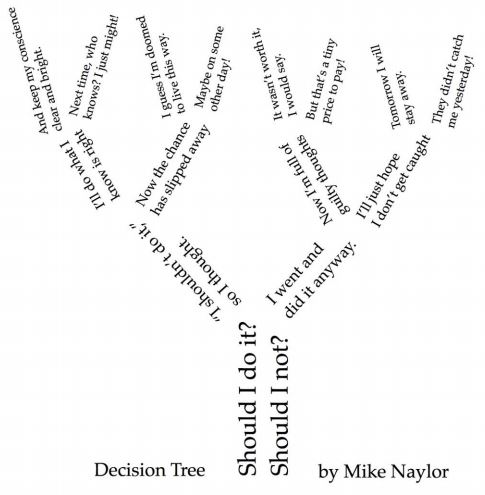
A visual poem -- Decision tree

From Norwegian math-poet Mike Naylor, this fascinating visual poem. 
(Thanks, Mike -- from JoAnne Growney -- for permission to post.)

Naylor presented this poem at the 2019 BRIDGES Math-Art conference
More information about the poets and poems for the 2019 BRIDGES Poetry reading is available here.

Wednesday, July 31, 2019

Recursion . . . in a life . . . in a poem . . .

     The New Yorker offers a rich variety of poetry and in their print issue of 22 July 2019 they give a poem that I love:  "Sentence" -- by Tadeusz Dabroswski  (translated from the Polish by Antonia Lloyd-Jones) plays with two meanings of the word "sentence" and also embodies the concept of recursion -- so important in mathematics.  Below I offer the opening lines; at this link may be found the entire poem (both a print version and an audio recording).

Sentence     by Tadeusz Dąbrowski

It’s as if you’d woken in a locked cell and found
in your pocket a slip of paper, and on it a single sentence
in a language you don’t know.   

Monday, July 29, 2019

What is beauty? Is mathematics beautiful?

     My thoughts have been turned to the beauty of mathematics by stumbling onto a very fine article, "Beauty Bare: The Sonnet Form, Geometry and Aesthetics," by Matthew Chiasson and Janine Rogers -- published in 2009 in the Journal of Literature and Science and available online here.
      The article opens with this quote from A Mathematician's Apology (see p. 14) by G. H. Hardy:       Beauty is the first test:  there is no permanent place 
                                                   in the world for ugly mathematics.

Today I'm puzzling over what "beauty" means . . .   

Thursday, July 25, 2019

As in mathematics--a lot in a few words--in Haiku

     Recently on a visit to the website Singapore Math I found dozens of "mathematical" Haiku -- and I offer several below.   Still more Haiku may be found at "The Republic of Mathematics" (a blog curated by Gary E. Davis), including a link to Haiku by Daniel Mathews.
     Haiku are three-line poems that often -- but not always -- conform to a 5-7-5 syllable count.  With their brevity they often resemble mathematics in that they have condensed a large amount of meainng into a few words.

Monday, July 22, 2019

Mathematicians are not just white dudes . . .

     Recently I found the wonderfully informative website arbitrarily close: musings on math and teaching -- my first visit to the site was to this 2016 posting about "The Mathematician's Project" -- a project and posting that offers lots of resources and links to introduce us to female mathematicians, black mathematicians, and more . . . 
     The following lines are from a puzzle-poem by mathematician-poet Benjamin Banneker -- a non-white dude; the sample has been obtained from a website that celebrates Banneker -- a website compiled by Washington, DC high school teacher John Mahoney.  These lines come from Puzzle 5:

A snip from a puzzle by Benjamin Banneker

Thursday, July 18, 2019

Math-Poetry -- Linz, Austria -- 07/19/2019

     On Friday, July 19, 2-4 PM at the 2019 Bridges Math-Arts Conference in Linz, Austria will be a Reading of Mathematical Poetry that features these poets:

Tatiana Bonch-Osmolovskaya 
     Susan Gerofsky
          Emily Grosholz 
               Lisa Lajeunesse 
                    Marco Lucchesi 
                         Iggy McGovern 
                               Mike Naylor and
                                   Eveline Pye 
reading mathy selections from their work.

And here is a sample of the stanzas you will enjoy at the reading -- from "First Test" by Marco Lucchesi, translated from the Portuguese by Renato Rezende:  

Wednesday, July 17, 2019

An Ode to Mathematics

     One of the math-poets that I have met through this blog is Foteck Ivota, a mathematics teacher in the Cameroon.  In an email message, Ivota has offered this point of view:
       I love poetry too so much and I believe poetry  can be used as a means of making students love and develop interest in mathematics. As teachers of this beautiful subject we face a lot of challenges to make students perceive maths as easy and down to earth.   
     Ivota also has shared several poems with me; here is one of them:

      An Ode to Mathematics     by Foteck Ivota

       Your merits, maths, many may miss
       And in ignorance may dismiss
       Marvelous Maths that is life,
       Believing that all is strife.

            Chorus:
                 Maths for you and Maths for me,
                 Maths, Maths and Maths for all,
                 Maths, Maths for everything.    

Monday, July 15, 2019

Mother-daughter geometry -- in poetry . . .

     Last week (July 9) was the birthday of my mother -- and, although her body lies in a grave, her spirit continues to dance (and to both inform and confuse me).  Recently published in the Journal of Humanistic Mathematics (January 2019 issue) this poem by Jenny Patton -- a creative writing teacher at Ohio State University and a wellness coach -- has been provoking my memories. 

       Geometry of Night     by Jenny Patton

       In three-dimensional Euclidean space,

       lines in a plane that do not meet are parallel.

       My beautiful aunt loved to sleep, blogs

       my insomniac cousin about my mother
       who went to her parallel life every night.

       Those studying Playfair’s axiom note the

       constant distance between parallel lines. 

Wednesday, July 10, 2019

Euler's Vision -- in Verse

      Scheduled to be read at the Mathematical Association of Victoria's annual conference in December of this year is a poetical choral piece for eight voices entitled "Euler's Vision" -- composed by Tom Petsinis -- a Melbourne writer (poet, playwright, and novelist) and mathematician.  Here are the opening lines:
From "Euler's Vision" by Tom Petsinis

Monday, July 8, 2019

Visual Poetry -- Newton's Third Law

     One of the long-term and talented producers and advocates of mathematical visual poetry is Kaz Maslanka; his long-term mathematical-poetry blog is found here.  Maslanka is a featured participant in The Film and Video Poetry Society's 2019 program.  On Saturday, August 3, in Pasadena, CA, Maslanka will offer a presentation entitled "Mathematics and Digital Art."  In addition, work by Maslanka on display (July 11 - August 3) at the Los Angeles Center for Digital Art.  Kaz has sent me this photo of one of his featured (backlit) images:

Newton's Third Law in Karmic Warfare
by Kazmier Maslanka

Digital painting displayed as a Duratrans

Wednesday, July 3, 2019

Fighting the heat -- with limericks!

     Brief poems with strict patterns -- like the FIB and the LIMERICK -- are often used to convey mathy messages.  Recently this limerick caught my eye (found at madkane.com).

       Heated Limerick     by Madeleine Begun Kane

       One-hundred degrees? I may swoon.
       Yes, I’m singing a very hot tune.
       And I’m down in the mouth
       Cuz this isn’t the south,
       But Bayside, New York — early June.

At her long-standing and encyclopedic website, madkane.com, Kane offers lots more limericks -- and instructions for writing a limerick --  and also math-humor.  

     A wonderful source of math-humor and limericks is Ben Orlin's site, "Math with Bad Drawings."  Here is a sample:

A limerick for mathematicians -- by Ben Orlin

This next clever limerick -- originally first posted in this blog back in March 2010,  has been attributed to Leigh Mercer:  

A clever computational limerick -- by Leigh Mercer

To find limericks previously posted in this blog, use the SEARCH box in the right-hand column OR follow this link.

Thursday, June 27, 2019

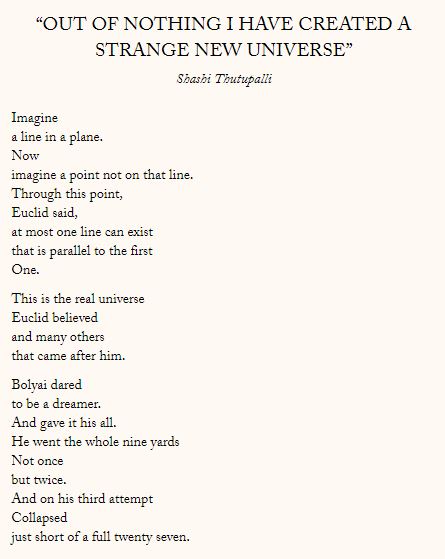
Out of Nothing -- A Strange New Universe

     Shashi Thutupalli is a scientist -- in Bangalore, India -- who enjoys poetry and often explores the connections between poetry and mathematics.   He has shared with me several samples of his work and I offer below the opening page (of three) of Thutupalli's poem, "Out of Nothing I Have Created a Strange New Universe."  (The full poem, together with artwork, is available in Visual Verse -- at this link.)

Page 1 of 3  -- the entire poem is found here at VisualVerse.org.

Also in Visual Verse is Thutupalli's "Dimensional Reduction' -- at this link

Monday, June 24, 2019

Counting to seventy . . .

    I am exited by last week's news that Oklahoma poet-- and member of the Muskogee Nation -- Joy Harjo has been appointed Poet Laureate of the United States.  Harjo came to poetry via music and she sees in poetry a way of making connections and building understanding.  
     Struggling through complexity to understanding is a similarity between poetry and mathematics. Beyond that basic connection, however, Harjo's poetry is not closely linked to mathematics.  EXCEPT:  One of her poems (found online at PoetryFoundation.org) follows a strict syllable count.  In a birthday tribute to a friend who has turned seventy, Harjo has produced a seventy-line poem in which the syllable counts proceed as 1, 2, 3, 4, . . . , 69, 70. (In the terminology of OULIPO, Harjo has produced a growth-only snowball.)   Here are the opening lines of Harjo's poem:

from Becoming Seventy     by Joy Harjo
                    Knoxville, December 27, 2016, for Marilyn Kallet’s 70th birthday.
                    This poem was constructed to carry any memory you want to hold close.
     We
     arrived
     when the days
     grew legs of night.  

Friday, June 21, 2019

Connecting with BRIDGES . . .

     Bridges Math-Arts Conferences have become an annual summer tradition and this year's conference is July 16-20 in Linz, Austria.  One of the participants in this year's Mathematical Poetry Program is University of British Columbia Professor Susan Gerofsky -- and I offer her "Desert Poem" below.  Gerofsky's poem was constructed using a permutation pattern called PH4 (from bell-ringing) and an explanation follows the poem.

               Desert Poem     by Susan Gerofsky

               Wings over dry land
               Over wings, land dry
               Over land, wings dry
               Land over dry wings
               Land dry over wings
               Dry land wings over
               Dry wings land over
               Wings dry over land --
               Wings over dry land.

Tuesday, June 18, 2019

Love, marriage, and number . . .

     Australian poet Richard Scutter has online collection of his own poems (this link leads to a chronological listing) and of favorite poems (go to this link and scroll down) by himself and others.  Here are samples:

        Marriage Mathematics

        each one bending
        to a heavenly plus
        couple greater value
                   1 + 1 = 3 + ...      

         ... and serious if a series starts
        but the minus of hell
        when one leaves  
                   2 – 1 = 0                          

Thursday, June 13, 2019

Solve a puzzle -- find a poem!

     At Canada's Capilano University, Lisa Lajeunesse teaches in mathematics in the School of STEM -- and is an enthusiastic promoter of links between mathematics and the arts.  At the 2018 Bridges Math-Arts Conference she presented this paper on "Poetry Puzzles"; a sample puzzle is offered below.
                              Place 2 or 4 or 1 or 3
                              in each cell that is free.
                              When you finish each number should show
                              once in each column and once in each row.
                                                  When you've filled in each cell --
                                                  all the numbers are there --
                                                  you can then read the poem
                                                  from your solved square.   

Monday, June 10, 2019

Sailboat Mathematics

     Celebrated on June 2 at the Joaquin Miller Poetry Series Washington DC's Rock Creek Nature Center, poetry by winners of the  Jacklyn Potter Young Poets Competition, sponsored by The Word Works, Inc.  One of these winners, Julien Berman, is a student at Georgetown Day School and a prize winning writer and accomplished violinist AND a member of the GDS Math team.
     Here is Julien's winning poem:

Sailboat Mathematics     by Julien Berman

A stretched canvas tarp
Not ungainly in style, but again not cut in a perfect polygon.
A wooden beam or two
Slung upwards and out, at ninety degrees.     

Wednesday, June 5, 2019

Have fun with "The Pi Song"

     Often we celebrate the number pi -- ratio of the circumference of a circle to its diameter, an infinite non-repeating decimal that begins with 3.1415926535 8979323846 2643383279 . . ..  Pi is a bridge between day-to-day mathematics that nearly all of us know and mathematics that is complex and difficult. 
     My own celebration of Pi includes these earrings -- but I have friends and former colleagues in the Bloomsburg University Department of Mathematics and Digital Sciences that celebrate Pi in a far more entertaining way -- in song.  Here is a link to the YouTube version of "The Pi Song" with lyrics by Bill Calhoun and Kevin Ferland and performed by "Professor Parody (Kevin Ferland).  Performance credits are found here.  And here is a link to some more details about the song.
Here is a link to a previous posting with more mathy song lyrics by Bill Calhoun.

Monday, June 3, 2019

Celebrating Walt Whitman . . .

     Last Friday -- May 31, 2019 -- was the 200th anniversary of the birth of American poet, Walt Whitman and the website of the Academy of American Poets offers poems by Whitman and background information to enrich our celebration.  Here, from his oft-revised-and-expanded Leaves of Grass (Signet Classics, 1960), is a poem -- "When I heard the learn'd astronomer" -- with mention of mathematics.  (Much of Whitman's work is available online here at Project Gutenberg.)

     WHEN I heard the learn'd astronomer
     When the proofs, the figures, were ranged before me,
     When I was shown the charts and diagrams, to add, divide, 
               and measure them,

Thursday, May 30, 2019

Delicious Geometry. . .words from Bertrand Russell

     Sometimes we find that words presented as prose are poetic . . . as these words of British philosopher and mathematician Bertrand Russell (1872-1970):

          At the age of eleven, I began Euclid, 
          with my brother as my tutor. This was one 
          of the great events of my life, as dazzling 
          as first love. I had not imagined 
          that there was anything so delicious in the world.

— Bertrand Russell Autobiography: 1872-1914, (Routledge, 2nd Ed. 2000, p. 30).

More thoughtful quotes from Russell may be found here.